

You spend your hard-earned money on registration and carve out time in a busy schedule, only to spend sixty minutes chasing a "ringer" who clearly belongs three tiers higher. It's a frustrating reality for many local players, but it shouldn't be the norm. Achieving true adult hockey division parity is the only way to ensure that every game remains competitive and worth the ice time. When teams are matched correctly, the focus stays on the sport and the community rather than a lopsided scoreboard.
We agree that there's nothing worse than a 10-0 blowout that feels like a waste of a Tuesday night. This article explores how modern leagues use data and active monitoring to eliminate skill gaps and keep the game exciting for everyone on the ice. You'll discover the transparent processes used to move teams between divisions and how organizers identify overqualified players to protect the integrity of your season. We will also preview the structural changes coming to South Calgary centres for the Fall 2026 season, which runs from September 14 to December 19, to ensure your time at the rink is balanced and fair.
Key Takeaways
- Understand the "Blowout Problem" and why balanced skill levels are essential for a sustainable recreational experience.
- See how leagues use metrics like goal differential and win/loss streaks to trigger administrative reviews of team placement.
- Learn why dynamic realignment after the first 5-8 games is more effective for Calgary players than fixed seeding.
- Discover how the SCRHL maintains adult hockey division parity through active monitoring at premier South Calgary centres.
- Get actionable tips for captains to accurately assess roster skill levels and uphold the spirit of the game.
Understanding Adult Hockey Division Parity and Why It Matters
True parity means every team enters the rink with a legitimate chance to win. It is the state of being equal in skill, effort, and execution. In recreational circles, achieving adult hockey division parity requires constant vigilance from league organizers. Without this balance, the schedule becomes a series of predictable outcomes rather than a competition. When every team has a fair shot at winning, the game remains engaging for everyone involved.
The "Blowout Problem" is the primary concern for any organized league in Calgary. When one team consistently wins by ten goals, the experience is ruined for both sides. The losing side feels demoralized and begins to question the value of their registration fees. The winning side often becomes bored or develops bad habits because they aren't being challenged. Neither scenario supports a healthy hockey community. Leagues must prioritize balance to keep players returning season after season.
Safety also plays a massive role in why balance matters. Lopsided scores frequently lead to frustration on the ice. When players feel they can't compete on skill, they sometimes resort to physical play or "frustration-based" penalties. Maintaining a level playing field keeps the temperature down during the game. It ensures that the focus remains on the sport and the exercise rather than a lopsided scoreboard. This is a foundational element of parity in sports and serves as a benchmark for league success.
The Difference Between Parity and Simple Tiering
Many leagues use a "set it and forget it" approach with standard divisions. This often fails because it doesn't account for roster changes or player chemistry. A team might have high-level individual skills but lacks the cohesion to compete in a higher tier. Conversely, a group of average skaters who have played together for a decade can often dismantle a disorganized group of elite players. Real adult hockey division parity looks at how a team performs as a unit. This creates the "any given night" excitement that brings players back to the rink week after week.
The Social Impact of Balanced Competition
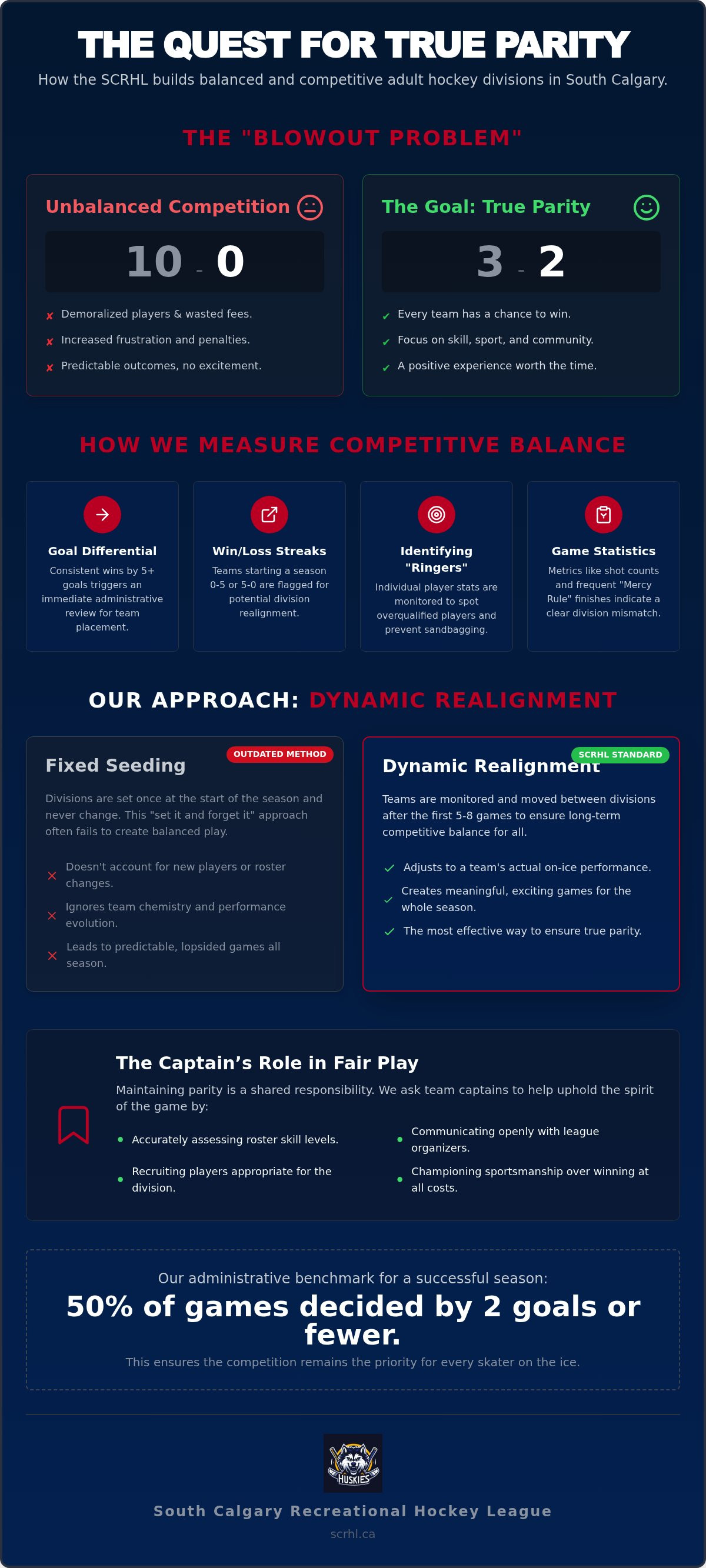
Hockey is a social sport. Fair games foster a better culture in the dressing room and the parking lot. When a game is decided in the final three minutes, players leave the ice with a sense of accomplishment regardless of the result. This builds long-term team loyalty and a stronger local community. We define division parity as the administrative effort to ensure 50% of games are decided by two goals or fewer. This specific metric ensures that the competition remains the priority for every skater on the ice.
How Leagues Measure and Realize True Competitive Balance
Measuring competitive balance requires more than just looking at the final score. It involves a systematic review of data collected throughout the season. Goal differential serves as the primary metric for adult hockey division parity. When a team consistently wins by five or more goals, it signals a mismatch that requires immediate administrative attention. Organizers also track win and loss streaks. A team that starts the season 0-5 with a -25 goal differential clearly needs a lower tier to remain competitive and engaged.
Historical data helps prevent these gaps before the first puck drop. By reviewing past season performances and individual player histories, leagues can seed teams with higher accuracy. This data-driven approach mirrors academic research on Competitive Balance and Match Attendance, which proves that balanced competition is the single biggest driver for participant satisfaction. If you are looking for a league that takes this data seriously, consider individual player registration to find your ideal skill bracket.
The "Ringer" factor remains a significant challenge for recreational sports. One elite player in a lower division can skew the entire balance of power. Effective league management identifies these outliers by monitoring individual point leaders. If one skater is scoring four goals every game while others struggle to find the net, it indicates they are in the wrong tier. This type of sandbagging is actively discouraged to protect the experience for the majority of players.
Statistical Indicators of a Mismatched Division
Organizers watch for specific red flags during the first few weeks of play. Frequent "Mercy Rule" finishes are the most obvious sign. If games are ending early due to lopsided scores, the division is not balanced. Shot counts also tell a story. A team that outshoots their opponent 40-10 every night is dominating play in a way that the final score might not fully capture. Tracking these nuances allows for proactive adjustments rather than waiting for captain complaints.
Roster Reviews and Honest Registration
Accurate seeding starts with the captain. We rely on team leaders to be transparent about their roster's collective experience. This includes being honest about former junior or collegiate players who might be joining the squad. For those without a full team, the vetting process for individual registrations is just as rigorous. We assess skill levels during initial sessions to ensure every free agent lands in a division where they can contribute. Professionalism also matters. Equipping a squad with custom jersey apparel helps teams feel like a cohesive unit, reinforcing their identity within their specific competitive tier.
Fixed Seeding vs. Dynamic Division Realignment in Calgary
Many leagues use a "set it and forget it" approach to team placement. This model assumes that every roster is perfectly assessed before the first puck drop in September. In reality, team dynamics change. A squad might add two high-level skaters late in the registration period, or a goalie might struggle with the speed of a new tier. To maintain adult hockey division parity, a league must be willing to adjust the standings based on actual on-ice performance rather than pre-season guesses. Static seeding often leads to predictable seasons where the top and bottom teams are decided by week three.
Dynamic realignment is the gold standard for non-contact hockey leagues in Calgary. This process involves a formal review of all division standings after a specific number of games. It ensures that the competition remains fresh and that every team has a reason to play hard every night. While it requires more administrative effort, the result is a higher quality of play across all levels of the league.
The Mechanics of Mid-Season Realignment
The re-tiering process typically occurs after the first 5-8 games of the season. This window provides enough data to identify statistical outliers. Teams with an undefeated record and a massive goal differential are moved up to a more challenging division. Teams at the bottom of the standings with significant point deficits are moved down. The league office manages the transition by adjusting schedules and ensuring that points earned during the initial phase are handled fairly. Clear communication with captains is essential during this shift to minimize logistical confusion and keep the season moving forward smoothly.
Why Fixed Divisions Can Stagnate Competition
Fixed divisions often create a "Bottom Feeder" effect. When a team realizes they are stuck in a tier that is far beyond their skill level, player morale drops. Attendance often declines because nobody wants to pay for a guaranteed blowout. This stagnation ruins the recreational experience and makes it difficult for teams to stay together long-term. Dynamic shifts solve this by providing a "reset" that places teams back into a competitive environment where they can actually succeed.
The "Sandbagger" problem is also mitigated through dynamic shifts. Some teams intentionally downplay their skill level during registration to win easy championships. When a league actively monitors adult hockey division parity, these teams are quickly identified and moved to a tier that matches their true ability. This preserves the integrity of the end-of-season playoffs. It ensures that trophies are won through hard-fought competition rather than clever division placement. Every team deserves a fair shot at a championship run against opponents of a similar calibre.
The Captain’s Role in Maintaining Fair Play and Parity
Captains act as the primary link between the dressing room and the league office. Their decisions during the registration process and throughout the season directly impact the quality of competition for everyone. While league administrators monitor stats, captains provide the ground-level data that ensures adult hockey division parity remains intact. A well-managed team starts with a leader who values fair competition over an easy win. This commitment to the "Spirit of the Game" is what keeps recreational hockey sustainable in South Calgary.
Open communication between team leaders and league commissioners is vital. If a game feels lopsided or a specific opponent seems misplaced, captains should report these observations immediately. This feedback loop allows for faster adjustments during the dynamic realignment phase mentioned earlier. Proactive captains also manage their own rosters with integrity, ensuring that any mid-season additions fit the skill level of their current tier. If you are ready to lead a squad this season, visit scrhl.ca to start your team registration.
Honest Self-Assessment During Registration
Accurate seeding begins with an honest look at your roster. Captains should follow a structured process to determine where their team fits best. This prevents the frustration of being overmatched or the boredom of dominating a lower tier. Use these three steps during your next registration cycle:
- Step 1: Evaluate the highest level of hockey played by the majority of your roster. Identify if your core played Junior A, collegiate, or minor hockey.
- Step 2: Consider the average age and fitness level of your players. Speed often dictates division placement as much as puck-handling skills.
- Step 3: Disclose any high-level players to the league immediately. Transparency about a former professional or elite junior player prevents administrative headaches later.
Managing the "Ringer" Temptation
The temptation to bring in a high-level "sub" for a crucial game is common, but it often backfires. Using a ringer for a single night can ruin your team’s reputation and lead to sanctions from league officials. It creates an environment of distrust and undermines adult hockey division parity. Instead of looking for a quick fix, focus on how to build a rec hockey team roster in Calgary that is balanced and sustainable for the long term. A consistent roster of similarly skilled players leads to better chemistry and more enjoyable games.
Captains are also responsible for policing their own bench. If a player is acting in an unsportsmanlike manner due to frustration or arrogance, the captain must intervene. Maintaining a professional and respectful atmosphere ensures that the league remains a welcoming space for all hobbyists. By prioritizing fair play, captains help preserve the competitive balance that makes Calgary’s recreational hockey scene successful.
Experience Fair Competition with the SCRHL in South Calgary
SCRHL stands as the authoritative organizer for recreational hockey in South Calgary. We recognize that your time and registration fees are significant investments. Our league commitment involves monitoring every game sheet to protect the integrity of the competition. We don't ignore lopsided results or mismatched tiers. Instead, we act on data to maintain adult hockey division parity throughout the season. By playing at premier facilities like Cardel Rec South and South Fish Creek, you experience the game in a professional environment designed specifically for active adults. We handle the logistics so you can focus on the sport.
Playing in South Calgary means more than just showing up for ice time. It is about being part of a stable, well-managed environment where you can focus on your health and social connections. Our morning sessions are ideal for those with flexible work hours; our evening and weekend slots cater to the traditional 9-to-5 schedule. This variety ensures that every player finds a time that fits their lifestyle without sacrificing the quality of the competition. We take pride in being a no-nonsense local organizer that values transparency and fairness above all else.
Our Approach to Calgary Hockey League Divisions
Our approach is methodical and data-driven. We utilize performance metrics from morning, evening, and weekend sessions to refine our tiers constantly. This localized focus on South Calgary communities ensures that players don't have to travel across the city for a fair game. We understand the local market and the calibre of players in our area. This level of detail makes our adult hockey league Calgary the preferred choice for those who value discipline and clear communication. We prioritize the logistical needs of our participants, ensuring schedules are released early and divisions are balanced before the first puck drop.
Ready to Hit the Ice?
Registration for the 2026 season is now open. We offer comprehensive options for both full teams and individual free agents. If you are a captain, our team registration process for Fall and Winter seasons is streamlined for quick completion. For individual players, we act as a bridge to find you a roster where you can contribute effectively. We also offer custom jersey apparel to help your squad foster a sense of pride and professional identity. The Fall 2026 season runs from September 14 to December 19, providing a consistent schedule for your busy lifestyle. Secure your spot now and join a community that values fair play and organized competition. We look forward to seeing you at the rink this season.
Secure Your Spot in Calgary’s Most Balanced League
Balanced competition is the foundation of a successful recreational season. Dynamic realignment and data-driven monitoring prevent the frustration of lopsided scores. Maintaining adult hockey division parity is a continuous process. It requires both administrative oversight and honest team reporting. Choosing a league that prioritizes these metrics ensures every hour at the rink is worth the effort. It keeps the game safe, social, and genuinely competitive for every skater.
The SCRHL offers Calgary’s most organized recreational hockey divisions. We focus on fair play and dynamic parity. Morning, evening, and weekend ice times are available to fit your schedule. You will play against teams with similar skill sets every week. Don't settle for another season of predictable blowouts. Bring your squad to a league that manages the logistical details with professional clarity and local pride.
Register your team for the SCRHL 2026 season today! We look forward to seeing you at the rink for a season of exciting and fair hockey.
Frequently Asked Questions
What happens if my team is clearly in the wrong division?
The league initiates a performance review if your team is significantly mismatched. Administrators analyze goal differentials and win/loss records during the first few weeks of the season. If the data confirms a skill gap, we move the team to a tier that better matches their collective ability. This proactive approach ensures adult hockey division parity remains the priority for everyone. Captains should report concerns early to facilitate a smoother transition between divisions.
How does the league identify "ringers" in recreational hockey?
We identify overqualified players by tracking individual scoring statistics and overall game impact. If a skater consistently dominates play or records excessive points compared to the division average, they are flagged for review. Our officials and timekeepers also provide on-ice observations to the league commissioner. This ensures that players who are clearly above their tier are moved to higher divisions to maintain a fair environment for recreational hobbyists.
Will our schedule change if we are moved to a different division mid-season?
Moving to a new division often requires updates to your upcoming game times and opponents. While we strive to keep your preferred morning or evening slots, some flexibility is required to ensure you play against balanced competition. The league office communicates these logistical changes directly to captains with as much lead time as possible. We prioritize organized scheduling to minimize disruption to your personal calendar during the realignment process.
Can individual players be moved between teams to improve parity?
We primarily move individual players who registered as free agents to ensure they are in a tier that matches their ability. Established teams generally stay together, but we may suggest roster adjustments if a specific player is skewing the division balance. This process helps maintain adult hockey division parity without breaking up groups of friends who registered together. Our goal is to find the right competitive fit for every skater in South Calgary.
How does SCRHL handle teams that win every game by a large margin?
Teams that dominate their tier are moved up during the dynamic realignment phase after the first 5-8 games. We use the "Mercy Rule" frequency as a key indicator that a team is overqualified for their current placement. This prevents the blowout problem from ruining the season for other teams in the division. We believe that every game should be a legitimate challenge rather than a predictable formality for either side.
Is there a difference in parity management between the Fall and Winter seasons?
Parity management remains consistent across both the Fall and Winter seasons. The primary difference is that the Winter season often benefits from data gathered during the Fall schedule. This allows for more accurate initial seeding since many rosters remain stable throughout the year. Regardless of the season, our commitment to monitoring game sheets and adjusting tiers stays exactly the same for all participants at our South Calgary centres.
Do we keep our points if our team is moved to a higher or lower tier?
Teams usually retain their points or have them adjusted proportionally when moving between divisions. This ensures that your early-season efforts contribute toward your overall standing and playoff seeding. The league office manages this data transition to keep the standings fair for both the incoming team and the existing teams in the new tier. We prioritize transparency in how these mathematical adjustments are calculated and communicated to team captains.
What is the best way for a new team to estimate their skill level?
New teams should evaluate the highest level of hockey played by the majority of their roster. Disclose if your core players have Junior, Collegiate, or high-level Minor hockey experience during the registration process. It's better to start in a slightly higher division and be moved down than to dominate a lower tier unfairly. Honest self-assessment during the initial registration helps us place you correctly from the very first puck drop.