

You finish your workday, grab your gear, and head to Cardel Rec South for an 11:00 PM puck drop, only to realize by the second shift that the opposing team belongs in a completely different tier. Getting blown out 10-0 isn't just frustrating; it's a waste of your time and registration fees. Achieving true adult hockey division parity is the most difficult but essential task for any league organizer. It's the difference between a season spent complaining in the dressing room and one where every game is decided by a single goal.
We understand that unfair competition ruins the recreational experience. You want to play against teams that match your skill level, where the outcome depends on effort rather than lopsided rosters. This article explains how we create a balanced environment for every player in Calgary. You'll discover our specific evaluation process, how we handle "sandbagging," and the logic behind our mid-season re-tiering. We'll show you how a commitment to fairness ensures that every night on the ice remains competitive, safe, and enjoyable for everyone involved.
Key Takeaways
- Understand the "Three-Goal Rule" and why narrow score margins create the most engaging recreational experience for every player.
- Discover how adult hockey division parity is enforced through data-driven seeding and mandatory evaluation periods during the first weeks of the season.
- Identify the signs of sandbagging and learn how active league management protects the integrity of lower divisions to prevent blowouts.
- Learn how captains can improve their team's experience by providing honest roster resumes and timely mid-season player updates.
- Explore the SCRHL commitment to transparency and fair play through proactive division adjustments and flexible scheduling at Cardel Rec South.
What is Adult Hockey Division Parity and Why Does it Matter?
In the context of recreational athletics, parity refers to a state of equality where teams within a specific tier possess comparable skill levels. This concept of parity in sports acts as the bedrock of a functional league. Without it, the schedule becomes a series of predictable outcomes rather than competitive events. For Calgary players, adult hockey division parity ensures that every team hitting the ice at Cardel Rec South has a legitimate chance to compete every single night.
We operate under the "Three-Goal Rule" philosophy. This suggests that the highest quality recreational games are those decided by three goals or fewer. When the score remains close, players stay focused and engaged until the final buzzer. Constant blowouts have the opposite effect, leading directly to player burnout and high league turnover. If a squad feels they are perpetually overmatched, they lose the motivation to return for the next season. Maintaining balance protects the long-term stability of our hockey community.
Parity also serves as a critical safety mechanism. Frustration is a primary driver of aggressive play and undisciplined penalties. When a team is trailing by a massive margin, players often lose their composure, which increases the risk of injury. Balanced games keep the atmosphere competitive but respectful. By ensuring teams are matched correctly, we reduce the friction that leads to unnecessary confrontations on the ice.
The Social Impact of Balanced Competition
The "beer league" culture in Calgary thrives on the social connection between teammates and opponents. It is difficult to maintain a positive environment when one side is dominating every shift without effort. Balanced competition fosters a community of respectful rivals. When every team feels they have a shot at winning, the post-game atmosphere remains light and enjoyable. This sense of fair play is the leading factor in long-term player retention across our Fall and Winter seasons.
Defining Skill Levels in Calgary Rec Hockey
Calgary features a diverse range of talent, from "Never-Ever" beginners to former junior or collegiate athletes. Placing these groups in the same division creates an unsafe and lopsided environment. Accurate self-scouting during the registration process is the first step in preventing this. Captains must be honest about their roster's collective experience to help us organize the tiers effectively. To determine your ideal starting point, you can review our adult hockey league Calgary guide. It provides a detailed breakdown of how we categorize different experience levels to maintain adult hockey division parity from the first puck drop.
The Mechanics of Skill-Based Tiering in Recreational Hockey
Establishing a balanced league is not a one-time event at the start of the season. It is a continuous process that begins with initial seeding. We analyze past performance records and detailed roster resumes to place teams in their preliminary divisions. This stage relies on using proven mechanisms for competitive balance to ensure that squads with similar experience levels face off from the first puck drop. However, paper rosters don't always reflect on-ice reality, especially with new teams entering the mix.
The first few weeks of our Fall and Winter seasons serve as a mandatory Evaluation Period. During this window, league organizers monitor every game to identify outliers. We look for specific statistical markers of a mismatch. A consistent goal differential of five or more, extreme disparities in shots on goal, and individual point streaks are immediate red flags. If a single player is averaging five points per game in a lower tier, it indicates that adult hockey division parity has been compromised. We also prioritize roster depth over individual talent. A team with three solid lines will almost always outperform a squad relying on one superstar, which is why we evaluate the collective skill of the entire bench.
The Re-Tiering Process: How Mid-Season Adjustments Work
If the data shows a team is clearly in the wrong spot, we initiate a mid-season move. The logic is simple: dominant teams move up to find a challenge, and struggling teams move down to find their footing. This protects the competitive integrity of the playoffs, ensuring that no team has an unfair path to a championship. We communicate these shifts directly to captains to ensure a smooth transition between divisions. If you are looking to join a league that actively manages these tiers, you can view our current registration options for upcoming sessions.
Monitoring Roster Consistency
Maintaining adult hockey division parity requires strict roster management. A single "ringer" can shift the balance of an entire division, turning a close game into a blowout. To prevent this, we utilize player ID checks and roster verification throughout the 2026 season. These checks ensure that the players on the ice match the names on the approved roster. Consistency is the only way to keep the competition fair for every team at Cardel Rec South.
Parity vs. Sandbagging: Addressing the #1 Player Grievance
Sandbagging remains the primary source of frustration in recreational sports. It occurs when a player or an entire team intentionally registers for a tier below their actual skill level to dominate the competition. This practice directly undermines adult hockey division parity and replaces healthy competition with resentment. In Calgary, where the rec hockey community is tight-knit, these mismatches are quickly noticed and often lead to high levels of player dissatisfaction.
The psychological toll of lopsided games shouldn't be ignored. Recreational athletes invest significant time and money into their seasons. Walking into a dressing room after a 12-0 blowout feels like a wasted evening. While many leagues implement "mercy rules" to stop the clock or cap the score on the official record, these are only temporary fixes. They don't solve the underlying talent gap that made the game uncompetitive in the first place. True fairness requires active management rather than just hiding the score.
Our commitment to fair tiering is also a matter of safety. We prioritize a non-contact hockey league Calgary environment where players of all skill levels can stay active without unnecessary risk. When teams are matched correctly, the game stays controlled. When a massive skill gap exists, the trailing team often becomes frustrated, which can lead to aggressive play and undisciplined penalties.
Identifying the "Ringer" Problem
A single elite player in a lower tier can disrupt the experience for 20 other people on the ice. It is important to distinguish between a regular player having a "hot night" and a "ringer" who is clearly over-skilled for the division. We provide clear reporting mechanisms for captains to flag these concerns. Our organizers investigate these reports by reviewing individual point totals and previous playing history. If a player is found to be in the wrong tier, we take immediate steps to restore adult hockey division parity.
The Myth of the "Easy Win"
Winning by double digits isn't enjoyable for either side. The winning team doesn't get challenged, which leads to sloppy play and lazy habits. The losing team stops trying, and the game loses its flow. Lopsided matchups actually increase injury risk because players lose their focus and intensity. Competitive hockey is far better for individual skill development. True satisfaction comes from a hard-fought game where the outcome is decided in the final minutes. We believe that a league where every game is a battle is a league worth playing in.
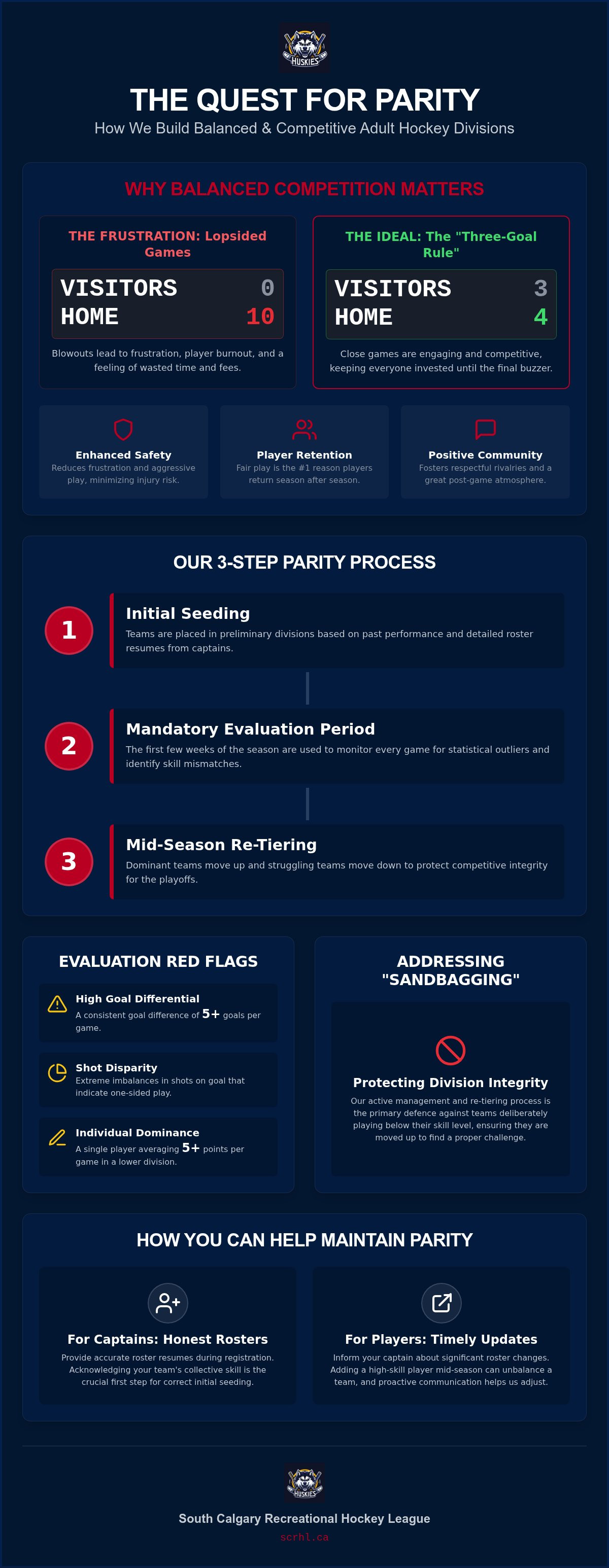
How Captains and Players Can Help Maintain Fair Divisions
Achieving adult hockey division parity is not solely an administrative task. It requires active cooperation from every captain and player in the league. While organizers provide the structure, the accuracy of that structure depends on the honesty of the data provided during registration. Captains must provide a transparent assessment of their team's collective experience before the season begins. A team of former Junior B players who haven't skated in a decade is still vastly different from a group of true beginners. Listing the highest level of hockey played by every roster member is the only way to ensure your team starts in the correct tier.
Roster management continues well after the first puck drop. If you add new players mid-season, you must update your roster immediately. Bringing in a high-skill friend to help during a playoff push might seem like a small move, but it directly compromises the fairness of the division. We also encourage "free agent" players to be entirely honest about their backgrounds. If you played collegiate hockey, say so. Transparency allows us to place you with a team where you will be challenged without overwhelming your opponents. Finally, participate in league surveys. Your feedback regarding division balance during the 2026 season helps us refine our re-tiering logic.
Best Practices for Roster Management
Building a sustainable team requires more than just finding 15 people who own skates. You should consult our how to build a rec hockey team roster Calgary guide for strategies on balanced recruitment. One common mistake is assuming that "Over 40" automatically means "Beginner." Age does not always correlate with a decline in skill, and a roster of experienced veterans can easily dominate a lower division. Additionally, finding a consistent goalie who matches your division tier is vital. A ringer in net can break the parity of an otherwise balanced game, making it impossible for the opposition to compete regardless of their effort.
The Captain’s Role in League Communication
Captains serve as the primary bridge between the locker room and the league commissioner. If you feel your team is tiered too high and you are losing every game by a wide margin, advocate for your players. We value proactive communication over silent frustration. Promoting a "culture of parity" within your own team is equally important. This means discouraging sandbagging and ensuring your players understand that a competitive 3-2 loss is more valuable than a 10-0 win. If you are ready to lead a team in a league that values your input, register your squad for the upcoming season today.
The SCRHL Approach to Competitive Balance in Calgary
Our approach to adult hockey division parity for the 2026 season is proactive and data-driven. We don't just set the divisions in September and walk away. Our management team actively monitors game results and officiating reports throughout the Fall and Winter sessions. By offering diverse ice times, including morning, evening, and weekend slots at Cardel Rec South, we can build deeper divisions. A larger pool of teams allows for more granular tiering, ensuring that the gap between the top and bottom of a division remains narrow.
The SCRHL re-tiering schedule begins immediately after the third game of the season. This initial Evaluation Period allows us to move teams that were incorrectly seeded before they fall too far behind in the standings. We conduct a secondary review mid-season to account for roster changes or teams that have significantly improved. This continuous oversight is what maintains the competitive balance that Calgary players expect from a professional recreational league. It ensures that adult hockey division parity remains a reality from opening night through to the championship final.
Registering Your Team for the 2026 Season
Securing a spot in the right division starts with the Calgary hockey team registration process. Captains should register early to provide the league with ample time to review roster resumes and past performance data. Early registration helps us group teams with similar profiles, which is the first step in establishing fair competition. When you register, you can select your preferred ice times without worrying about sacrificing the quality of play. We maintain balanced tiers across all sessions to accommodate your work and family schedule.
Individual Players and Free Agents
Solo registrants are never just placed on a random bench. We use a skill profiling system to place free agents on teams that match their specific experience level. You can find more details on what to expect after your individual hockey registration Calgary. Our goal is to ensure a welcoming environment, especially for those returning to the game after a long hiatus. We carefully monitor these placements during the first few weeks to ensure the player and the team are a good fit for the division speed and intensity.
Elevate Your Game with Calgary’s Most Balanced Divisions
Maintaining adult hockey division parity requires constant vigilance and honest communication between players and league organizers. We've explored how skill-based tiering prevents lopsided scores and reduces the frustration that leads to aggressive play. By prioritizing a dedicated re-tiering process and verifying roster resumes, we ensure that every game remains competitive. This commitment to fair play is what makes our community at Cardel Rec South the premier choice for recreational athletes.
You don't have to settle for blowout games or unfair competition. We offer Calgary's most organized recreational hockey divisions with flexible morning, evening, and weekend sessions to fit your lifestyle. Whether you are a captain building a squad or an individual player looking for a new home, our system is designed to place you exactly where you belong.
Join a league where every game counts—Register for the SCRHL 2026 Season today! We look forward to seeing you on the ice for a season of safe, competitive, and rewarding hockey.
Frequently Asked Questions
What happens if our team is winning every game by a huge margin?
If your team consistently wins by large margins, we identify you for a potential mid-season move. Our management team monitors goal differentials and individual scoring streaks starting from the third game of the season. Teams that are clearly over-skilled for their current tier are moved up to ensure adult hockey division parity is maintained. This prevents blowouts and ensures every squad in the division has a fair chance to compete.
Can a team be moved to a different division in the middle of the season?
Yes, we actively re-tier teams during the Fall and Winter seasons. The first three games of each session serve as a mandatory evaluation period. If the results show a significant skill mismatch, we move teams to a more appropriate division immediately. We also conduct a secondary review at the mid-point of the season. This proactive approach ensures that the playoff brackets remain competitive and fair for all participants at Cardel Rec South.
How does the SCRHL determine if a player is a "ringer"?
We identify "ringers" by comparing individual performance data against the division average. If a player’s point totals are significantly higher than the rest of the tier, we investigate their previous playing history. Captains are required to submit roster resumes that list the highest level of hockey played by each member. We also utilize player ID checks and roster verification throughout the 2026 season to ensure that every participant matches their registered skill profile.
What is the difference between recreational tiers and competitive divisions in Calgary?
Recreational tiers focus on balanced play for hobbyists, ranging from beginners to former high-level athletes. Competitive divisions often prioritize higher speed and intensity; however, our focus remains on maintaining a safe, non-contact environment. In our league, tiers are organized by collective team skill rather than just individual talent. This structure allows players to enjoy the social aspects of the game while still participating in meaningful, closely contested matches against similar opponents.
Does the SCRHL offer parity for morning and weekend hockey sessions too?
Yes, we apply the same adult hockey division parity standards to our morning, evening, and weekend hockey sessions. Regardless of your preferred ice time, our organizers monitor game results to ensure teams are tiered correctly. We utilize our large pool of registrants to create deep divisions across all time slots. This ensures that even those playing at 6:00 AM or on Sunday afternoons experience the same level of competitive balance as our prime-time divisions.
How do I know which skill level to select during individual registration?
You should select your level based on the highest tier of hockey you have played. We categorize players from beginners to those with collegiate or professional experience. If you haven't played in several years, we recommend starting in a slightly lower tier to adjust. Our individual registration guide provides a detailed breakdown of these levels. Being honest about your background ensures we place you on a team where you will be competitive and safe.
What should I do if I think our team is in a division that is too hard for us?
Captains should contact the league commissioner immediately if they feel their team is overmatched. We value proactive communication and will review your goal differentials and game reports to assess the situation. If the data supports your claim, we will look for an opportunity to move your squad to a lower tier during our scheduled re-tiering windows. Our goal is to ensure that every team enjoys a season where the outcome is decided by effort.
Does parity apply to non-contact rules as well?
Parity and player safety are closely linked in our league. We enforce strict non-contact rules across all divisions to protect our participants. When teams are tiered correctly, frustration levels stay low, which naturally reduces aggressive play and undisciplined penalties. Our referees are trained to maintain this standard regardless of the division level. Ensuring that every team is playing against appropriate competition is the best way to maintain a safe, respectful environment on the ice.