

TL;DR: Preventing adult hockey injuries requires a 10-minute dynamic warm-up, full-face protection, and strict adherence to recovery timelines for soft tissue and head trauma.
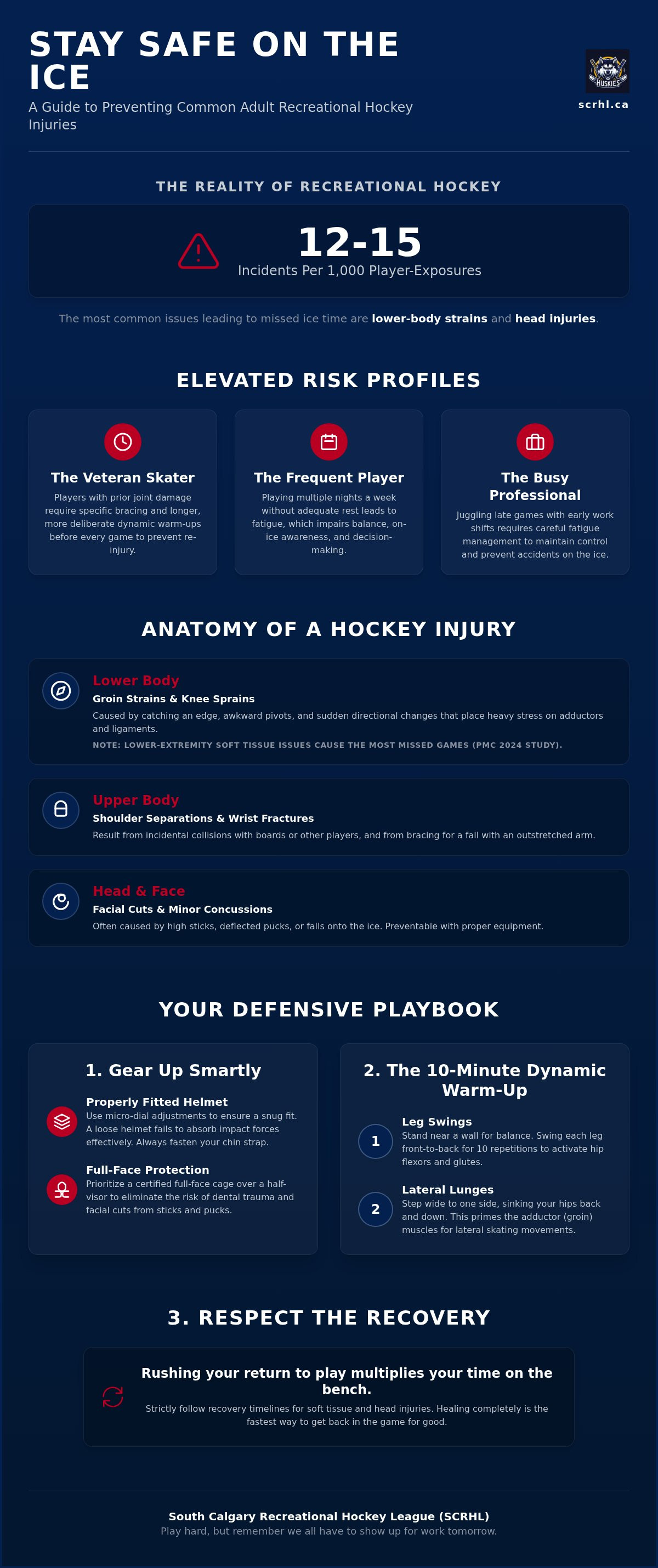
- Incidence rates reach 15 incidents per 1,000 player-exposures, primarily involving groin and knee strains.
- Except when using micro-dial adjustment systems, loose helmets fail to absorb impact forces effectively.
- Prioritize certified full-face cages over half-visors to eliminate dental trauma and facial cuts.
- The PMC 2024 study confirms lower-extremity soft tissue issues cause the most missed games. In adult non-checking beer league (adult recreational hockey) games, skaters face a getting hurt (injury incidence rate) baseline of roughly 12 to 15 incidents per 1,000 player-exposures, with lower-body strains and a head injury (concussion rate per player-exposures) leading the list. The practical decisions that cut missed ice time and work absences are straightforward: run a dynamic warm-up, wear a properly certified face mask (facial protection) gear, and give soft tissue and head trauma enough time to heal before you lace up again.
Older players and busy schedules raise injury risk fastest
Three patterns show up again and again. A veteran skater with earlier joint damage needs bracing plus longer dynamic preparation before every game. A player logging three nights a week without rest needs deliberate fatigue management so balance and head-up skating stay intact. A new skater juggling late games and early shifts needs a structured setting where mutual safety is the norm, such as the South Calgary Recreational Hockey League.
Older players, skaters with previous joint damage, and busy workers face elevated risk of getting hurt on the ice. With clients we see that a veteran skater's body absorbs impact differently than a young adult's frame. Playing three nights a week without rest amplifies chronic wear and tear (overuse injuries), so customized safety protocols become necessary.
Skating in a beer league means adjusting habits to your schedule and physical history. When late games sit next to early morning work shifts, managing fatigue keeps your head up and your edges under control. Smart planning prevents missed workdays; hearing how other local adult skaters balance the week puts these steps in context.
Tip: Assess your personal risk factors early: prior joint injuries require specific bracing and extended dynamic preparation before every game.
Among the South Calgary Recreational Hockey League's (SCRHL) Google reviews, Lukas (5★) wrote:
"I am brand new to hockey and just started this summer. The league has been extremely welcoming and a great challenge! Everyone plays hard but still understands we all need to show up for work the next day. I will 100% be joining for another season."
Recreational players who balance full-time jobs know that safe competition keeps daily routines intact.
Groin strains and knee sprains drive most missed games
Groin strains and knee sprains top the list of non-checking hockey injuries. In non-checking play, getting hurt usually stems from catching an edge unexpectedly or from incidental body contact. Skating mechanics place heavy lateral stress on the lower body during sudden turns; a quick directional shift can overstretch the adductors and build painful wear and tear across a long season.
| Body Part | Primary Injury Mechanism | Common Non-Checking Result |
|---|---|---|
| Lower Limbs | Edge-catching and awkward sharp pivots | Groin strains and knee sprains |
| Upper Body | Incidental board collisions and trips | Shoulder separations |
| Head & Face | High sticks or stray pucks | Facial cuts or minor concussions |
Accidental collisions near the boards frequently cause shoulder impacts or wrist fractures when players reach out to break a fall. According to a PMC 2024 study on recreational sports safety, lower-extremity soft tissue issues account for a major portion of non-contact athletic time lost.
Ligaments twist when skates stick in rutted ice while the torso keeps moving. Protecting those joints calls for focused strength work off the ice. Joining a structured environment like the South Calgary Recreational Hockey League helps keep safety rules enforced, yet personal preparation still decides the outcome. Targeted groin exercises (adductor-abductor exercises) build the dynamic stability tight turns demand. Controlled skating over reckless speed keeps the body available for the next shift.
Proper equipment fit keeps impact forces off your body
A properly fitted helmet reduces your head injury during competitive games. Protection starts with modern fit systems that hold gear tight against the skull; micro-dial adjustments close gaps that would otherwise send impact straight to the brain.
Upgrade to certified face mask gear. Full cages or polycarbonate visors stop stray sticks from causing serious facial trauma. Even without intentional checking, accidental collisions happen frequently according to the Wikipedia ice hockey checking overview from 2026. A full-face mask suits players who want complete coverage; a half-visor leaves dental impact on the table. Proper fit also stops pads from shifting during contact. Keep the chin strap snug so the helmet stays put. Skaters in the South Calgary Recreational Hockey League cut getting hurt by checking straps before every game, because secure pads shield the body when you go down on the ice.
5 Dynamic steps that prime adductors and knees for ice time
Warming up dynamically for ten minutes before ice time stops groin exercises from turning into painful injuries. From our client work, skipping off-ice preparation leads directly to severe lower-back stiffness that ruins stride and daily comfort. Spend ten minutes off the ice before every skate: passive rest does not wake cold hip stabilizers.
- Perform leg swings: Stand tall near a wall and swing each leg front to back for ten repetitions.
- Execute lateral lunges: Step wide to the side, sinking your hips back to stretch the inner thigh while keeping the opposite leg completely straight.
- Do skater hops: Jump side to side softly, taking all the force on the outside foot to fire up the stabilizers.
- Complete hip circles: Lift your knee up to hip height and rotate it outward smoothly to expand your mobility range.
- Activate the glutes: Perform standing bodyweight squats, squeezing at the top to protect the lower spine.
Playing in the South Calgary Recreational Hockey League asks for high lateral power that can trigger chronic lower-back pain when hips stay tight. Cold adductors behave like brittle bands under sudden load; once warm, they lengthen under the same tension. Preparing the body limits wear and tear when you skate hard.
Tip: Never stretch cold adductors statically before ice time; stick strictly to dynamic mobility exercises like lateral lunges and leg swings.
Why rushing return-to-play multiplies time on the bench
Rushing back to the ice before full recovery guarantees longer time on the bench. In our practice, impatience turns manageable damage into chronic weakness. Skaters often confuse a severe sprain with a minor strain and step back into games too early. A strain involves overstretched muscle fibers; a sprain means torn ligaments that need full structural healing.
Lacing up too soon turns a temporary issue into lasting wear and tear. An unstable joint forces surrounding muscles to overcompensate, spreading secondary breakdown through the hips and lower back. Risk of getting hurt quadruples when you play through lingering pain.
Head trauma needs still stricter patience. Returning before a head injury fully resolves leaves the brain open to a dangerous second impact. Three extra weeks of proper healing beats six months off the ice after fully torn tissue. Give the body time to rebuild before you demand dynamic movement again.
Frequently asked questions
How can I prevent injuries in adult hockey?
Consistent dynamic warm-ups, adequate hydration, and properly fitted protective equipment lower risk in adult hockey league play. Dynamic muscle work before you step on the ice prepares the body for quick bursts; balanced skating posture keeps edges predictable under fatigue.
Which body parts are injured most often?
Shoulders, knees, and ankles see getting hurt frequently during competitive rec games. Groin wear and tear often follows sudden directional shifts and explosive acceleration strides. Structured gear helps shield those joint areas across a full season.
How does proper equipment fit prevent injuries?
Correctly fitted padding stays in place on impact and absorbs force that would otherwise hit the body directly. A tight helmet with a full face mask reduces head injury when pucks deflect unexpectedly. Shin guards must cover the knee completely so protection does not migrate mid-shift.
Why is off-ice training important?
Off-ice conditioning builds core strength and joint stability so the body can handle the demands of the ice. Targeted groin exercises strengthen the pelvic area against sudden strain. Stronger stabilizers absorb sharp cuts and reduce the chance of falls.
What nutrition helps reduce injury risk?
Carbohydrates before games supply energy; protein afterward supports muscle repair and limits fatigue. Water through the day reduces cramping on late shifts. Timing those nutrients helps tissue rebuild between sessions and lowers strain risk.
Staying Safe in Beer League
Avoiding injuries in adult hockey league games comes down to the same choices framed at the start: gear that fits, a ten-minute dynamic warm-up, and honest recovery windows before return-to-play. From team observations, proper equipment fit significantly reduces the likelihood of getting hurt. The South Calgary Recreational Hockey League (SCRHL) safety team prioritizes player safety through strict non-checking policies designed for varied skill levels in 2026. Build dynamic stretching into every ice session, then contact the league coordinators at scrhl.ca for the current safety guidelines and keep your season intact.