

Can a regular hockey game lead to more genuine professional connections than another formal networking event? For Calgarians, building professional networks through hockey Calgary can offer a more natural starting point: shared ice time, familiar teammates and conversations that develop without a sales pitch.
Formal events can feel transactional, and work circles don’t always introduce you to new people. On a recreational team, regular contact gives trust time to grow. The game stays the focus. A quick chat before or after a session can open the door to a connection, while a thoughtful follow-up can keep it going without putting pressure on a teammate.
This guide explains how to build connections while respecting the social side of hockey, when to follow up and how to keep professional conversations balanced. It also covers how to find a Calgary setting that fits your schedule. The South Calgary Recreational Hockey League offers individual and team registration, along with morning, evening and weekend sessions. Consistent participation is a starting point, not a promise of business outcomes.
Key Takeaways
- Shared ice time can make first conversations feel more natural than introductions at a formal business event.
- Regular play helps teammates become familiar, but social trust doesn’t automatically establish professional credibility.
- For building professional networks through hockey Calgary players can focus on consistency, listening and genuine conversation instead of pitching teammates.
- Ask open questions about work and interests, then follow up only when the conversation makes it welcome.
- SCRHL offers team and individual registration, with morning, evening and weekend sessions to fit different routines.
Why recreational hockey can help Calgary professionals meet naturally
Professional networking doesn’t have to start with a name tag or a planned business introduction. In recreational hockey, it can grow alongside regular play: teammates get to know one another through shared routines, conversation and time on the ice. The game gives people a common starting point, so a first exchange might be about a pass, a position or how long someone has played.
That shared activity can ease the pressure of meeting someone new. At a business event, the reason for approaching a stranger may be clear, but the conversation can feel transactional. On a team, the immediate purpose is to play. An introduction can stay casual, and people can learn about one another gradually rather than trying to establish a professional connection in a single conversation.
This is one way to think about the concept of professional networking: relationships can develop through ongoing contact and shared interests, not just formal business settings. For Calgary players, building professional networks through hockey is best treated as a possibility that comes with participation, not a promised result. A teammate may become a useful contact, but playing together doesn’t guarantee referrals, clients or career opportunities. Professional credibility also takes more than a friendly interaction.
What makes a hockey setting different from a formal networking event?
A game creates a shared focus before anyone discusses work. Small interactions, from getting ready to play to regrouping between shifts, can make names and faces more familiar over time. That gives conversation a natural opening. Let professional topics follow rapport and mutual interest. The game and the people playing it should remain the reason to be there, not a backdrop for an ongoing pitch.
Consistency helps turn a first introduction into familiarity. Seeing teammates regularly gives you more chances to talk, listen and discover shared interests. Trust develops through ordinary actions: being reliable, respecting others and contributing to the team. It isn’t a shortcut to business confidence. Someone may enjoy playing with you and still need separate evidence of your skills, judgement or work before a professional relationship takes shape.
That distinction keeps expectations realistic. A useful connection might mean learning about a different line of work, hearing a local perspective or finding someone with a shared interest. It doesn’t have to lead to a job or a sale to be worthwhile. Mutual interest matters. If a teammate doesn’t want to discuss work, respect that and return the focus to hockey.
Who might benefit from meeting people through Calgary hockey?
Newcomers to Calgary may welcome a recurring social setting beyond work. Career changers can meet people outside their current field, while anyone looking to expand local circles can get to know teammates through regular play. Connections can be worthwhile across different industries. You don’t need a senior title, a business to promote or a specific sales goal. Curiosity, respect and a genuine interest in the team are enough to begin.
Hockey won’t replace deliberate career development or formal networking when you need a direct professional introduction. It can offer another route to familiarity, grounded in a shared activity. Keep showing up because you value the game and community. If professional conversation develops naturally, treat it as one part of the relationship, not the purpose of every shift.
How repeated team interactions can turn introductions into trust
A first introduction gives teammates a name and a face. Regular contact adds context. You might learn who communicates clearly during a shift, who checks in after a tough game and who makes room for others. Over time, familiar faces can become easy conversation, and shared experiences may create professional rapport. That progression is gradual. It comes from how people treat one another, not from treating every game as a networking opportunity.
Why regular contact matters more than one impressive introduction
A polished introduction can be forgotten. Seeing a teammate again creates another chance to talk without starting from scratch. A brief exchange before a game might grow into a conversation about work or life in Calgary after a few more sessions. There’s no need to force the pace. Familiarity builds as people learn names, remember details and find common ground.
Reliability shapes those impressions. Arriving prepared, communicating respectfully and contributing to the team can show consideration over time. These habits may make conversation more comfortable, but they don’t prove someone’s professional ability. Social trust is about feeling at ease and respected. Professional credibility depends on relevant experience, judgement and the quality of someone’s work.
What shared team experiences can reveal
Playing together gives people a chance to observe specific behaviours. Does a teammate listen, communicate clearly and stay respectful when a play doesn’t go as planned? Do they follow through on team commitments? These moments can add context to an introduction, but they’re only a small view of a person. An on-ice impression shouldn’t replace informed business judgement, references or a proper assessment of qualifications when those matter.
Hypothetical example, not an SCRHL member story: Imagine a Calgary project manager joins a recreational team and meets a teammate who works in design. They start with simple conversations about hockey. Later, after learning they both work on community projects, they discuss what their roles involve. The project manager may now feel comfortable asking about the designer’s experience, but would still review relevant work before considering a professional collaboration. The team connection starts a conversation; it doesn’t settle a business decision.
This is a practical way to approach building professional networks through hockey Calgary: let repeated contact make introductions easier, then let mutual interest guide whether a professional conversation continues. Keep expectations balanced. A good teammate isn’t automatically a suitable client, colleague or referral source, and a useful relationship doesn’t have to produce a business outcome.
Repeated contact makes introductions feel more natural; consistent respect gives trust room to grow. For a regular setting to meet and play with local adults, explore Calgary adult recreational hockey through the South Calgary Recreational Hockey League.
Hockey networking versus traditional Calgary business networking
Each networking format creates a different kind of first contact. Recreational hockey brings people together around a shared activity and gives familiarity time to develop. A business event makes its purpose clear from the start, often bringing people together because of a profession, industry or specific goal. Work-based introductions follow another route: someone who knows both parties helps start the conversation.
None is automatically better. The right choice depends on what you want from a connection and how you prefer to meet people. Hockey can add recurring social contact to your routine, but it’s a sports setting first. Formal networking is more direct when you need to meet people with a particular professional focus.
When hockey may suit your networking style
Hockey may fit people who prefer a shared activity to a room built around introductions. Conversation can develop at its own pace, with the game providing an easy common topic. Regular attendance matters more than treating each session as a prospecting opportunity. Show up to play and be a good teammate. If a work conversation comes naturally, let it stay mutual and low-pressure.
This approach can suit someone who wants to expand their local circle without making every interaction explicitly professional. It also takes time. A single game may lead to a pleasant introduction; recurring participation gives people more chances to recognize one another and talk. That familiarity is a potential benefit, not a substitute for settings designed to reach a specific professional audience.
When a formal networking event may be more direct
An event organized around an industry or profession can put a shared work interest up front. That makes it easier to explain why you’re there, ask focused questions and meet people connected to a particular field. If you need to discuss a career move, find peers in a specialty or make a targeted professional introduction, a relevant formal event may be the clearer route.
Work-based introductions can also be efficient when a trusted colleague already knows someone whose experience matches your goal. In either case, be clear about what you hope to learn or discuss. You don’t have to choose one format for every need. Use direct approaches for specific objectives and recurring activities for broader social connection.
For professionals considering building professional networks through hockey, Calgary offers a useful local perspective: a league and a business event serve different purposes. One gives people a reason to meet repeatedly through play; the other can make professional interests explicit from the outset. Neither guarantees a referral, a job lead or a lasting connection.
Think about your immediate goal before choosing where to invest your time:
- Meet people gradually: choose a recurring shared activity and take part consistently.
- Reach a defined professional group: look for a work-focused setting tied to that audience or purpose.
- Explore a warm introduction: accept a relevant connection through someone you already know.
These approaches can complement each other. A teammate might become a friend or professional contact over time, while a formal event can help you find people whose work directly relates to your plans. Keep your expectations suited to the setting. In hockey, participate for the game and community. In professional settings, be open about your interests and respectful of others’ time.
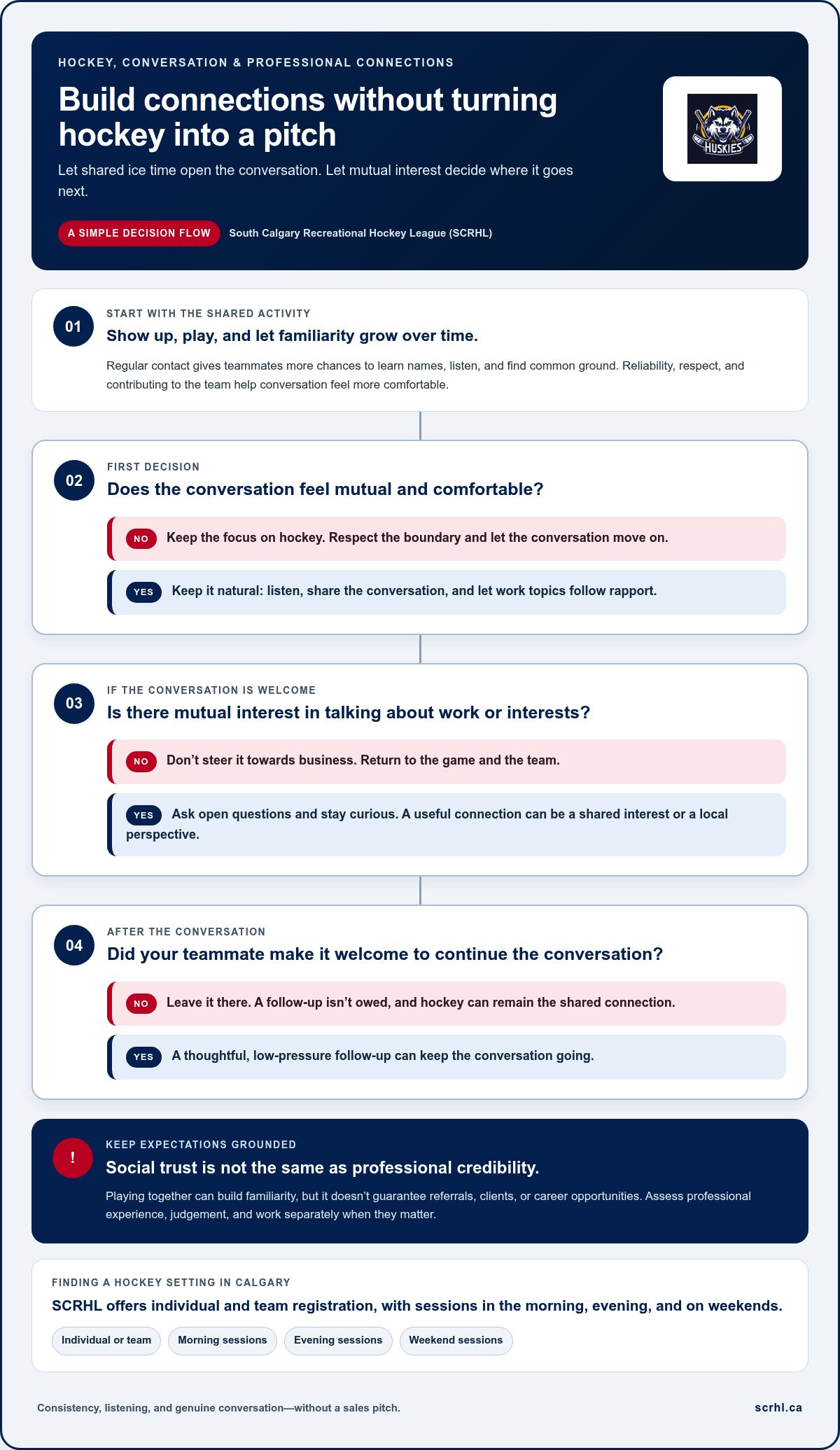
Practical ways to build professional connections without making hockey awkward
Keep the order simple: participate first, get to know your teammates, and let any professional connection develop through mutual interest. You don’t need a networking script. Small, considerate actions make conversation easier without shifting the focus away from the game.
- Show up consistently. Regular attendance helps teammates recognize you and makes it easier to pick up a conversation where it left off.
- Learn names and listen. Use names naturally, pay attention to what people share, and remember details that may help you continue a conversation later.
- Ask open questions. Start with hockey, Calgary or shared interests. If work comes up, ask what someone enjoys about their role rather than jumping straight to what they can do for you.
- Follow up only when it fits. Refer to something the person chose to discuss, and leave them room to respond or not.
Starting conversations before, during, and after a game
Before a game, a simple introduction or question about how long someone has played gives them an easy way into conversation. Between shifts, keep your attention on the game and your teammates. Save longer chats for an appropriate pause or after play. You might ask what someone likes doing around Calgary or follow up on an interest they mentioned. If they steer the conversation back to hockey, take the cue.
Don’t turn a post-game chat into a sales pitch or press teammates to exchange contact details. If you have information that might help, offer it briefly and let the other person decide whether to hear more.
Following up while keeping the relationship genuine
If a conversation gives you a clear reason to reconnect, send a brief message that refers to that topic. For example, you could share an article related to an interest they mentioned, with a short note explaining why you thought of them. Avoid generic pitches or repeated messages if they don’t reply. Ask before introducing teammates to a contact or forwarding someone’s information.
Respectful follow-up is permission-based and low-pressure: make one relevant offer, accept the response, and don’t treat silence as an invitation to keep pursuing the conversation. Keep future interactions friendly whether or not a professional opportunity develops.
A practical rule for building professional networks through hockey Calgary players can follow is to keep the game and team relationships at the centre. Work talk should be welcome, brief and reciprocal. A teammate’s interest in hockey doesn’t automatically mean they want business advice, a referral request or a pitch.
Want a regular setting to put these habits into practice? Explore SCRHL adult hockey registration and find a way to take part that fits your routine.
Finding a Calgary recreational hockey community with SCRHL
The South Calgary Recreational Hockey League (SCRHL) organizes adult recreational hockey in Calgary. Joining creates a regular setting to play and meet people through a shared interest. It can support the social side of building professional networks through hockey Calgary, but it doesn’t promise business leads, referrals or career outcomes. The value is in taking part, getting to know teammates and letting any professional connection develop naturally.
SCRHL offers Fall and Winter seasons, with morning, evening and weekend sessions. Choosing a time you can attend consistently can help you become familiar with the group and take part in the wider hockey community. The best fit is the one that works with your routine and gives you space to enjoy the sport.
Choosing a participation route that fits your situation
Team registration suits a group that’s ready to enter a season together. It gives existing teammates a shared route into league play. Captains organizing a group can use the Calgary rec hockey roster guide to consider roster planning before the season begins.
Individual registration is an entry point for players looking to join league play and find a roster. If you’re weighing this route, the Calgary adult hockey league guide can help you understand the league setting and think through how you want to participate. Either route can bring you into regular contact with fellow players. Neither should be treated as a shortcut to professional opportunities.
Taking the next step with a team or as an individual
Before registering, consider which season fits your plans and which session times you can make work. Morning hockey may suit one routine, while evening or weekend sessions may fit another. A consistent time can make it easier to keep showing up and become part of the group. Choose based on the hockey experience you want, not on assumptions about who you might meet.
If you’re registering as an individual, the guide to what happens after individual registration can help you understand the next steps. Captains can focus on bringing their group together and preparing for the season. Both options offer a way to participate in organized adult recreational hockey in Calgary.
Set a realistic goal: join a team, enjoy the game and contribute to a positive community. You may meet people with different backgrounds and interests, but professional relationships depend on mutual interest and what develops over time. Hockey provides the shared setting. Your conduct, consistency and respect help make it a good one.
Make your next move about showing up
Before your next season, set a simple goal that has nothing to do with leads or referrals. You might aim to learn a few teammates’ names, feel more at home in a new community or make hockey a regular part of your week. That gives you a reason to take part even if no professional opportunity comes from it.
Building professional networks through hockey Calgary works best when the professional side stays a possible bonus, not the measure of a good season. Keep your expectations grounded, be open to conversation and let relationships take their own course. The first step is choosing a hockey setting that fits your routine and gives you a reason to return.
Ready to make that move? Explore SCRHL registration options and find your place in Calgary recreational hockey. Come for the game, contribute to the team and give new connections room to grow.
Frequently Asked Questions
Can recreational hockey help if I am new to Calgary?
Yes, a recreational team can give you a regular activity and a shared topic as you get to know people in Calgary. Start with practical, local questions, such as what teammates enjoy doing outside hockey or which parts of the city they like to explore. Treat suggestions as personal opinions, not official city advice. A team can help you feel more connected, though it can’t guarantee new friendships or professional opportunities.
Do I need to be a strong hockey player to make professional connections?
No, a standout performance isn’t what makes a conversation worthwhile. Teammates can get to know you through ordinary interactions, such as communicating clearly, respecting the group and taking part in team discussions. Focus on enjoying the game and being considerate, rather than trying to impress people. If you’re unsure about the play, asking a teammate a straightforward question can be a friendly way to learn and connect.
How can I mention my work without sounding like I am selling something?
Answer honestly when someone asks what you do, then keep the explanation brief and plain. For example: “I work in accounting, mostly with small businesses.” You can add what you enjoy about the work, then ask about their interests or return to hockey. Avoid unsolicited offers, claims about what you could do for a teammate, or turning a casual question into a pitch. Let their response guide whether the topic continues.
Should I exchange business cards with hockey teammates?
Only if exchanging details makes sense to both of you. A business card can feel out of place if it appears before there’s a reason to stay in touch. If a teammate asks about your work or suggests continuing a conversation, offer your card or ask what contact method they prefer. Keep it optional. A friendly conversation doesn’t create an obligation to share personal or professional contact information.
Can hockey networking work when teammates have different careers?
Yes. Building professional networks through hockey in Calgary doesn’t depend on everyone working in the same field. A teammate in another industry might offer a fresh perspective, explain how their work connects with yours or simply become part of your local circle. Stay curious without assuming they can refer clients or solve a work problem. A connection can be valuable for shared interests and conversation, even when your careers don’t overlap.
Is it appropriate to discuss work during a hockey game?
Keep work talk out of active play. Players need to focus on the game, and conversations can wait for a natural pause. Before or after a session, a brief work-related exchange may be fine if the other person seems interested. If they give a short answer or turn back to hockey, follow their lead. The setting is recreational, so professional discussion should never distract from play or make a teammate feel cornered.