

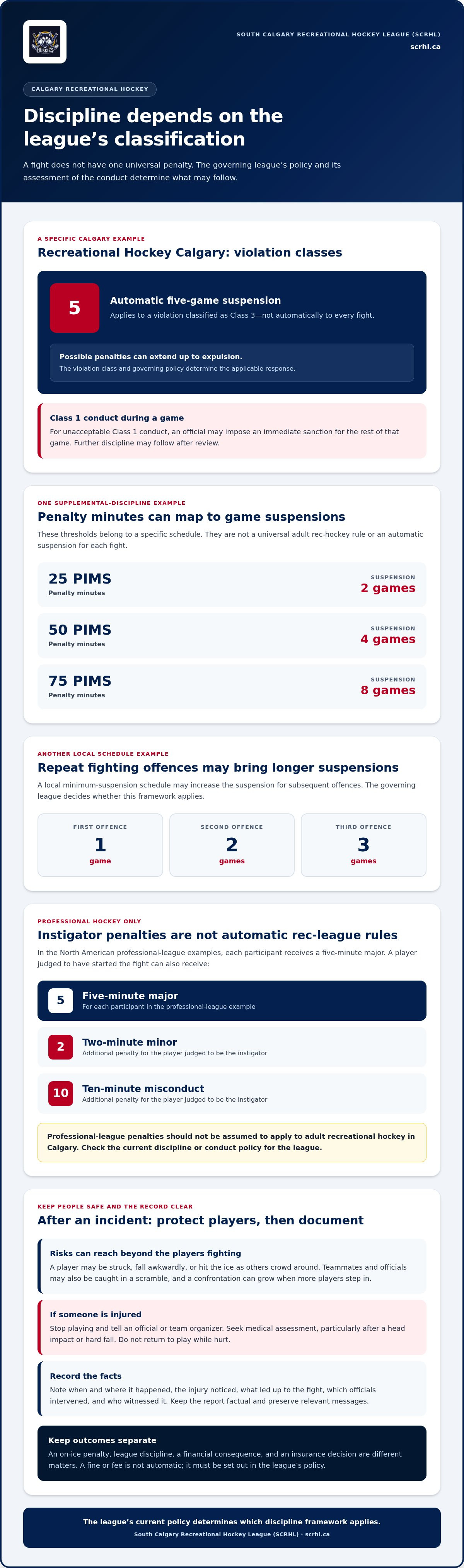
Dropping the gloves can bring consequences beyond time in the penalty box. The consequences of fighting in Calgary rec hockey depend on the league’s rules and how it classifies the incident. In Recreational Hockey Calgary, a Class 3 violation carries an automatic five-game suspension, with possible penalties up to expulsion; that penalty applies to Class 3 violations, not automatically to every fight.
A heated moment can put players at risk and disrupt the game, so it’s sensible to understand the rules before stepping onto the ice. The consequences depend on the league’s discipline policy and the conduct involved, including whether the incident is treated as a broader violation.
This article covers the safety risks, how instigator penalties work in professional hockey, and the disciplinary outcomes Calgary recreational leagues may apply. A professional-league penalty should not be assumed to apply to adult rec hockey.
Key Takeaways
- Fighting can create safety risks for players and disrupt the game, so avoid escalating a confrontation.
- Professional-hockey instigator penalties don’t automatically apply to Calgary recreational leagues.
- Repeat fighting offences can bring increasing suspensions under the governing league’s discipline policy.
- Learn how your league classifies conduct, since disciplinary categories can carry different consequences.
Fighting-related safety concerns
A fight puts more than the players throwing punches at risk. Someone may be struck, fall awkwardly, or hit the ice as others crowd around. Helmets and gloves don’t prevent collisions or uncontrolled falls. In a tight corner, teammates and officials may also be caught in the scramble. The consequences of fighting in Calgary rec hockey can affect everyone nearby.
A confrontation can become harder to control if more players get involved. For example, a teammate stepping in can turn a one-on-one altercation into a larger scrum. Officials may need to stop play and separate participants before restarting the game. The interruption can distract players and raise tension on the ice.
A league penalty is separate from a criminal charge. Whether police become involved or a charge is laid depends on the reported conduct and the authorities’ assessment under applicable law.
A suspension does not automatically determine liability or insurance coverage. Those outcomes depend on the events, policy wording, and any claim review. Report the incident through the league’s process and keep a clear record. League discipline and an insurance decision are separate matters.
If you’re injured, stop playing and tell an official or team organizer right away. Seek medical assessment, particularly after a head impact or hard fall. Don’t return to play while hurt. Record when and where the incident happened, the injury you noticed, and who was present.
Keep your report factual. Note what happened before the fight, where it occurred, and which officials intervened. Preserve relevant messages and ask witnesses to record what they saw. A clear timeline helps distinguish the physical incident from later discussion. Understanding the consequences of fighting in Calgary rec hockey also means knowing how to document an incident.
Before a dispute escalates, move away from your opponent after a whistle. Let the official manage the exchange rather than responding to a shove or challenge. Choosing not to fight helps protect players and keeps recreational hockey focused on the game.
Instigator penalties
An instigator is the player judged to have started a fight. In North American professional leagues, each participant receives a five-minute major penalty. The instigator can also receive a two-minute minor and a ten-minute misconduct. These are professional-league penalties, not automatic rules for Calgary adult recreational hockey.
The distinction matters: “instigator” describes a role in an incident, while each league’s policy sets the response. Officials and administrators assess what happened, including who initiated the confrontation and whether it continued after play stopped. For example, a player who deliberately challenges an opponent may be treated differently from someone who enters an existing scrum.
Repeat fighting incidents are handled under the applicable league policy. A local minimum-suspension schedule may increase the suspension for subsequent fighting offences: one game for a first offence, two for a second, and three for a third. Don’t assume that schedule applies to every Calgary adult recreational league. The governing league’s rules determine which disciplinary framework applies.
Find the current conduct rules in the official discipline or conduct policy for your adult league. Read its definitions of fighting and instigation, how repeat offences are counted, and who reviews incidents. Team documents may explain the process, but the league’s governing policy sets the applicable discipline framework.
A fine or fee isn’t automatic just because an official identifies an instigator. Any financial penalty must be set out in the league’s policy, which determines whether a charge applies and what conduct triggers it. An on-ice penalty, a suspension, and a financial consequence are separate outcomes.
Players choosing a schedule can compare morning, evening and weekend hockey sessions with their weekly commitments.
In the professional-league examples, that additional discipline is tied to the instigator designation. It is not a general description of every fight call. In the North American professional leagues discussed on the page, an instigator can receive an extra two-minute minor penalty and a ten-minute misconduct. Recreational players should check their own league’s wording before comparing outcomes.
What are the penalties for fighting in Calgary recreational hockey leagues?
There is no single penalty schedule for every Calgary recreational league. One specific supplemental-discipline schedule illustrates how accumulated penalty minutes can lead to suspensions: 25 PIMS brings a two-game suspension, 50 PIMS brings four games, and 75 PIMS brings eight games. These thresholds belong to that schedule; they are not a universal adult rec-hockey rule or an automatic suspension for each fight.
For adult players, the governing league’s policy is the relevant one. Check whether it sets discipline by penalty-minute totals, by conduct category, or through a review of the incident. These systems can produce different outcomes, even when the conduct is similar.
Recreational Hockey Calgary uses violation classes. Its Class 3 violations carry an automatic five-game suspension, with possible penalties up to expulsion. That consequence applies to conduct classified as Class 3, not automatically to every fight. The classification and policy determine the applicable response.
For unacceptable Class 1 conduct arising during a game, a Recreational Hockey Calgary official may impose an immediate sanction for the rest of that game. Further sanctions may follow after review. For example, removal from the current game can be followed by a separate disciplinary decision after administrators assess the incident.
Separate the on-ice penalty from any additional league discipline. Officials record what happened, then the governing policy guides the review. A player’s penalty-minute total, the conduct category, and the review findings can all affect the outcome. A suspension affects eligibility to play; expulsion ends participation in that league.
Read the current discipline policy for your adult league. Look for its definitions of fighting, how repeat conduct is handled, whether penalty minutes accumulate, and how incidents are reviewed. Don’t apply another organization’s schedule to your team. The rules of the league you play in determine the process and consequence.
Do Calgary rec hockey leagues suspend or expel players for fighting?
Yes. Calgary recreational leagues can suspend players, and serious violations may lead to expulsion. Recreational Hockey Calgary’s policy links discipline to violation classes, so the outcome depends on how the conduct is classified. Read the written decision closely and identify the class, sanction, and any appeal instructions. These details explain the decision better than assuming every fight receives the same penalty.
For a Class 3 decision, Recreational Hockey Calgary requires a two-thirds majority of its board. That voting threshold applies to the board’s decision, not to every disciplinary matter. It shows why the assigned violation class matters: the policy sets different processes as well as different possible outcomes.
A player appealing a Complaints Committee decision must provide notice of intent within five business days of receiving the written decision. After receiving a written appeal, the President must arrange a hearing date within seven business days. Record the decision date and appeal instructions promptly so you can track these deadlines.
Keep the written decision and note when it arrived. Compare its stated classification and sanction with the policy’s appeal procedure. If an appeal is available, follow the notice requirements and deadlines for that process. Don’t assume an informal conversation replaces required written notice.
For Calgary players weighing league participation, understanding the discipline process is part of choosing a suitable recreational setting. Consider how formal rules fit your expectations for competitive play and conduct. For a schedule option alongside those considerations, explore morning, evening and weekend hockey sessions.
Rules can differ by league: local minimum-suspension tables often list multi-game suspensions for repeat fighting offences. Recreational Hockey Calgary’s Class 2 violations carry a suspension of three (3) up to five (5) games. These entries are tied to a specified repeat offence or violation class, so they should not be treated as a universal penalty for every fight. If Recreational Hockey Calgary imposes an immediate suspension while an investigation is pending, that time counts toward the overall suspension period. Players should check which policy applies and how the league classified the incident before assessing the possible length of a suspension.
South Calgary Recreational Hockey League (SCRHL): Fall Season Team Registration
South Calgary Recreational Hockey League (SCRHL) offers adults organized recreational hockey in Calgary. Teams ready for the Fall season can register through Fall Season Team Registration. Players planning for another season can choose Winter Season Team Registration, while Individual Player Registration offers a route for individual players. Morning Hockey Sessions are another scheduling option.
Choosing a league is also a chance to read its conduct expectations before play and decide whether its format suits your team or schedule. For registration and session details, visit scrhl.ca or contact South Calgary Recreational Hockey League (SCRHL).
Set your expectations before your next game
Understanding the consequences of fighting in Calgary rec hockey can help players make considered choices before emotions rise. Agree with teammates on how to handle disagreements: give each other space, avoid escalating a challenge, and let officials manage the exchange. Shared expectations offer a practical guide when a game gets tense.
Before choosing a season, consider the kind of hockey environment you want: competitive, social, and respectful of everyone sharing the ice. Read the applicable conduct policy and raise any questions about league expectations before play begins. Knowing what to expect helps you focus on your role, your teammates, and the game.
If you’re considering adult recreational hockey in Calgary, contact South Calgary Recreational Hockey League (SCRHL) to explore your next step. Find a season that fits your plans and enjoy getting back on the ice.
Frequently Asked Questions
Dropping the Gloves: What Kind of Fighting Is Allowed in Hockey?
Don’t assume fighting is allowed in a Calgary recreational game. The rules depend on the league’s conduct policy, which defines prohibited behaviour and possible discipline. A professional-hockey penalty or another organization’s rules don’t automatically apply to your league. Before playing, read the applicable policy and follow officials’ directions during disputes. A whistle or heated exchange isn’t permission to start or join a fight.
What consequences apply to players who start or continue a fight in a Calgary rec hockey game?
Starting or continuing a fight can lead to penalties under the applicable league’s discipline policy. The response depends on the conduct and how the league classifies the incident. For example, Recreational Hockey Calgary uses violation classes, with possible suspensions that vary by class and may include expulsion for the most serious category. Read the written policy and any decision notice to understand the process that applies.