

How long it takes to get custom hockey jerseys depends on the design, customization choices and how quickly the team approves the final artwork. Approval is a key step: revisions after review can affect the production schedule.
Plan jerseys well before the season starts. Your team needs time to agree on colours, numbers, names and other design details, then review the layout together before production begins.
This guide explains how the approval process works and which customization choices can affect turnaround. You’ll learn what to prepare as a team, where revisions can add time, and how to plan jerseys around your season schedule.
Key Takeaways
- Get team colours, names, numbers and artwork organized before the design review to keep decisions moving.
- Know how requested changes and customization choices can affect the production schedule.
- Map the main production and delivery stages so you can plan around your team’s season start.
- Compare stitched and embroidered details with other customization choices before approving the final design.
- Once your team is ready to plan its season, explore South Calgary Recreational Hockey League’s Fall or Winter Season Team Registration.
Custom jersey design and approval process
Design approval marks the point when a team’s choices become a production-ready order. Start with one coordinator who gathers decisions from players and sends a clear, consolidated set of instructions. This prevents different versions of the Calgary team crest, colours, names and numbers from circulating at once. Before production begins, settle both the overall look and each player’s details. Even a small placement issue can be noticeable, so review alignment carefully.
Use a consistent approval sequence to catch errors before final sign-off:
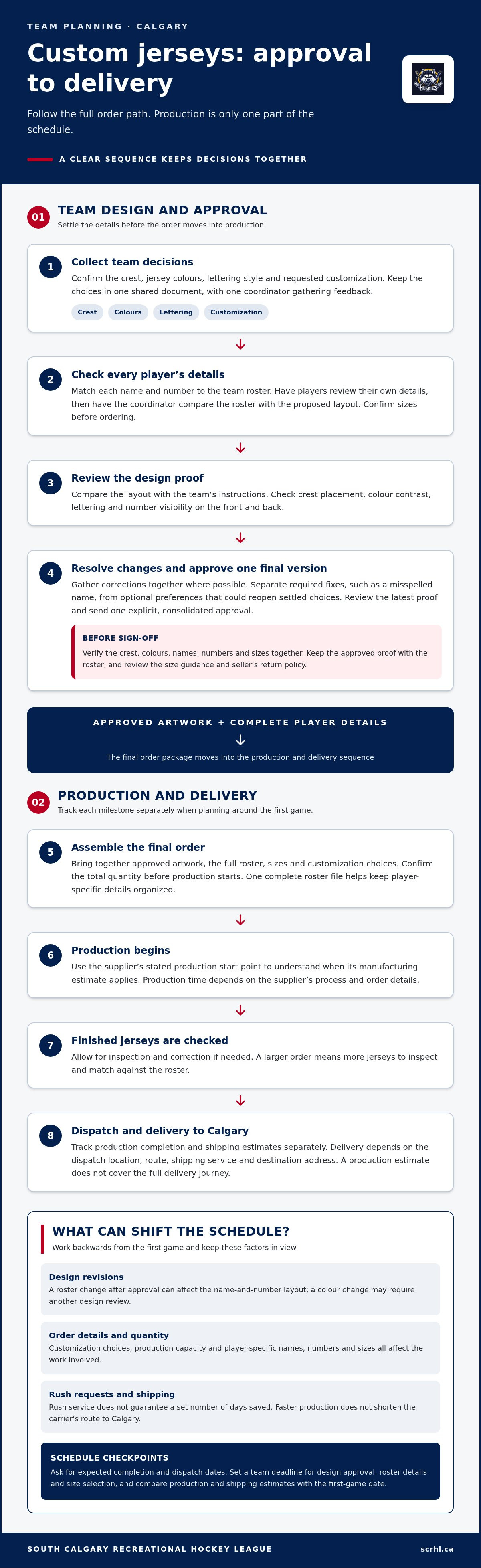
- Collect team decisions. Confirm the crest, jersey colours, lettering style and any requested customization. Record choices in one shared document, rather than scattered messages.
- Check player details. Match each player’s name and number to the team roster. Ask players to review their own details, then have the coordinator compare the list with the proposed layout.
- Review the design proof. Check crest placement, colour contrast, lettering and number visibility on the front and back. Compare the displayed layout with the team’s instructions, not just with earlier drafts.
- Resolve changes together. Gather corrections in one round of feedback where possible. Separate required fixes, such as a misspelled name, from optional design preferences that could reopen settled choices.
For example, a roster change after approval can affect the name-and-number layout. A colour change may also require another design review. Treat each updated proof as a new version and make sure the team reviews the latest file. The coordinator should record who approved it and which roster was used. This creates a clear reference if questions arise later.
Before ordering, review the size chart and measurement guidance, confirm every customization detail, and read the seller’s return policy. Pay particular attention to whether personalized jerseys can be returned and how errors or sizing concerns are handled.
Make final approval explicit. Ask the team to verify the crest, colours, names, numbers and sizes in the same review. Then send one consolidated approval rather than separate messages that could conflict. Keep the approved proof with the roster. This gives the team a clear record of its final design choices.
Customization turnaround time
Customization affects several stages, from artwork setup to final inspection. For a team in Calgary, the schedule depends on the supplier’s workflow, order details and delivery route.
Rush Order Options
A rush request asks a supplier to prioritize an order within its production workflow. It does not create a standard Canadian turnaround or guarantee a set number of days saved. The time gained depends on the existing production schedule, customization choices and whether the artwork and roster are ready.
Before relying on rush service, separate production time from shipping time. A faster production slot will not shorten the carrier’s route to Calgary. Ask for the expected completion and dispatch dates, then compare them with the team’s first game. If the design or player details change, the requested priority may no longer fit the original schedule.
Making and Delivering Jerseys
Making and delivering jerseys involves distinct stages: preparing the order, producing the customized items, checking them, dispatching the shipment and delivering it to the team’s address. Total turnaround depends on the time each stage takes. A production estimate alone does not cover the full delivery journey within Canada.
For an order going to Calgary, note where it ships from and when the carrier receives it. The delivery window depends on the dispatch location, route, shipping service and destination address. Ask for production completion and shipping estimates separately. This helps your team see whether production or transport has a greater effect on the schedule.
Order Quantity and Production Time
Order quantity affects production volume and the work needed to manage player-specific details. A larger team order means more jerseys to produce, inspect and match against the roster. Names, numbers and sizes also need accurate records. The effect on turnaround depends on production capacity and how customization is handled across the order.
Send one complete roster instead of adding players in separate batches. For example, list each player’s name, number and size in one organized file, and confirm the total quantity before production starts. Changes after that point can require updates to the order and its checks. One coordinator can gather revisions and submit a single final version.
To protect the schedule, set a team deadline for design approval, roster details and size selection. Keep the first game date visible when comparing production and shipping estimates. A Calgary team can also plan its ice time alongside its apparel schedule by reviewing hockey sessions in Calgary.
Typical customization production timeline
A team’s production timeline is a sequence of milestones, not one isolated manufacturing step. Work backwards from the first game, allowing time for order preparation, production, quality checks and delivery. The exact duration depends on the supplier’s process and the order details.
Start by identifying when the jerseys need to be ready in Calgary. Then map the work that must be completed beforehand. Artwork approval, complete player information and shipping arrangements all affect when the next stage can begin. An early delay can shift the expected arrival date, even if production itself proceeds as planned.
Track the order through these milestones:
- Order details assembled. Bring together the approved artwork, roster, sizes and customization choices in one final package.
- Production begins. Use the supplier’s stated production start point to understand when the manufacturing estimate applies.
- Finished jerseys are checked. Leave room for inspection and correction if a name, number or design detail needs attention.
- Shipment reaches Calgary. Separate dispatch from arrival, since transit adds time after production ends.
For example, a team with a fixed season opener can plan backwards from that date. Set an internal deadline for final order details before the supplier’s production window, and allow a separate buffer for transit and receiving the shipment. This makes the deadline clear without assuming every supplier measures turnaround the same way.
Begin planning as soon as the season date and team requirements are clear. This gives the group time to settle design choices, confirm the roster and account for production and delivery. Waiting until the first game is close leaves less flexibility if the design changes or player information needs correction.
Ask for a timeline that identifies its starting point and final milestone. An estimate that begins after artwork approval differs from one that starts when the order is submitted. Likewise, “complete” could mean jerseys leave production or arrive at the team’s Calgary address. Compare estimates using the same milestones to plan effectively.
Assign one person to manage the schedule. The coordinator can record the season start, internal approval deadline, production start and expected arrival. If the roster changes, they can flag the effect before the order moves to the next stage. A written timeline helps the whole team prepare for its opening game.
How long does it take to make and deliver custom hockey jerseys in Canada?
For a Canadian team, total turnaround includes production and shipping to the team’s address. The schedule depends on the supplier’s workflow, order details and delivery route to Calgary. Ask for an estimate covering the complete process, not manufacturing alone. This makes it easier to align the order with your season plans.
Separate the order into stages before comparing timelines:
- Order preparation: the supplier receives the jersey specifications and prepares the order for production.
- Manufacturing: the jerseys are made with the team’s chosen design and customization.
- Inspection and dispatch: finished items are checked, packed and handed to a carrier.
- Transit to Calgary: the shipment travels from its dispatch point to the team’s destination.
Each stage has its own start and finish. A production estimate may begin after artwork approval, while delivery starts after dispatch. A production-only estimate can leave shipping time out of the total. Compare estimates using the same milestones, and ask what starts the supplier’s clock and what event ends it.
Delivery time depends on the dispatch location, selected shipping service and Calgary destination. A shipment sent from within Alberta follows a different route from one travelling across Canada. The delivery address also affects the final arrangements. Use an estimate for the actual destination, whether the jerseys are going to a team representative, residence or arena.
A quote depends on factors such as order quantity, jersey type, decoration method and design complexity. Keep the quote separate from the turnaround estimate. This lets your team compare costs and delivery milestones without treating one as a substitute for the other.
For scheduling, record when the order is ready for production, its expected dispatch date and when the jerseys need to be in hand. Compare the expected arrival with the first scheduled game. If there is little room, move the team’s internal order deadline earlier instead of relying on the carrier to make up time.
When reviewing an estimate, ask whether its endpoint means production completion, dispatch or delivery. These milestones give a Calgary team a clearer basis for planning. After arrival, assign someone to match each jersey against the order record, including player name, number and size. Keep the shipment details until the order has been checked, so any discrepancy is identified before game-day preparation.
Shipping time varies with the dispatch location, selected shipping service and delivery address. Ask for an estimate based on your team’s actual destination.
How long do embroidered or stitched hockey jerseys take to produce?
Embroidery and stitched details add production steps beyond choosing a jersey colour. The timeline depends on the artwork, placement, number of customized pieces and the supplier’s production process. There is no fixed turnaround for every embroidered or stitched order. Ask for a schedule based on the exact design and full order.
Embroidery creates a design with thread, while stitched lettering or crests are sewn onto the garment. The method affects how the artwork is prepared and applied. A simple name treatment differs from a detailed crest with several colours or fine lines. These choices affect the work involved, so the estimate should reflect the actual customization.
Before the order enters production, clarify these details:
- Decoration method: Confirm which elements are embroidered and which are stitched or applied another way.
- Artwork requirements: Provide the final crest file and identify any colours or details that must remain clear.
- Placement: Specify where the crest, name and number belong on each jersey.
- Order list: Match each player’s name, number and size to the correct jersey.
For example, a team crest with fine lettering may require a different setup from a bold, single-colour mark. If the design changes after the production file is prepared, the supplier may need to revise that file before applying the decoration. Settling the artwork early helps avoid reworking the same details at different stages.
Ask when the quoted production period begins. Some schedules start after artwork approval; others start once the complete order is ready. Also ask whether the estimate covers decoration, inspection and dispatch, or only manufacturing. These milestones help a Calgary team compare the estimate with its first game and shipping needs.
For stitched jerseys, make placement instructions clear across the roster. Consistent crest placement requires a clear, approved layout. The same applies to names and numbers. A coordinator can compare the final roster with the order sheet before submission, then keep the approved version for reference during production.
Build the team schedule around the actual decoration method, order details and delivery destination. Record the supplier’s production start, expected dispatch and arrival milestones separately. To coordinate jerseys with your season plans, organize your team’s hockey season.
South Calgary Recreational Hockey League (SCRHL): Fall Season Team Registration
South Calgary Recreational Hockey League (SCRHL) offers Fall Season Team Registration for adult teams planning their season in Calgary. If your group is choosing a league while organizing jerseys, registration is a natural next step beyond apparel planning. Teams can also consider Winter Season Team Registration, while individual players can register separately. Morning Hockey Sessions offer another option for players planning ice time.
Review the registration options that fit your team or playing plans, then visit scrhl.ca for South Calgary Recreational Hockey League information.
Set Your Team Up for the Season Ahead
Knowing how long it takes to get custom hockey jerseys helps you plan, but the next step is to connect the apparel schedule with your season plans. Choose a team decision-maker, keep your roster organized and select the registration path that fits your group. South Calgary Recreational Hockey League (SCRHL) offers Fall Season Team Registration, Winter Season Team Registration and Individual Player Registration for adult recreational hockey in Calgary.
If you’re still weighing how long it takes to get custom hockey jerseys, use your expected season start to guide when your team finalizes its plans. A clear schedule makes it easier to coordinate decisions and prepare for the first skate.
Contact South Calgary Recreational Hockey League (SCRHL) to discuss registration options. Get your plans in motion and look forward to taking the ice together.
Frequently Asked Questions
Do you do this for whole teams?
Yes. South Calgary Recreational Hockey League (SCRHL) offers custom-designed hockey jerseys and apparel for teams. An organizer can gather player details and coordinate the order alongside the team’s season plans, keeping each player’s information connected to the right team. SCRHL also offers team and individual registration for adult recreational hockey in Calgary, helping captains coordinate league participation and team apparel.
How long does it take?
There is no single turnaround for every custom jersey order. Timing depends on the design, customization, production workflow and shipping destination. A useful estimate separates artwork approval, production, inspection, dispatch and transit to Calgary. Ask what starts the estimate and whether it ends at dispatch or delivery. Captains can then plan jersey distribution around the expected arrival and the team’s first scheduled game.
What if there's a mistake?
Compare the jersey with the approved design and order record, then document the specific discrepancy. Note the affected item, player name, number and size; photos can help explain the issue clearly. Keep the packaging and avoid altering the jersey while recording the details. Send the information through the seller’s stated order or support channel. The approved proof can help show whether the mismatch involves production or information submitted with the order.
What is the typical turnaround time for sublimated custom hockey jerseys?
There is no standard turnaround for sublimated custom jerseys. Timing depends on the supplier’s production workflow, order details and delivery arrangements. A finalized design and complete roster help the order proceed without waiting for team decisions. Ask for separate production completion and delivery estimates, including when the timing begins. For a Calgary team, use the expected arrival date to plan jersey distribution before the first game.
What steps in the design and approval process can delay a custom hockey jersey order?
Approval can take longer when feedback arrives in separate rounds or submitted details conflict. For example, a player’s name might be spelled differently on the roster and design proof. Assign one approver to compare the proof with the team’s final information, consolidate comments and resolve conflicting preferences. A new crest or colour choice can reopen settled decisions, so distinguish a required correction from a fresh design change before approval.