

A player other than the goaltender who catches the puck with a closed hand must put it back on the ice immediately or may receive a two-minute minor penalty. These fair play rules in adult hockey also address conduct, appeals and sportsmanship, which may earn a Fair Play point in leagues that use that system. Knowing how the rules work helps you understand what happens during a game and why it matters.
Fair play means more than avoiding penalties. It also shapes how players handle disagreements and protect one another on the ice. This guide explains the closed-hand puck rule, how conduct concerns and appeals are handled, and when a Fair Play point may be awarded. It also covers how fair play relates to safety, so you can better understand what’s expected.
Key Takeaways
- Know what to do if you catch the puck, and why handling it promptly matters.
- Understand how conduct concerns are managed and what an appeal process can involve.
- Learn what sportsmanship can contribute to a team’s Fair Play standing.
- See how respectful play and safer contact help make adult hockey better for everyone on the ice.
Closing hand on the puck
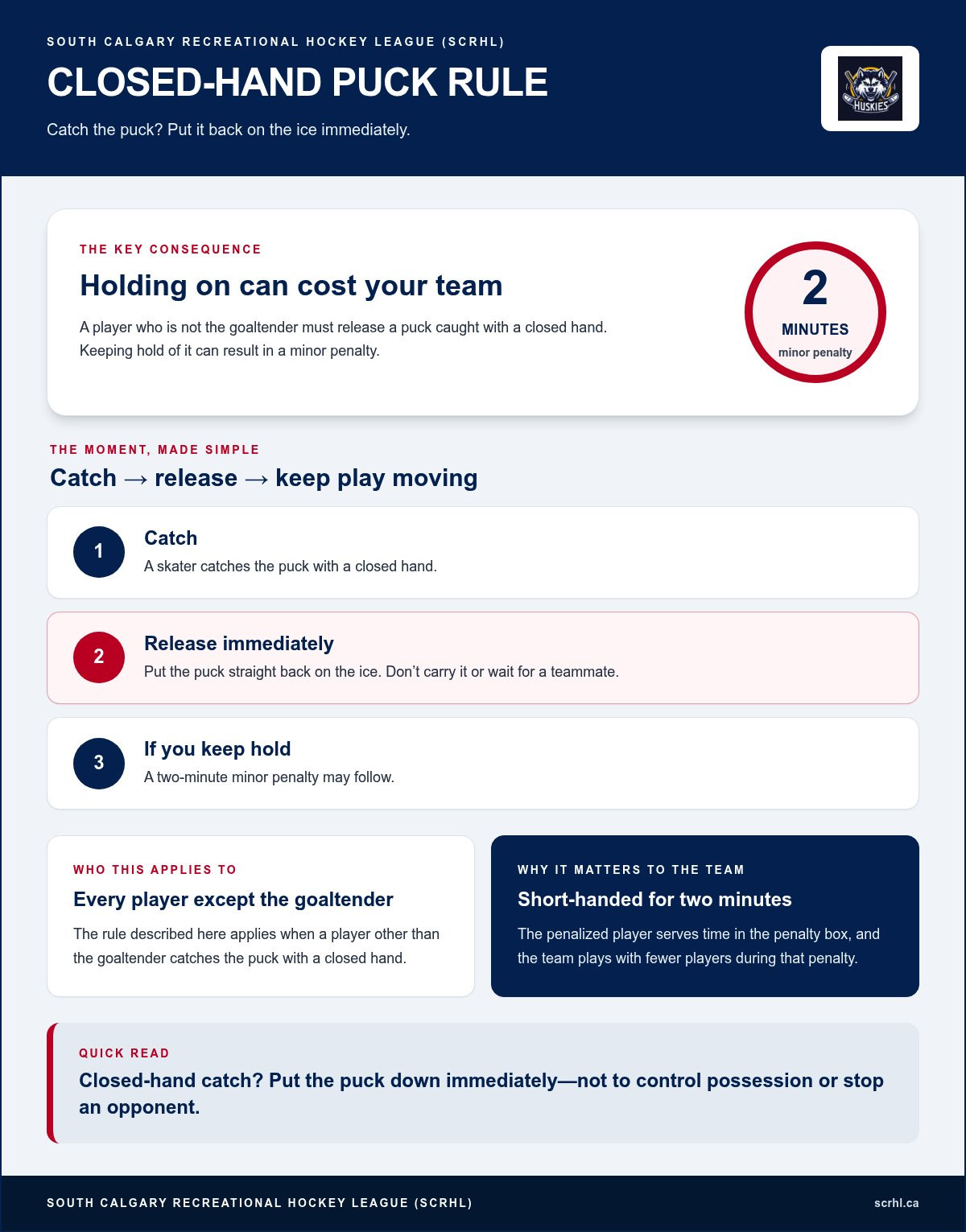
Fair play rules in adult hockey, explained through puck handling, start with a simple distinction. A player other than the goaltender who catches the puck with a closed hand must put it back on the ice immediately. Holding on to it instead can result in a two-minute minor penalty. Release the puck promptly rather than use the catch to control possession or stop an opponent.
Imagine catching the puck in the air as an opponent approaches. Put it straight down rather than carry it or wait for a teammate. That immediate action lets play continue under the rule. A closed hand isn’t a way to secure the puck, even during a scramble near the boards or in front of the net.
A minor penalty means the penalized player serves two minutes in the penalty box. During that time, the team plays short-handed, so holding the puck can affect everyone on the ice. The player loses playing time, and teammates must defend with fewer players. That’s why the next action after a catch matters.
- Catch: A player who isn’t the goaltender catches the puck with a closed hand.
- Release: Put the puck back on the ice immediately.
- Penalty: Keeping hold of the puck can bring a two-minute minor.
The practical rule is straightforward: if you catch the puck, return it promptly. That follows the rule and avoids turning a brief moment into a penalty that leaves your team short-handed for two minutes.
Closing hand on the puck
This puck-handling example shows how fair play rules in adult hockey work. A player other than the goaltender who catches the puck with a closed hand must put it back on the ice immediately. Holding on to it instead can result in a two-minute minor penalty. Release the puck promptly rather than use the catch to control possession or stop an opponent.
Imagine catching the puck in the air as an opponent approaches. Put it straight down rather than carry it or wait for a teammate. That immediate action lets play continue under the rule. A closed hand isn’t a way to secure the puck, even during a scramble near the boards or in front of the net.
A minor penalty means the penalized player serves two minutes in the penalty box. During that time, the team plays short-handed, so holding the puck can affect everyone on the ice. The player loses playing time, while teammates defend with fewer players. The next action after a catch matters to the whole team.
- Catch: A player who isn’t the goaltender catches the puck with a closed hand.
- Release: Put the puck back on the ice immediately.
- Penalty: Keeping hold of the puck can bring a two-minute minor.
A practical understanding of fair play rules in adult hockey starts with this response: if you catch the puck, return it promptly. That follows the rule and avoids turning a brief moment into a penalty that leaves your team short-handed for two minutes.
Earning a Fair Play point
Skill divisions, player eligibility and substitute-player rules depend on each competition’s regulations. A Fair Play point is a standings reward for sportsmanship only where a league uses that system. It doesn’t determine who qualifies to play or which skill level is appropriate. In South Calgary, follow the local competition’s rules for eligibility and substitutes.
Minnesota Hockey offers an example of how a Fair Play system can work: a team may earn one extra standings point for good sportsmanship. In round-robin invitational pool play, that point is added to points for wins or ties. This describes Minnesota Hockey’s system, not a rule for adult leagues in Calgary. Each local competition’s standings rules determine whether sportsmanship affects points.
Minnesota Hockey also uses penalty-minute thresholds that vary by youth division. Its examples include 10 minutes for Squirt, 8 for Girls 10U, 12 for Peewee and 10 for Girls 12U. These thresholds are not Calgary adult-league limits. They show why players need to distinguish a particular association’s youth system from the rules governing their own adult competition.
Under Minnesota Hockey’s system, a minor or bench minor counts as 2 penalty minutes, and a major counts as 5. A misconduct counts as 10, while a minor with a misconduct counts as 12. Head contact, charging, checking from behind and boarding also count as 12 minutes toward its threshold. These values explain that system only; they don’t establish Calgary adult-league penalty scoring.
- Review the competition’s standings rules for Fair Play points.
- Follow its penalty-scoring method and thresholds.
- Use its eligibility and substitute-player requirements.
For adult players in Calgary, distinguish sportsmanship recognition from roster eligibility. A Fair Play point applies only when the competition awards one. Local rules determine who may participate, including skill-level placement and substitute players.
Check your competition’s regulations for the permitted skill division and requirements for player eligibility and substitutes.
Fair play and safety in hockey
Fair contact rules help players compete without turning a puck battle into a dangerous collision. The season runs more smoothly when players know which contact is allowed and which actions can put others at risk.
Body Checking and Contact
Body checking is a deliberate use of the body to impede an opponent. Competitive contact includes battling for position, angling and leaning. In USA Hockey adult recreational leagues, body checking isn’t allowed; contact is limited to those competitive actions. In a board battle, for example, players can angle for the puck but shouldn’t use a deliberate body check to dislodge an opponent.
In those leagues, a deliberate body check carries at least a five-minute major penalty and often a game misconduct. Checking from behind became illegal in 2000, according to the Public Health Agency of Canada. Avoid approaching an opponent from behind, especially near the boards, where a fall can cause serious harm.
Stick Use and Related Penalties
Rules on stick use address actions such as high-sticking, slashing and tripping, which can injure opponents or unfairly stop their movement. Keep the blade controlled and use it to play the puck, not to strike or obstruct another player. Swinging at an opponent’s stick, for example, can turn a puck challenge into a penalty review.
These actions are judged during play, so the official’s view of the contact and its effect matters. USA Hockey adult recreational rules list contact with an opponent’s head as a two-minute minor plus a 10-minute misconduct. Avoid lifting or swinging the stick near an opponent’s head, even while trying to reach the puck.
Protective equipment requirements for adult hockey in Canada depend on the governing competition’s rules. Wear the equipment your league requires and inspect it before each season. A loose strap or damaged piece can interfere with protection, so address equipment concerns before taking the ice.
Explore adult hockey in Calgary and bring a safety-first approach to your next season.
South Calgary Recreational Hockey League (SCRHL): Fall Season Team Registration
South Calgary Recreational Hockey League (SCRHL) runs organized adult recreational hockey in South Calgary. Fall Season Team Registration is available for groups ready to play together. Once you understand how conduct, puck handling and safety rules shape play, choosing a league is a practical next step.
Have a team? Fall or Winter Season Team Registration gives your group a way to enter a season. If you’re joining on your own, Individual Player Registration is an option. Morning Hockey Sessions suit players looking for an earlier ice time.
Knowing the fair play expectations helps players contribute to a respectful team environment from the first game. Review the registration options and choose the one that fits how you want to play. Contact South Calgary Recreational Hockey League (SCRHL) or visit scrhl.ca to take the next step.
Bring fair play into your next season
Understanding the fair play rules in adult hockey gives you a better starting point for decisions throughout the season. Carry that understanding into how you communicate with teammates, respond to officials and approach each shift. Consistent choices help set the tone for the whole team, not just the player involved in one play.
If you’re planning to play in Calgary, choose the registration path that fits your situation, whether you’re joining with a team or as an individual. South Calgary Recreational Hockey League (SCRHL) offers Fall Season Team Registration, Winter Season Team Registration and Individual Player Registration.
Take the next step at your own pace. Contact South Calgary Recreational Hockey League (SCRHL) to explore adult hockey registration in Calgary. A thoughtful start helps you arrive ready to play your part in a respectful, enjoyable season.
Frequently Asked Questions
What do fair play rules mean in adult recreational hockey?
Fair play rules set expectations for respectful competition and compliance with game and conduct standards. They cover more than penalties: how players interact with opponents, officials and teammates also shapes the game. For example, you can challenge for possession without retaliating after a whistle. Read your league’s rules before the season to understand how it addresses play and conduct.
How do penalties and suspensions work in Canadian adult hockey leagues?
The league running the game determines how it handles penalties and suspensions. An official may assess an on-ice penalty, while further discipline may follow the league’s review process. The rulebook specifies which conduct may bring additional consequences and how decisions are handled. If a call or disciplinary decision affects your game, note the incident and use the league’s process to raise your concern.
What are adult hockey rules for fighting, rough play, and verbal abuse?
League rules govern fighting, rough play and abusive language. Avoid escalating contact or arguments: a shove after the whistle or hostile comments toward an official can become a conduct issue. Follow the official’s direction, step away from the confrontation and let the league’s process address what happened. Don’t retaliate; it can create another incident instead of resolving the first.
How do adult hockey leagues handle sportsmanship complaints and repeat offenders?
Leagues handle complaints through their own conduct procedures, which may include reviewing an incident and deciding on discipline. For a recurring concern, keep a factual record of each incident, including the game and the behaviour you observed. Specific details give the league a clearer account than a general claim that someone is a problem. Follow the league’s reporting process and keep your communication focused on actions.
What should a player do if an opponent or teammate breaks fair play rules?
Avoid retaliation, and bring any immediate safety concern to the official’s attention. Once play has stopped, write down what happened, including the game situation and the specific conduct. Then raise your concern through the league’s process or with the appropriate team representative. A clear, calm report distinguishes what you observed from assumptions about another player’s intent.