

You don't need twenty years of minor hockey experience or five days of ice time a week to control an adult rec game. Smart positioning and efficient skating beat raw youth speed on almost every shift. If you are trying to figure out how to improve skills playing rec hockey while balancing work and family, you don't need expensive specialty camps or endless free hours to make a real impact.
Every rec player knows the pain of running out of steam halfway through a third-period shift, or looking down at the blade only to get stripped on a breakout pass. It feels frustrating chasing opponents who spent their teenage years in competitive minor hockey. You can close that gap quickly. This guide delivers practical skating, stickhandling, and spatial adjustments that elevate your game using the ice time you already have.
Ahead, we cover efficient edge habits that conserve your endurance, heads-up puck control techniques to find open teammates, and positioning cues that consistently put you in prime scoring ice.
Key Takeaways
- Deepening your knee bend and mastering edge control delivers immediate skating power while conserving energy for late-game shifts.
- Adjusting your top hand spacing builds puck-control confidence so you can execute accurate breakout passes with your head up.
- Understanding defensive-side positioning stops wasted puck chases and keeps you competitive against opponents with minor hockey backgrounds.
- Learning how to improve skills playing rec hockey comes down to targeted off-ice stability work combined with disciplined, short shift lengths.
- Applying these habits in organized game play allows adult players to contribute consistently to team scoring without needing daily practice ice.
Skating Efficiency: The Foundation of Adult Rec Hockey Skills
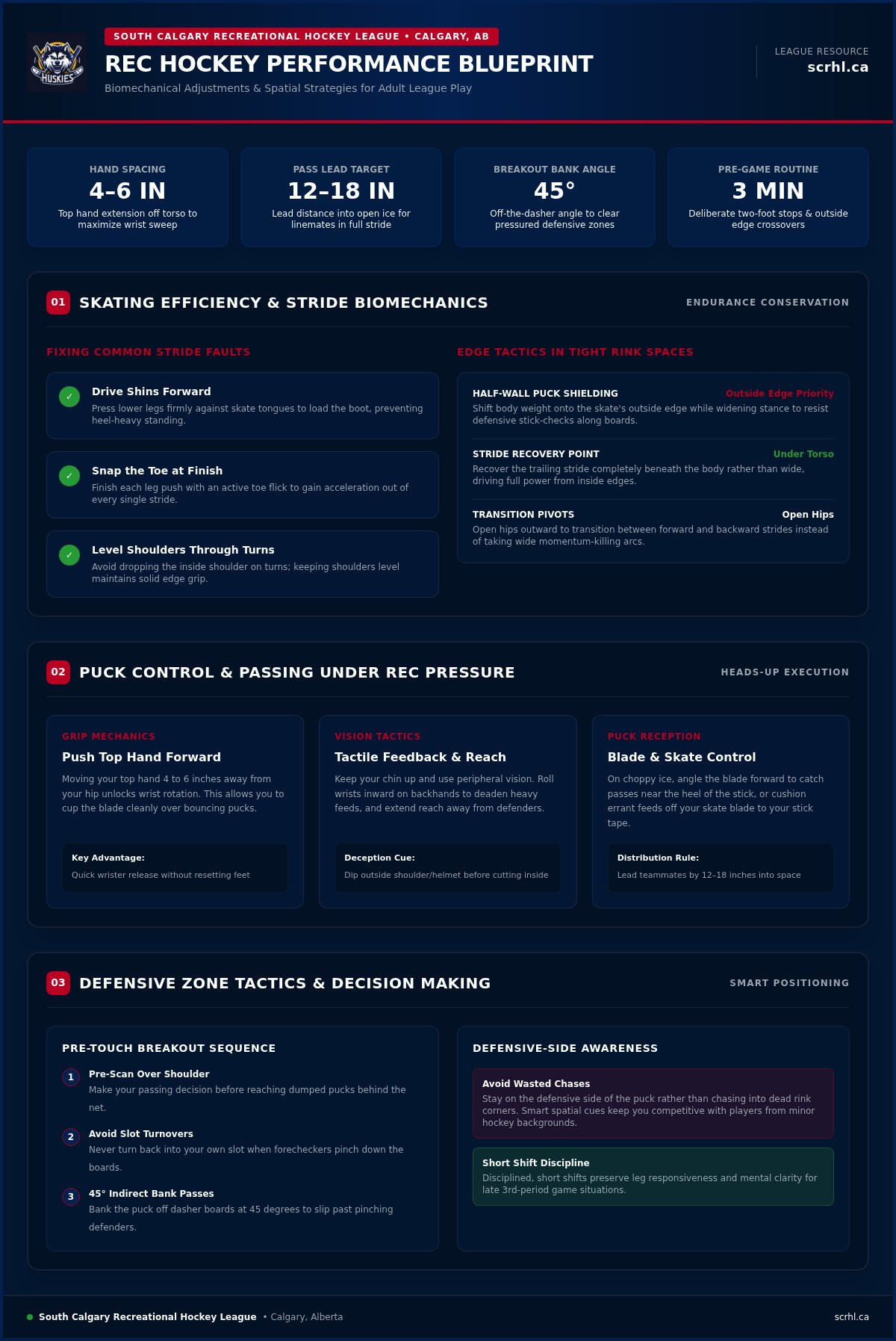
Most adult skaters waste substantial energy by skating tall. Bending your knees drops your hips, lowers your centre of gravity, and lengthens your push. This mechanical adjustment delivers immediate power without requiring extra leg strength. When you recover your trailing stride completely beneath your torso rather than leaving it trailing wide, you generate maximum push off your inside edges on every sequence.
Transitioning quickly between offence and defence separates effective recreational players from those chasing the play. Instead of skating wide arcs that take you away from the action, open your hips outward to pivot smoothly from forward to backward strides. Anyone reviewing an authoritative ice hockey overview will see that efficient skating mechanics underpin all game tactics. Figuring out how to improve skills playing rec hockey starts right here: clean biomechanics conserve endurance, keeping your legs responsive through late-game shifts.
Fixing Common Adult Stride Faults
Standing upright limits ankle flexion, forcing you onto your heels and ruining your balance. To fix this instantly on the ice:
- Drive your shins forward: Press the front of your lower legs firmly against your skate tongues to load the boot.
- Snap the toe: Finish each push with an active toe flick to gain extra acceleration out of the stride.
- Level your shoulders: Dropping an inside shoulder during high-speed turns throws off edge grip and causes skate blowouts.
Edge Control for Tight Rink Spaces
Adult recreational hockey rarely features open ice. You must navigate traffic along the boards and around the hash marks without sacrificing momentum. Prioritize your outside edges. When shielding the puck on the half-wall, push your weight onto that skate's outside edge while widening your stance. This creates a solid base that prevents stick-checks from knocking you off balance.
Use your three-minute pre-game warm-up deliberately. Practise sharp two-foot stops facing both directions instead of drifting around the perimeter. When turning, engage your crossover by driving hard off the underneath skate's outside edge rather than relying solely on the top foot. Making these subtle footwork corrections turns dead rink corners into breakout lanes, giving you a distinct competitive advantage without extra practice ice.
Puck Control and Passing Under Rec League Pressure
Handling the puck with poise starts with grip mechanics. Many adult rec players glue their top hand against their hip, locking the wrist and limiting their sweep. Push your top hand out four to six inches in front of your body. This adjustment creates a full range of motion, allowing you to cup the blade cleanly over the puck to deaden bouncing passes and release quick wristers without adjusting your footing.
Accurate puck distribution keeps opposing checkers on their heels. Stop firing passes straight at your linemates' skates. Lead them by placing the puck twelve to eighteen inches ahead into open ice so they can collect it in full stride. When receiving erratic feeds on choppy ice, angle the blade forward to catch the puck near the heel of your stick, or deaden it against your skate blade before kicking it up to your tape. Testing these instincts in structured games is essential; consider securing an individual player registration in a league with balanced division tiers to practise against realistic pressure.
Developing Soft Hands with Heads-Up Vision
Fixating on the blade invites blindside stick checks. Trust your tactile feedback and use peripheral vision to track the puck while your chin stays up. Add these specific execution cues to your game:
- Roll wrists on the backhand: Turn your wrists inward upon impact to soften heavy passes and prevent dangerous defensive rebounds.
- Freeze defenders with body fakes: Shift your helmet or dip an outside shoulder toward the boards before cutting inside to create clean passing lanes.
- Protect with your reach: Extend the puck away from reaching sticks rather than keeping it tucked closely into your skates where skates tangle.
High-Percentage Passing in the Defensive Zone
Turnovers inside your own blue line result directly from hesitation. When forecheckers pinch down the boards, avoid turning back into your own slot. Bank indirect passes off the dasher boards at a 45-degree angle to slip the puck past their defence and into the neutral zone.
Make your breakout decision before you reach the puck. Scan your options over your shoulder while retrieving dumped pucks behind the net. Verbal communication eliminates confusion across the defensive zone. Shout clear commands like "man on," "wheel," or "reverse" so your defence partner knows where open ice exists before contact arrives. Developing this situational awareness answers the core question of how to improve skills playing rec hockey faster than repetitive off-ice stickhandling drills alone.
Positional Awareness: Working Smarter Instead of Chasing Pucks
Skating speed matters far less when you anticipate where the puck will end up. The most common mistake in recreational hockey is puck chasing, where three players collapse into the same corner boards. When a linemate enters a battle along the wall, stay five to ten feet back in the slot. Support them by offering a clean outlet option rather than crowding their skating space.
Defensive positioning relies on disciplined geometry. Always keep your body situated on the defensive side of the puck, positioning yourself directly between your assigned player and your goaltender's crease. When defending in your own zone, protect the high slot first. Intercepting cross-ice passes eliminates prime scoring chances before they happen. If you want to master how to improve skills playing rec hockey, understanding spatial responsibilities creates more offensive transitions than raw foot speed ever will.
Winger Responsibilities in All Three Zones
Wingers carry specific coverage priorities across the 200-foot surface. Avoid drifting out of position by sticking to these structural rules:
- Lock down the opposing point: Guard the opposition defenceman at the blue line. Stay in their shooting lane without overcommitting too low into the circles.
- Anchor the half-wall on breakouts: Hug the boards at hash-mark height to receive bank passes, giving your defencemen a reliable target against an aggressive forecheck.
- Drive the net on offensive attacks: Funnel hard toward the top of the crease to set screens, disrupt sightlines, and bury loose rebounds.
Centremen and Defencemen Gap Control
Centremen must act as the third defenceman in their own end. Support down low below the faceoff dots, dig pucks out of corners, and trail behind the play so opposing forwards cannot exploit open ice behind your defence pairs.
Defencemen must manage their gap with strict discipline. Backpedal early enough to maintain a single stick-length distance from oncoming rushers through the neutral zone. Forcing opponents toward the outer boards prevents clean entries into the middle lane. Joining a well-structured adult hockey league in Calgary rewards this brand of disciplined hockey, where balanced divisions allow your spatial awareness and positional consistency to dictate game outcomes.
Practical Off-Ice Training Routines for Busy Working Adults
Dryland preparation bridges the gap when ice time is limited to one or two nights per week. Heavy weightlifting is unnecessary for adult rec competition. Instead, prioritize rotational core strength and single-leg balance. Medicine ball side throws against an outdoor brick wall or rotational cable twists train the exact abdominal and oblique muscles used in snap shots and slap shots. Pair these with Bulgarian split squats, walking lunges, and calf raises to build the unilateral lower-body stability needed to stay balanced over your edges during hard turns.
Joint health keeps players active season after season. Cold arena environments make tight hips and groins vulnerable to pulls. Spend five minutes in the dressing room completing dynamic leg swings, deep bodyweight squats, and lateral lunges before lacing up. Dedicating consistent off-ice effort answers the puzzle of how to improve skills playing rec hockey without committing to expensive, time-draining training camps.
Fifteen-Minute Daily Stickhandling Drills at Home
A smooth garage floor and a wooden stickhandling ball or golf ball are all you need to sharpen quick hands between games. Focus on these targeted home drills:
- Figure-eight patterns: Roll the ball through a figure-eight pattern around two pucks, actively cupping the blade on both forehand and backhand passes.
- Single-leg balancing: Stickhandle continuously while standing on one foot to force your ankle stabilisers and core to stay engaged simultaneously.
- Wide-reach extensions: Push the ball as far across your body as possible to both sides, pulling it back cleanly to expand your puck-protection radius.
Stamina and Recovery for Rec League Skaters
Adult recreational hockey demands brief bursts of maximum output rather than steady-state cardio. Jump on a stationary bike or run outdoor intervals using 45 seconds of high-intensity sprinting followed by 90 seconds of active recovery. This routine matches typical shift lengths and rest ratios, training your cardiovascular system to flush lactic acid efficiently on the bench.
Proper hydration begins eight to ten hours before puck drop, not when you arrive at the arena. Drinking enough water throughout the workday prevents third-period cramping and maintains mental sharpness during defensive coverage. Understanding these physical demands is part of what recreational players encounter in our guide to non-contact hockey. Ready to bring your upgraded conditioning to competitive, well-organized games? Explore our evening and weekend hockey sessions to secure a roster spot on a schedule that fits your working life.
Applying Your Skills: Game Situations in Organized League Play
Practising drills in isolation will only take you so far. Real game speed tests your execution under defensive pressure. To accelerate your development, pick one specific mechanical focus for each match. Choose either your outside edge cuts, scanning before touching the puck, or keeping your top hand extended. Tracking your team's turnovers also reveals vital tactical trends; if carrying the puck over the blue line repeatedly ends in lost possession, switch toward dumping and chasing or hitting trailing trailers.
Discipline your ice time. Long shifts kill development. When you remain on the ice past 60 seconds, lactic acid builds up, posture collapses, and your reaction speed deteriorates. Short, intense shifts of 45 to 50 seconds keep your legs explosive and ensure you remain defensively responsible on backchecks. This game-management mindset is fundamental when learning how to improve skills playing rec hockey over a full winter season.
Maximizing Development During Every Shift
Make every second on the bench and ice count toward your progression. Implement these operational game habits:
- Sprint off the ice: Skate directly to the bench door the moment the puck transitions forward instead of gliding in wide circles.
- Communicate between whistles: Align with your defence partner before each drop to assign who takes the slot and who pressures the wall.
- Track positional gaps: Identify when opposing wingers cheat high so you can pinch safely along the dasher boards.
If you don't have a regular roster, learn what happens after individual hockey registration to secure a steady spot where you can test these concepts weekly.
Choosing the Right League Environment for Skill Growth
Development stalls when games are uneven. Mismatched tiers lead to blowout scores where beginners get stripped instantly while experienced skaters coast without challenge. True progression requires division parity. When teams share comparable skating and passing abilities, you earn the split-second required to execute heads-up plays, test breakout passes, and protect the puck under controlled checking pressure.
Recreational sports offer significant physical and social benefits across Calgary, but consistent parity is what keeps competition fair. Registering with SCRHL gives players access to structured, non-contact divisions scheduled across morning, evening, and weekend slots. Whether you enter through individual player registration or bring a whole team for the fall season, balanced division play provides the ideal environment to refine your skills and contribute to winning hockey.
Take Your Game to the Next Level This Season
Mastering how to improve skills playing rec hockey doesn't demand hours of daily practice or expensive camps. Real progress comes from deepening your knee bend for stride power, keeping your top hand extended for heads-up passing, and holding disciplined defensive positioning. When you combine those adjustments with short, high-intensity shifts, you instantly become a more effective teammate on every drop of the puck.
The best place to test these upgrades is in an organized environment built around strict division parity. The South Calgary Recreational Hockey League delivers competitive, balanced matchups designed specifically for adult players. With clean non-contact play and flexible morning, evening, and weekend ice times across South Calgary rinks, you can play regular hockey that fits your work schedule.
Register for upcoming seasons with the South Calgary Recreational Hockey League today as an individual player or enter a full team. Grab your gear, trust your edges, and enjoy competing in games where your hard work shows up directly on the scoresheet.
Frequently Asked Questions
How often should an adult rec hockey player practice to see noticeable progress?
One to two organized games per week combined with 15 minutes of dryland work at home is sufficient for measurable progress. Adults don't need daily ice time to sharpen their habits. Consistency in game execution matters far more than volume. Dedicating just five minutes to edge work during warm-ups and reviewing positional discipline between shifts compounds quickly across a standard season.
Can you become a good hockey skater if you started playing as an adult?
Yes, adults can develop into strong, highly effective skaters by focusing on biomechanics rather than raw agility. Adult beginners often grasp edge angles, weight distribution, and forward knee flexion faster than kids because they understand direct technical cues. Committing to a low centre of gravity and practising balanced stops during warm-ups builds dependable skating confidence within a single winter season.
What is the best way to increase stamina for adult rec hockey shifts?
High-intensity interval training off the ice builds game stamina faster than steady-state jogging. Ride a stationary bike or run outdoor intervals with 45 seconds of maximum effort followed by 90 seconds of active recovery to mimic shift demands. Understanding how to improve skills playing rec hockey also means managing your ice time; keeping shifts under 50 seconds prevents severe muscle fatigue late in games.
Should rec hockey players use a lower stick flex to improve their shot?
Most adult recreational players benefit immediately from dropping to a lower stick flex. Choose a flex rating roughly half your body weight or slightly less, often between 65 and 77 flex for recreational skaters. Stiff shafts require heavy downward force to load properly. A whippier shaft allows you to flex the stick easily and snap off quick wrist shots without needing perfect mechanics.
How do I stop looking down at the puck when stickhandling in games?
Push your top hand four to six inches outward from your hip and rely on peripheral vision. When your hands sit too close to your torso, you are forced to stare downward at the blade. Extending your arms lets your hands feel blade contact naturally. Practise rolling a wooden ball at home while keeping your eyes fixed forward on a wall clock.
What equipment adjustments make the biggest difference in skating comfort and speed?
Dialling in your blade hollow and boot fit delivers the fastest mechanical upgrade. Many players skate on blades sharpened too deep, which causes edges to bite excessively and drains leg stamina. Testing a shallower hollow, like 5/8-inch instead of 1/2-inch, increases glide speed across Calgary rinks. Leaving your top skate eyelet unlaced also promotes deeper ankle bend for a longer stride.
How does division parity in adult recreational leagues help individual player development?
Division parity guarantees you play against peers with comparable skating and tactical abilities. When rosters are balanced, you earn the split-second required to execute breakout passes and test edge work without getting overwhelmed. In Calgary, leagues like SCRHL structure balanced tiers so players exploring how to improve skills playing rec hockey can build real confidence in fair, competitive, non-contact game environments.