

One tryout can give a coach an initial read, but it shouldn’t define a player’s place on the team. Integrating new players onto a hockey team works best when coaches assess each person’s strengths, set a clear role and encourage teammates to communicate from the start. A newcomer needs a fair chance to contribute, not pressure to master an unfamiliar system overnight.
It’s natural to wonder whether one tryout is enough to make a decision. Use it to observe skills and comfort on the ice, then build a fuller picture through practices and game situations. Small adjustments can help a newcomer settle in while keeping the team’s approach clear and consistent.
This guide explains how to adapt skill-based drills, encourage communication and assign practical responsibilities. You’ll also learn how to address common newcomer concerns and pair new players with experienced teammates, so everyone knows how to help the group work together.
Key Takeaways
- Keep familiar drills in the rotation and adjust the challenge to suit each player’s current skills.
- Choose partner activities that make players communicate, cooperate and read each other’s movement.
- Explain team systems briefly, then give each newcomer a clear area where they can contribute.
- Recognize effort and good decisions openly; offer corrections quietly to help players build confidence.
- Pair newcomers with approachable teammates who can help them feel included on and off the ice.
Adapting drills to player skill levels
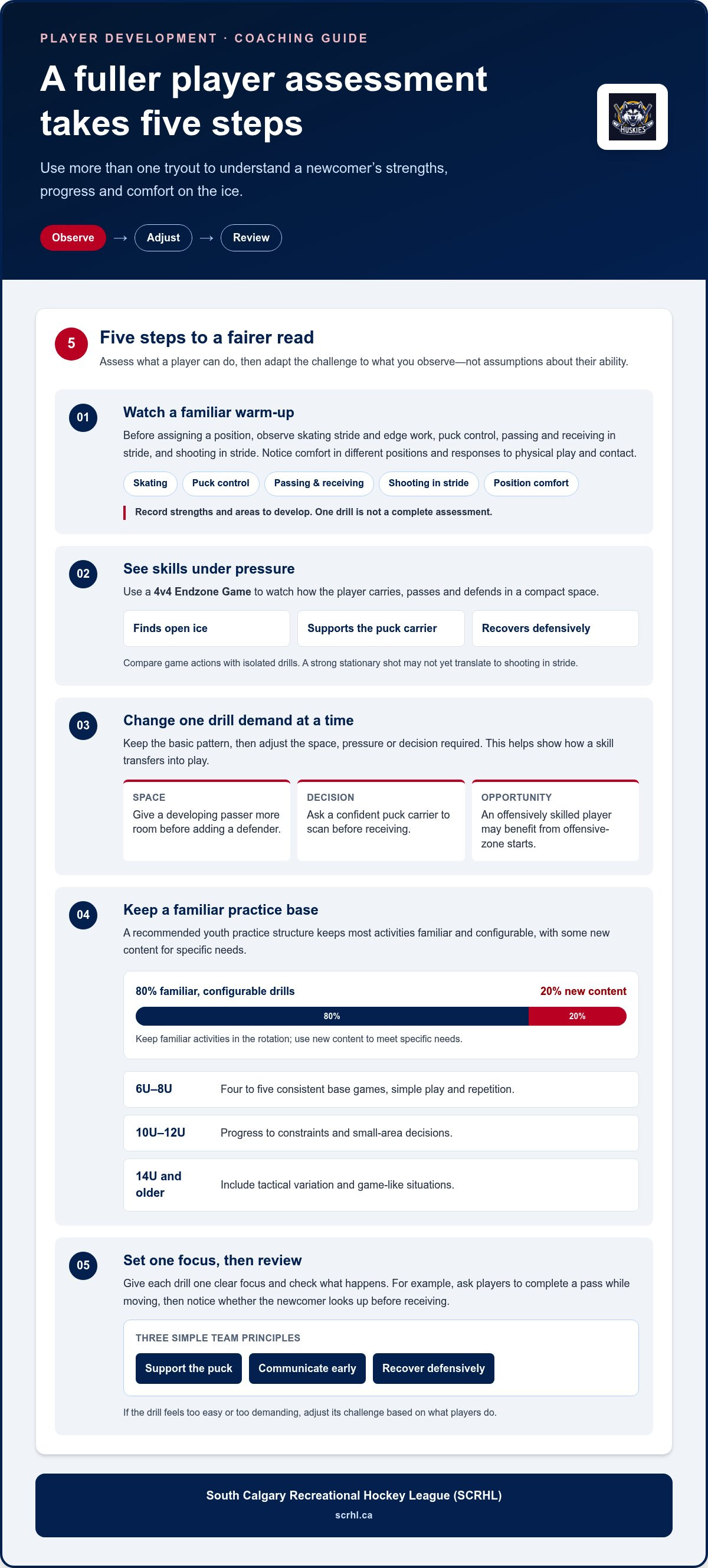
Assess newcomers through skating, puck control, passing, decision-making and comfort in different positions. Hockey Canada recommends individual player assessments because players develop at different rates.
- Watch the player in a familiar warm-up before assigning a position. Note their skating stride, edge work, puck control, passing and receiving in stride, and shooting in stride. Also observe how they respond to physical play and contact. For example, a player may handle passes well but hesitate under pressure. Record strengths and areas to develop instead of treating one drill as a complete assessment. Integrating new players onto a hockey team starts with observing what each person can already do.
- Use a small-area game to observe skills under pressure. A 4v4 Endzone Game creates chances to carry, pass and defend in a compact space. Watch whether the newcomer finds open ice, supports the puck carrier and recovers defensively. Compare those actions with isolated drills. A strong stationary shot, for example, may not yet translate to shooting in stride. Use both settings to identify a suitable starting challenge.
- Change one drill demand at a time. Keep the basic pattern, then adjust the space, pressure or decision required. Give a developing passer more room before adding a defender. Ask a confident puck carrier to scan before receiving. Coaches can also create opportunities suited to a player’s strengths, such as offensive-zone starts for an offensively skilled player. For coaches integrating new players onto a hockey team, small adjustments make it easier to see how a skill transfers into play.
- Keep familiar activities in the practice plan instead of replacing them constantly. A recommended youth practice structure uses 80% familiar, configurable drills and 20% new content for specific needs. For players aged 6U-8U, use four to five consistent base games, simple play and repetition. Players aged 10U-12U can progress to constraints and small-area decisions. For players aged 14U and older, include tactical variation and game-like situations.
- Set one clear focus for each drill and review the result. For example, ask players to complete a pass while moving, then notice whether the newcomer looks up before receiving. Keep shared team principles to three simple ideas, such as supporting the puck, communicating early and recovering defensively. If the drill feels too easy or too demanding, adjust its challenge based on what players do, not assumptions about their ability.
Partner drills that encourage cooperation and communication
Pair drills give newcomers a practical way to learn teammates’ habits while playing. Use each activity to practise a specific exchange, such as calling for a pass or supporting a puck carrier.
- Start with a moving-pass sequence. Pair a new player with a teammate and have them skate parallel, exchanging passes across the ice. Ask the passer to call the receiver’s name before sending the puck. Then switch sides and roles. This gives both players a simple communication cue and lets them practise receiving in stride. If a pass is missed, reset the movement and focus on timing rather than adding pressure.
- Build a give-and-go drill around eye contact and timing. One player carries the puck toward a marker, passes to their partner, then cuts into open space for a return pass. The receiver calls “back” or signals with their stick before returning the puck. Swap the starting role after each attempt. This routine helps a newcomer learn how a teammate signals, moves and expects support during play.
- Practise support options with a puck-protection activity. The puck carrier moves through a marked area while their partner stays available at an angle. The supporting player calls “here” and adjusts position when the carrier changes direction. Switch roles after each turn. Encourage the pair to communicate before pressure arrives, not only after possession becomes difficult. The drill teaches both players to create a passing lane and recognize when support is needed.
- Add a small-area game that rewards cooperation over solo possession. Give each pair a shared objective, such as completing a pass before taking a shot. Pause after a sequence when a player moves into space but doesn’t receive the puck. Ask the pair what call or position could make that option clearer next time. Keep feedback specific: “Call early” gives a player an action to try on the next shift.
- Finish with a brief partner review. Ask each player to name one helpful call they heard and one moment when support arrived at the right time. Then rotate partners during the next practice, so the newcomer learns more teammates’ communication styles. For Calgary adults looking for a setting to play as a team, organized recreational hockey can provide a natural place to put these habits into practice.
Assigning newcomers a clear responsibility
Give a new player a short introduction to the team’s systems, then identify where their skills can help most. A specific responsibility makes expectations easier to follow during practices and games.
- Explain the team’s shared principles before adding detailed plays. Keep the group’s guidance to three simple ideas, such as supporting the puck, communicating early and recovering defensively. Describe what each looks like in play. For example, “support the puck” could mean moving into a passing lane when a teammate carries it. A newcomer can then connect each principle to an observable action.
- Choose one responsibility that fits the player’s current strengths. An effective passer might be asked to look for a safe outlet on their first breakout touch. A strong skater could focus on joining the rush when a teammate has control. Keep the assignment narrow at first. Avoid giving a newcomer several new duties before they understand the team’s positioning.
- Describe the responsibility in a game situation. Instead of saying “play better defensively,” tell a winger to stay available above the puck when their line enters the offensive zone. Explain who they support and what space they should watch. A concrete instruction helps the player act without guessing what the coach means.
- Connect each role to a simple decision. A defenceman might hear, “If the first pass is covered, keep possession and use the boards.” A forward could be asked to move into open ice when a teammate controls the puck along the boards. These examples show the newcomer what to do when the first option isn’t available.
- Check understanding privately before the next drill or shift. Ask the player to describe their responsibility in their own words. If they’re unsure, explain the situation again and walk through it on the ice. For example, point out the forward’s support lane during a slow breakout rehearsal. A quick demonstration can replace a long explanation.
- Review the assignment after the player has tried it. Praise a useful decision, such as choosing a safe pass under pressure, and give one specific correction if needed. Keep corrections focused on the next action. “Scan before receiving” is clearer than a general comment about awareness. Adjust the responsibility as the player learns the system.
- Make the role useful to the full line, not just the newcomer. Tell linemates how they can support the assignment, such as creating a passing option for a player responsible for moving the puck out. This sets a shared expectation. The newcomer contributes to the group, while teammates know how to respond during play.
New players’ concerns and confidence
Ask directly what feels unfamiliar, then respond with clear expectations and practical support. Adjustment depends on how well the player learns the team’s systems, builds connections and gets meaningful chances to play.
-
Discuss Concerns With Players and Families
Arrange a brief conversation with the player and their family before the first game. Explain the team’s basic systems, the player’s initial role and how coaches will share feedback. Ask what concerns the player, such as unfamiliar line changes, positioning or joining an established group.
Listen before offering solutions. If a player worries about making mistakes, describe how coaches will correct decisions privately and recognize effort openly. Keep expectations consistent in conversations with the player and family. Avoid promising a fixed position or result; explain the next practical step instead, such as walking through a breakout during practice.
-
Support New Players’ Confidence
Let the newcomer keep playing to the strengths that brought them success. A player joining a new team doesn’t need to imitate a former teammate or replace someone who has left. Identify one useful contribution, then reinforce it with a specific example, such as choosing a safe pass under pressure or supporting a puck carrier.
Give corrections quietly and privately, and praise effort or good decisions where teammates can hear. If the player hesitates after a turnover, focus feedback on the next action: recover to the defensive position or offer a passing lane. Avoid public criticism or several corrections at once. A clear, manageable cue helps the player respond during the next shift.
-
Allow Time for Team Adjustment
Track adjustment through observable signs, not a fixed deadline. A newcomer may learn line changes quickly but need more playing time to recognize teammates’ habits or read the team’s defensive coverage. Coaches should watch communication, positioning and decisions across practices and games before changing responsibilities.
Use short, regular substitution spells and provide meaningful playing time each week. Avoid alternating a full game with only a brief appearance, which gives the player fewer chances to settle into the team’s rhythm. After games, ask what felt clear and what remained difficult. Use the answer to choose one focus for the next practice, then review progress through the player’s actions.
Pairing new players with experienced buddies
Pair each newcomer with an approachable teammate who can explain routines and make introductions. Use shared practices and social activities to help both players build trust.
-
Teach Team Systems and Expectations
Choose a buddy who communicates clearly and understands the team’s usual systems. Ask them to explain practical details, such as where players gather before practice, how line changes work and what the team expects during a breakout. A newcomer can ask questions one-to-one instead of trying to learn every routine during a fast shift.
Have the buddy demonstrate one system at a time on the ice. For example, during a breakout, they can show where to move when a defenceman retrieves the puck and which passing option to offer. Then let the newcomer practise the same pattern beside them. Avoid long explanations packed with unfamiliar terms. Check understanding by asking the new player to describe their next move.
Keep the buddy relationship practical, not supervisory. The experienced player can clarify team routines, introduce linemates and help the newcomer understand expectations. Coaches still handle instruction and feedback. Invite the newcomer to ask about a specific play after practice, then revisit the movement during the next drill. This gives the player a clear way to learn systems through examples and repetition.
-
Build Chemistry and Prevent Cliques
Mix experienced and new players in small-sided games using the same units planned for game day. Shared shifts create chances to learn each other’s pace, preferred passing options and communication habits. Rotate combinations so newcomers meet teammates beyond one established line. Watch for players who remain isolated during drills, warm-ups or breaks, then make a direct introduction.
Encourage the buddy to invite the newcomer to a team meal or dinner at home. A relaxed conversation away from the rink can make it easier to join team discussions later. Keep invitations open to the group, rather than letting the same circle make plans every time. Coaches can also start a simple post-practice conversation by asking players to name one helpful play they saw from a teammate.
Give both partners a shared task, such as organizing a warm-up passing sequence or communicating during a small-area game. This makes the newcomer an active teammate, not a guest being looked after. Notice whether the player is included in group decisions and receives passes during drills. If not, adjust the groups and invite different teammates to partner with them.
Ready to find a place to play with a team in Calgary? Explore recreational hockey options.
South Calgary Recreational Hockey League (SCRHL): Fall Season Team Registration
South Calgary Recreational Hockey League (SCRHL) offers Fall Season Team Registration for Calgary groups ready to organize their season and play together. A clear team structure gives new and returning players a shared place to build communication, practise familiar routines and develop chemistry over the season.
If you’re joining without a full team, Individual Player Registration is another option. SCRHL also offers Winter Season Team Registration and Morning Hockey Sessions, so players can choose a format that fits their plans. Team registration is the natural next step for a group preparing to play together; individual registration suits a player looking to join recreational hockey independently.
Contact South Calgary Recreational Hockey League or visit scrhl.ca to explore registration options.
Put the next practice plan into action
Treat one newcomer’s first team experience as a chance to improve how the group welcomes future players. Before the next practice, decide who will greet them, which teammate can answer routine questions and what first task will help them join the play. Afterward, note what worked and what caused confusion. Small, practical changes can make team expectations easier to understand.
Keep the conversation open beyond the first skate. A brief check-in can reveal whether the player feels comfortable asking for the puck, understanding line changes or speaking up with teammates. Use that feedback to shape the next practice, rather than assuming silence means everything is clear. Strong team habits grow through consistent actions from coaches and players alike.
Integrating new players onto a hockey team is an ongoing team effort, built through clear communication and shared responsibility. If you’re ready to play recreational hockey in Calgary, contact South Calgary Recreational Hockey League (SCRHL) to explore your next step. Give each newcomer a welcoming start, and help the whole team move forward together.
Frequently Asked Questions
Can a coach sign a player after only one tryout?
A coach may offer a roster spot after one tryout if the team’s selection process allows it. One skate can reveal a player’s current skills, but it gives limited evidence about consistency, communication and performance in different situations. Before deciding, consider observed play alongside the team’s needs and the player’s preferred position. A tryout invitation itself doesn’t mean a roster spot is guaranteed.
How do I stop experienced players shouting at newcomers?
Set a team standard that feedback must help a teammate act, not embarrass them. If a veteran shouts, stop the behaviour and restate the expectation: call for the puck or give a clear positional cue without insults. Speak privately with the player afterward, then check in with the newcomer. For example, replace “You never cover” with “Stay between the puck and the net.”
What ages and levels are affected by the changes?
Skill-based drill adjustments can help players at different ages and experience levels. For 6U-8U, use repetition, simple games and four to five familiar base games. Players aged 10U-12U can work through constraints and small-area decisions. For 14U and older, add tactical variation and practise transferring skills into game situations. These are practice approaches, not eligibility rules or roster changes.
How can a hockey team welcome and integrate new players?
Make the first arrival easy to manage: introduce the player to the person leading the warm-up, show them where the team meets and explain how players receive schedule updates. Share useful team routines before the first shift, such as where to leave personal items and how the group organizes line changes. A named point person helps the newcomer know whom to approach with practical questions.
What are effective onboarding steps for new hockey players?
Start with a short pre-practice orientation. Identify the team’s meeting point, explain how players rotate through drills and give the newcomer a chance to ask about unfamiliar terms. During the skate, introduce teammates by name and demonstrate one routine at a time. After practice, ask which part of the session felt unclear. Use that response to prepare a focused explanation for the next skate.
What are common challenges new hockey players face when joining a team?
New players may struggle to read unfamiliar linemates, learn system terminology or judge when to change lines. They may also feel unsure about joining conversations in an established group. Ask which situation feels hardest, then address it with a direct example. For instance, explain the team’s call for a line change before the next game, rather than expecting the newcomer to infer it during play.
How long does it typically take a new player to adjust to a hockey team?
Adjustment depends on how well the player learns the team’s systems, builds connections and gets meaningful chances to play. Coaches can let the player play first, then make small adjustments over time based on games and video.