

What if the conversation about hockey wasn’t a yes-or-no decision, but a chance to plan together? Trying to convince partner to let me play hockey can feel difficult when you’re both concerned about time, household responsibilities, or the cost of another commitment. Those concerns deserve a clear answer, not a rushed promise.
A calm, specific conversation can help you work out what playing would look like in your shared life. Estimate the time involved, talk through how you’ll handle chores and family plans, and agree on boundaries before registering. You don’t need to settle every detail in one conversation. Start by listening, then build a plan you can both live with.
This guide will help you prepare for that discussion, address common worries, and agree on a schedule and budget that feel manageable. It also covers Calgary recreational options, including Fall and Winter seasons, team or individual registration, and morning, evening, and weekend sessions. The goal is a practical plan that makes room for hockey without leaving your partner to carry extra responsibilities.
Key Takeaways
- To convince partner to let me play hockey, focus on a shared plan rather than winning an argument. Explain why the game matters to you, then listen to your partner’s concerns.
- Choose a calm time to talk, use first-person language, and describe the commitment you’re considering without making assumptions.
- Compare hockey time, household responsibilities, and related spending so you can agree on practical adjustments and clear boundaries.
- Set a trial period and write down the schedule, spending limit, household commitments, and date to review the arrangement.
- Match the agreement to a Calgary recreational option. SCRHL offers adult league registration by team or as an individual, with Fall and Winter seasons and morning, evening, and weekend sessions.
Why playing hockey matters, and what your partner may be worried about
Wanting to return to hockey is reasonable. The game may offer exercise, social connection, routine, or enjoyment. If you’re anticipating a disagreement, though, it can feel uncomfortable to raise the subject. Start with a different goal: understand what worries your partner and work out whether there’s an arrangement that respects both of you.
Hockey can mean different things to each person. You may miss the pace of a game or time with teammates. Your partner may be thinking about late evenings, shared expenses, family duties, travel across Calgary, or the possibility of injury. Those concerns don’t automatically mean they’re against hockey. They may want to understand what the commitment would change at home.
Shared decisions deserve an open discussion. Personal recreation can also matter to your sense of wellbeing and balance. Neither point has to cancel out the other. The aim isn’t to win permission or dismiss a concern. It’s to identify what playing would involve and look for a fair way to make space for it. For context, the sport of ice hockey has a long history and distinct rules, but your reason for playing can be as personal as enjoying time on the ice.
Separate the request from the concern behind it
A quick “no” may be a reaction to the practical impact, not a rejection of hockey itself. Ask a calm, open question: “What part of me playing feels difficult for you?” Then give your partner room to answer. Listen without interrupting, correcting details, or immediately defending your idea. Before proposing a fix, clarify what you heard: “Is the main concern how often I’d be away, or how we’d manage things at home?”
This helps uncover the actual issue. If the worry is family time, a different session time may help. If it’s household workload, a clear plan for sharing tasks may matter more than the rink location. Don’t assume you’ve found the answer until your partner says you understand their concern.
Decide what you are asking for before you talk
Be specific about the commitment you have in mind. Are you hoping to play occasionally, try one season, or join a regular weekly routine? You don’t need every detail settled, but a defined request is easier to discuss than “I want to play more.” If you’re working out how to convince partner to let me play hockey, begin with an honest proposal rather than pressure.
Write down what’s flexible. You might consider a morning session instead of an evening one, or individual registration if you don’t have a full team. Then list the household tasks you can take responsibility for, including when you’ll do them. That gives you a starting point for a balanced conversation, not a promise made in the moment.
- Time: Which days or parts of the week could work?
- Home responsibilities: What will you continue to handle or take on?
- Family plans: Which commitments should stay protected?
- Travel and injury: What specific concern needs a practical discussion?
Bring the list as a conversation aid, not a contract your partner has to accept. Next, compare the real trade-offs together and decide what boundaries would make a trial feel fair.
How to have a constructive conversation about joining a hockey league
A useful conversation has a clear order: choose a calm moment, explain what playing means to you, then ask what concerns your partner. That gives both of you room to speak before you start solving logistics. Avoid raising it during an argument, while someone is rushing out the door, or in the middle of an urgent household task. Pick a time when you can listen without watching the clock.
Choose the right moment and make a clear request
State the commitment you’re considering as plainly as you can. For example: “I’d like to look at playing in one season. I’m still working out which session could fit, and I want us to talk about the impact first.” This is more useful than a vague request or a demand for an immediate yes. Ask an open question: “What would make this plan feel manageable for you?”
First-person language keeps the focus on your experience rather than blame. Try “I miss playing and would like to find a way to make it work,” instead of “You never support what I want to do.” If you’re trying to convince partner to let me play hockey, focus on explaining your reasons and building a workable plan, not applying pressure. The CDC outlines the health benefits of physical activity, which can help you describe why making time for regular movement matters to you.
You could open with: “I’d like to talk about joining a recreational hockey league. Playing matters to me, and I know it could affect our time and responsibilities. Can we talk through what concerns you and see whether there’s an arrangement that works for both of us?” This invites a discussion. It doesn’t assume your partner’s answer or minimize the effect on shared plans.
Listen, reflect, and respond without escalating
When your partner responds, let them finish before you answer. Then summarize the concern in your own words: “It sounds like you’re worried that games could leave you managing more at home. Have I understood?” This gives them a chance to correct your interpretation. Acknowledging a real trade-off isn’t the same as agreeing that you shouldn’t play.
Once you understand the issue, suggest adjustments that address it. If the concern is time together, discuss which plans you’ll protect. If it’s household work, talk about what you’ll handle and when. Keep the focus on the proposed hockey commitment, not a list of past disagreements. If either of you becomes upset, pause rather than pushing for a decision. Agree on a time to return to the conversation.
- Start with your reason: Say what you miss or hope to gain from playing.
- Ask before problem-solving: Find out which part of the commitment feels hardest.
- Check your understanding: Reflect the concern back before suggesting changes.
- Pause if needed: Take a break and set a time to continue the discussion.
When you’re ready to compare practical options, Calgary adult recreational hockey sessions can make the discussion more specific. Explore Calgary adult recreational hockey options as a starting point for matching the commitment to your shared plan.
Compare the real trade-offs: hockey time, shared duties, and spending
A hockey commitment affects more than the time on the ice. Put the likely impacts beside possible adjustments, then agree on a boundary for each concern. This keeps the discussion specific and helps both of you see what would change in day-to-day life.
| Concern | Likely impact | Possible adjustment | Agreed boundary |
|---|---|---|---|
| Time away | Less time for shared plans or household tasks | Compare session options and protect planned time together | Set which existing plans take priority |
| Travel and preparation | The outing may take longer than the ice time alone | Include travel, getting ready, and recovery in the calendar | Agree how schedule changes are communicated |
| Spending | Registration and related hockey costs affect the shared budget | Set a spending limit before choosing a registration option | Discuss any cost beyond the agreed limit first |
| Injury concerns | An injury could affect work, home routines, or recreation | Discuss sensible precautions and what support may be needed | Don’t treat risk as something that can be eliminated |
Make the time commitment visible
Use a shared calendar to map the full outing, not only game time. Include travel, preparation, and time to recover. Morning, evening, and weekend sessions can create different scheduling patterns. Compare the session times with work hours, caregiving, household tasks, and plans already on the calendar.
Agree on a simple communication boundary. For example, decide how much notice you’ll give if a session changes or conflicts with a shared plan. If hockey affects an existing arrangement, discuss the change rather than assuming your partner can absorb it.
Plan spending and responsibilities together
Registration is one part of the budget. Consider travel and other hockey-related spending too. Set a limit together before selecting a season or registration option. If the total commitment changes, return to the budget discussion instead of treating the original agreement as unlimited.
Be just as specific about work at home. Agree which tasks you’ll complete before or after a session and who will cover anything that overlaps with hockey. To convince partner to let me play hockey, show that the plan accounts for both people’s time and responsibilities. Ask whether your partner also wants protected time for their own recreation. A fair arrangement makes room for both, rather than treating one person’s leisure as more deserving.
For injury concerns, separate practical precautions from guarantees. Talk about what risks worry your partner and what reasonable steps could address them. No plan can promise that an injury won’t happen. A useful agreement takes the concern seriously and identifies how you’ll handle a disruption if one occurs.
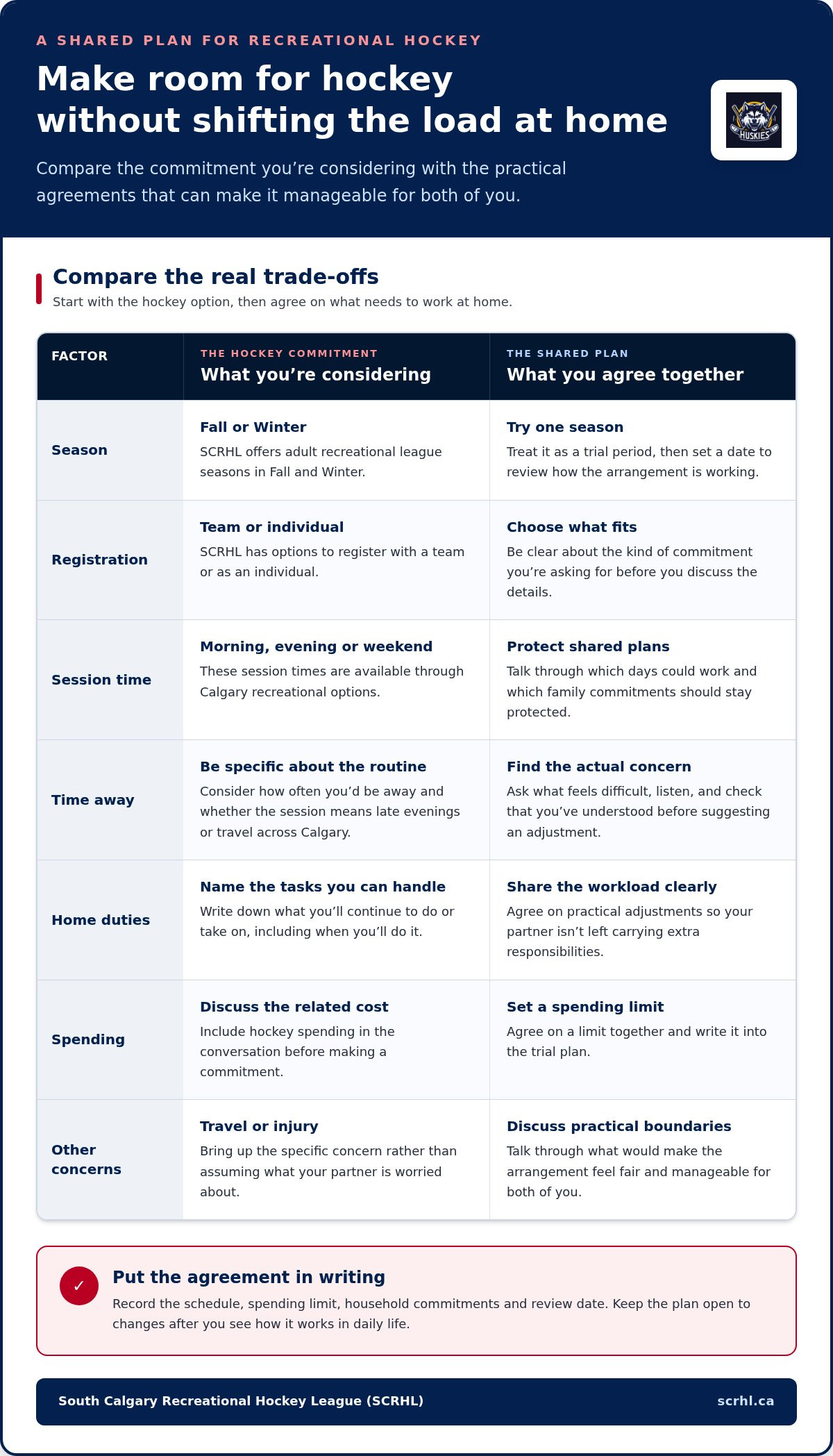
Agree on a low-pressure hockey plan you can review together
A workable agreement doesn’t have to settle every future season. Start with a defined trial, such as trying the routine for an agreed period or reviewing it at the end of a season. The purpose is to see how the plan works in everyday life, not to pressure your partner into a permanent yes.
Write down the basics while you’re both clear on what you’ve agreed to. Include the proposed schedule, shared spending limit, household commitments, and a date to check in. Agree on signs that the arrangement is working, such as completing agreed tasks, communicating schedule changes, and preserving the time together you both value. If you’re trying to convince partner to let me play hockey, a reviewable plan can make the request easier to discuss than an open-ended commitment.
Choose a format that fits your current hockey experience
Consider whether joining an existing roster or registering as an individual better suits your situation. If you already have a team, team registration may fit the plan; if you don’t have a full team, individual registration is another route. Calgary players can read about individual hockey registration expectations or review building a Calgary rec hockey roster when comparing these paths.
Choose based on the commitment you’ve agreed to, not on what sounds easiest in theory. A team plan may involve coordinating with other players. Individual registration may suit someone without a roster. Keep the schedule and budget limits in view as you consider the format.
Set a fair review point
Pick a check-in date that gives you both time to experience the routine. At that conversation, each partner can say what’s working and what needs adjustment. A missed household task or a changed session is a reason to discuss the specific issue, not automatic proof that the whole arrangement has failed. Look for patterns and make a practical adjustment where needed.
If your partner still says no, ask what specific condition would change the discussion. Is the concern the timing, the spending limit, or the effect on family responsibilities? Listen to the answer. If there isn’t a clear condition, don’t keep pressing for an immediate decision. Pause and return to the topic when both of you are ready.
- Write the plan: Record the schedule, budget, household tasks, and review date.
- Define success together: Agree on what a manageable routine looks like for both partners.
- Adjust with care: Treat setbacks as a prompt to review the plan, not assign blame.
Once you’ve agreed on the practical limits, explore Calgary adult recreational hockey registration and compare the team or individual option with your plan.
Find a Calgary recreational hockey option that fits the agreement
Once you’ve agreed on practical limits, compare them with Calgary hockey options. A good fit should work with your schedule and the level of commitment you discussed. Don’t choose based only on the first session time you see. Consider how it fits around work, home responsibilities, travel, and the review plan you’ve agreed on.
Explore adult recreational hockey in Calgary
The South Calgary Recreational Hockey League (SCRHL) organizes adult recreational hockey in Calgary, with team and individual registration. Its sessions include morning, evening, and weekend ice times. Reviewing the adult hockey league Calgary player’s guide together can provide broader local context for the discussion.
Be clear about what you’re comparing. Recreational league registration is for organized adult league play. It’s a different decision from buying hockey equipment or seeking professional coaching. Your experience still matters when choosing an option, so compare the information provided about the season and registration with the commitment you have in mind.
If you have a full team, team registration may be the right option to discuss. If you’re looking to play without bringing a complete roster, individual registration may suit your circumstances. Compare each path against the agreement: Does the commitment fit? Can the session times work with your shared calendar? Is the proposed spending within the limit you both set?
Take the next step as a team
Review the Fall and Winter season information and individual registration details together. Treat this as a fact-finding step, not a decision you have to make on the spot. Note any schedule or commitment details that affect your agreement, then discuss whether they fit. If a detail changes the plan, bring it back to your partner before committing.
If your goal is to convince partner to let me play hockey, a local option can make the conversation concrete: you’re comparing a real recreational league pathway with the time and boundaries you’ve already discussed. Keep the choice mutual. Your partner should have space to raise a concern, and you should be able to explain why playing matters to you.
When you’re ready to explore a Calgary league together, explore adult recreational hockey with SCRHL.
Take the next step together
A decision about hockey doesn’t have to settle every future season. Treat the next step as a chance to build trust: make space for each person’s needs, follow through on what you’ve agreed, and stay open to adjustments as circumstances change. A plan works best when both partners can speak honestly about how it feels in practice.
If you’re trying to convince partner to let me play hockey, focus on creating room for a fair decision, not securing a one-sided win. Your partner’s concerns matter, and so does your wish to take part in something meaningful to you. Keep both in the conversation.
When you’re ready, review SCRHL’s local league information together and decide whether an option fits the agreement you’ve made. Explore adult recreational hockey with SCRHL as a practical next step. Take your time, discuss what you find, and move forward as a team.
Frequently Asked Questions
What if my partner says hockey is too expensive?
Start by finding out which costs concern your partner most. Registration may not be the only consideration; travel and other hockey-related spending can affect the household budget too. Agree on a spending limit, then compare it with current registration information before making a commitment. If the figures don’t fit, discuss whether another season or a different session time would make the overall plan work. Keep the conversation focused on what suits your household, not on who deserves more spending money.
Can I join a Calgary hockey league without already having a full team?
Yes. SCRHL offers individual player registration as well as team registration for organized adult recreational hockey in Calgary. Individual registration gives you a route to explore if you don’t have a complete roster. Review the relevant season information together, since registration details can vary. This may also help narrow the discussion to your own schedule and commitment, rather than asking your partner to plan around a whole team.
How can we make hockey fair if my partner does not play?
Fairness doesn’t require matching hobbies. It means both people’s time and interests receive consideration. Ask your partner if there’s an activity or personal commitment they’d like to protect, then discuss how each person’s plans fit alongside shared responsibilities. For example, compare the next few weeks of commitments and flag conflicts early. This makes recreation part of a shared household plan, rather than a benefit reserved for one person.
Should I promise my partner that hockey will not affect our plans?
No. You can’t guarantee that a schedule will never conflict with something else. Instead, agree on how to enter sessions into your calendar, how you’ll share changes, and which plans you’ll treat as priorities. If a conflict comes up, raise it as soon as you know and discuss a fair response. Following a clear communication routine is more credible than promising there will never be an interruption.
What if my partner is worried I will get injured playing hockey?
Take the concern seriously without promising that injury is impossible. Ask what specifically worries your partner, then discuss your comfort level and the type of play you’re considering. You can talk about sensible precautions, but don’t present them as a guarantee. If you have a personal health concern or a medical question about taking part, seek advice from an appropriate health professional before deciding.
What if we cannot agree after talking about it?
Pause the discussion if it’s turning into an argument, then consider what is keeping you apart. Is the disagreement about a specific issue, such as a schedule conflict, or does it point to a wider relationship concern? A smaller, time-limited arrangement may help test a practical solution. If conversations repeatedly feel hostile or controlling, prioritize your wellbeing and consider speaking with someone you trust for support.