

What if making friends on a hockey team doesn’t depend on being the most skilled player or the loudest person in the room? Making friends as a new hockey player in Calgary can feel daunting when teammates seem to know one another already, or you’re unsure what to say before and after a game. Differences in experience can add to that uncertainty. But connection doesn’t have to happen all at once. Familiarity grows through small, repeated interactions on and off the ice.
This guide shares practical ways to feel more at ease when joining a team, start simple conversations, and connect with teammates without forcing it. You’ll also learn how to think about skill differences and choose a recreational hockey setting that fits your experience and schedule. In Calgary, organized adult hockey provides recurring sessions where players can get to know one another over time. If you don’t have a full team, individual registration is an option. The South Calgary Recreational Hockey League offers morning, evening, and weekend sessions.
Key Takeaways
- Making friends as a new hockey player in Calgary starts with small, familiar interactions, not an instant connection.
- Use warm-ups, line changes, and post-game routines as natural openings for conversation with teammates.
- Compare league play, pickup hockey, and learn-to-play programs to find a structure and social pace that suits you.
- Arrive prepared, introduce yourself, communicate clearly on the ice, and follow up after the session.
- Explore SCRHL’s individual or team registration for Fall and Winter adult recreational hockey in Calgary.
Starting Over on the Ice: Why Making Friends as a New Hockey Player Can Feel Awkward
Joining a team can feel harder when teammates seem to know one another already. They may greet each other by name, follow familiar routines, or chat easily in the dressing room. As the new player, you’re still learning names, team customs, skill expectations, and where to go. It’s natural to wonder whether you’re fitting in.
Friendship isn’t an entry requirement. You don’t have to arrive with a teammate or become close with everyone right away. Comfort often grows as faces become familiar and shared routines make conversation easier. A newcomer-friendly hockey environment is organized and respectful, with room for players to communicate and get to know one another at their own pace. That won’t create instant friendships, but it gives you a practical place to start.
Is it normal to feel like the new person on a hockey team?
Yes. A quiet teammate may be concentrating on the game, getting ready, or feeling shy themselves. Silence isn’t always a sign of disinterest. Focus on getting settled and learning how the group communicates. A quick greeting or a simple question about the next drill can be enough for a first exchange.
Ice hockey has its own shared language and routines. If you’re still getting comfortable with the sport, Ice Hockey on Wikipedia offers general background on the game. You don’t need to know every custom before taking part. Regular shared ice time creates natural chances to connect, one greeting or conversation at a time.
What helps a new player feel included?
Start with what you can control: communicate clearly on the ice, play respectfully, and introduce yourself to a teammate or two. A simple “Hi, I’m new to the team” gives others an easy way to respond. Notice who seems open to a chat, while remembering that not everyone socializes in the same way.
Feeling included isn’t a test of skill or outgoingness. You can be a quieter player, still be learning, and contribute to a positive team atmosphere. Follow the play, listen to teammates, and offer a brief thank-you after a helpful pass or clear instruction. Small, considerate moments repeated across sessions can make the next interaction feel more natural. For making friends as a new hockey player in Calgary, aim for steady familiarity rather than pressure to click immediately.
How Calgary Hockey Routines Turn Familiar Teammates into Friends
Seeing the same teammates at regular sessions gives connection room to grow. The first time, you might only exchange names. At the next skate, you recognize someone on the bench. After a few shared games, a quick greeting can turn into a question about the last play or how the team is doing. No big conversation is required.
Hockey creates natural moments to speak. Before play, you can chat while warming up or getting ready. During line changes, a quick call helps everyone stay organized. After the game, a short comment about a good pass or a close shift can carry into the dressing room. These small exchanges help build familiarity without taking attention away from the game.
Connection doesn’t happen only on the ice. The bench and dressing room offer quieter opportunities to learn names, share a laugh, or ask a practical team question. Keep it brief and follow the other person’s lead. Some teammates will be ready to chat; others may prefer to focus before or after play.
Use small, repeatable moments to start conversations
Make the first exchange easy. Introduce yourself by name, then ask a hockey-related question such as, “How long have you played with this team?” or “Do we usually warm up together?” After a shift, thank a teammate for a pass, useful tip, or clear call. These comments are specific and natural, so neither person has to keep the conversation going if the timing isn’t right.
“Shared ice time makes conversation easier because familiar faces give you a natural place to start.”
Make consistency work with your Calgary schedule
Choose a session time you can realistically attend. Morning hockey may fit before a workday; evening sessions may suit after-work routines; weekend sessions can work better around weekday commitments. Consider family plans and your commute before settling on a schedule. A session that regularly fits your week is easier to keep than one that adds stress.
Predictable attendance helps teammates recognize you and makes small interactions build on one another. You don’t need to be at every skate to become familiar. Showing up consistently when your schedule allows gives the group more chances to connect through warm-ups, line changes, and post-game routines. For recurring adult hockey in Calgary, explore adult recreational hockey sessions with the South Calgary Recreational Hockey League.
League Play, Pickup Hockey, or Learn-to-Play: Which Calgary Setting Suits a Newcomer?
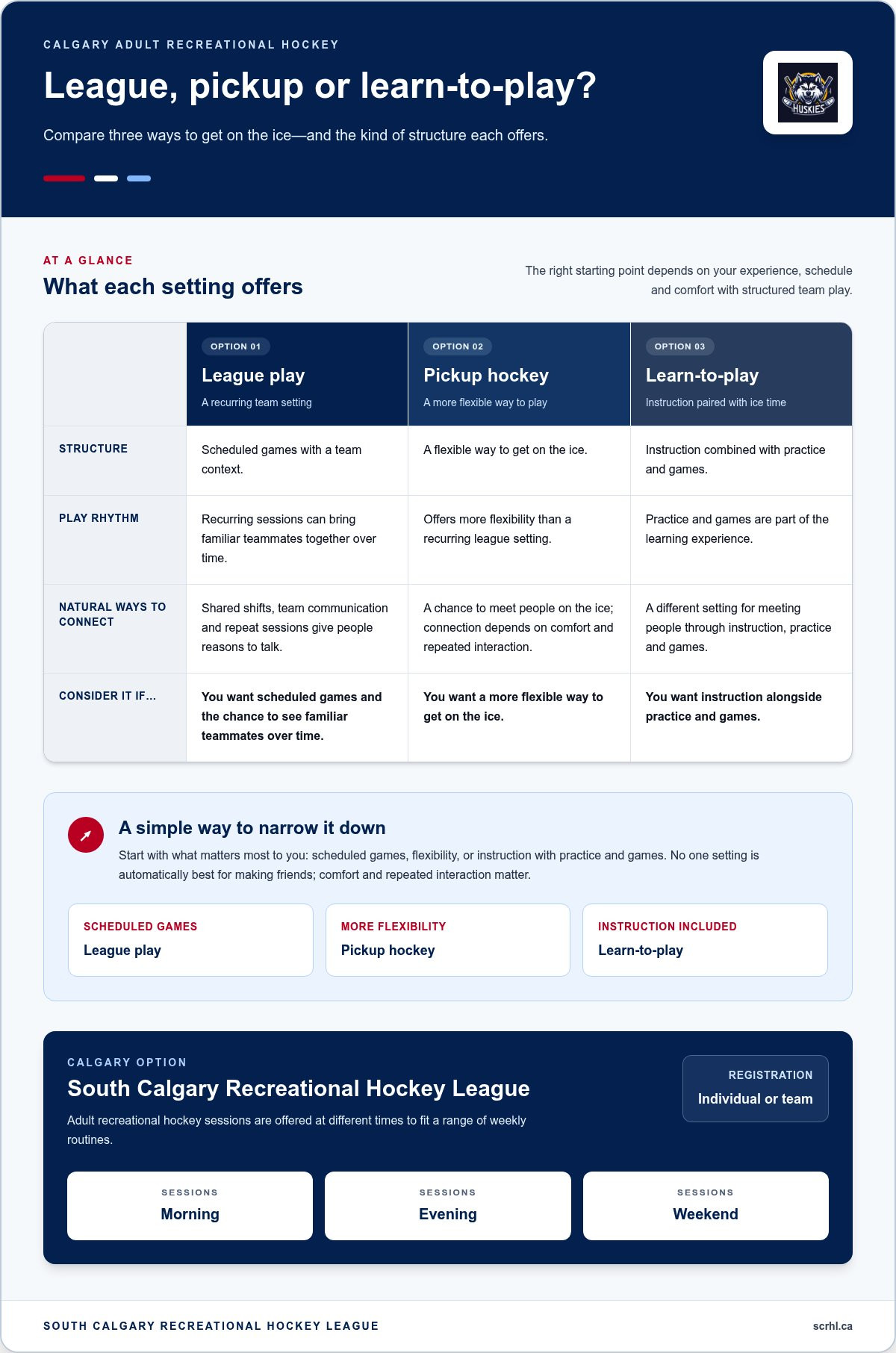
The right starting point depends on your experience, schedule, and comfort with structured team play. A recurring league offers a set team context. Pickup hockey can be a more flexible way to get on the ice. Learn-to-play programs pair instruction with practice and games. None is automatically the best route for making friends as a new hockey player in Calgary. Each creates different opportunities to meet people, and connection still depends on comfort and repeated interaction.
When organized adult league play may be a good fit
League play suits players who want scheduled games and the chance to see familiar teammates over time. Shared shifts, team communication, and recurring sessions give people natural reasons to talk. You don’t need to arrive with a full roster: SCRHL offers individual player registration, as well as team registration, for its Fall and Winter seasons. The league organizes adult recreational hockey in Calgary. For broader context on choosing a local league, read an adult hockey league Calgary player guide.
When pickup or learn-to-play may suit a different starting point
Pickup hockey may work for players who prefer to join games without committing to a full season. The group and social mix can vary from session to session, so pickup can offer flexibility but less continuity with the same teammates. That can be useful if your schedule changes often or you want to try playing with different people before choosing a regular team setting.
Learn-to-play programs suit adults who want instruction alongside other beginners. They offer a learning-focused setting to practise fundamentals and build confidence before taking on more structured team play. If your main concern is contact and playing style, explore a non-contact hockey league guide to understand that format.
Before deciding, consider how much structure you want, how often you can attend, and whether you’d rather learn skills or settle into a recurring team. SCRHL organizes adult recreational league play, with morning, evening, and weekend sessions to fit different schedules. Choose the setting that feels manageable and works with your week. It can create opportunities to connect, but no format guarantees friendship.
What to Say and Do at Your First Calgary Hockey Sessions
A simple plan can take some pressure off your first skate. Arrive prepared, find the dressing room, and give yourself enough time to get settled before heading to the ice. If you’re unsure where to go or how the team gets organized, ask a practical question. It’s a straightforward way to learn the routine and start a conversation.
Once play begins, listen for calls and communicate clearly with your teammates. Keep your play respectful and focused on the group. After the game, thank someone for a useful pass or clear call. These steps help you take part without needing to be the most experienced or outgoing player.
Three easy ways to connect in your first game: introduce yourself, make a clear call on the ice, and thank a teammate after a helpful play.
Easy conversation starters for the rink
Keep an opening relevant to the moment. You might ask, “What position do you usually play?” or “Is this your regular session?” A brief introduction gives the other person context: “I’m new to the team,” “I’ve just moved to Calgary,” or “I’m getting back into hockey.” You don’t need to explain your whole story.
Let the conversation set its own pace. A short answer may mean a teammate is focused on getting ready, not that they don’t want to talk. A quick exchange can be enough for the first session. If you see them again, you’ll have an easy point of connection.
How to handle nerves, mistakes, and different skill levels
Nerves can make every pass or missed play feel more noticeable than it is. Mistakes are part of recreational hockey. Reset calmly, get back into position, and focus on the next shift. Clear calls such as “I’m open” or “change” help teammates respond and keep play coordinated. Supportive communication helps the group stay focused on playing together.
Skill levels can vary, so prioritize awareness and teamwork over trying to prove yourself. If you’re uncertain about where your experience fits, read a Calgary hockey league divisions guide for more context on level options. Feeling comfortable on a team takes time, and making friends as a new hockey player in Calgary doesn’t depend on getting every play right.
If you’re ready to take part in organized adult hockey, explore Calgary hockey registration options with the South Calgary Recreational Hockey League.
Find Your Place in Calgary Recreational Hockey with SCRHL
Joining an organized league gives you a regular team setting and a reason to return to the ice. The South Calgary Recreational Hockey League (SCRHL) organizes adult recreational hockey in Calgary, with individual and team registration for Fall and Winter seasons. Morning, evening, and weekend sessions provide schedule options to weigh against work, family, and other commitments.
Choosing a session that fits your routine can make it easier to attend regularly. Familiarity builds through showing up, sharing the ice, and getting to know teammates over time. There’s no need to expect a close friendship after one game. For making friends as a new hockey player in Calgary, a consistent place to play offers a natural setting for low-pressure interactions.
Joining as an individual when you do not have a team
You don’t need to arrive with a full roster to explore organized league hockey. Individual registration gives players without a team a route into league participation. It’s a practical option if you’re new to Calgary, returning to hockey, or simply don’t have a group ready to register together.
Individual registration is a starting point, not a promise of a particular team placement or social outcome. Learn what to expect from the process in a guide to individual hockey registration in Calgary. As you consider the next step, think about the session times you can attend and the kind of recurring schedule that fits your life.
Turn the first game into the start of a routine
After you join, keep the first goal simple: attend when your schedule allows, learn a few names, and take part in team routines. Small signs of connection might include a familiar greeting, a teammate making room on the bench, or an easy conversation after play. These moments can grow gradually, and they won’t look the same for every player.
Give yourself time to settle in. Some connections begin with a shared shift or a quick exchange about the game. Others take longer to develop. You can contribute by communicating clearly, playing respectfully, and returning for the next session when it works for you. Explore SCRHL hockey registration for individual and team registration for Calgary’s Fall and Winter seasons.
Make Your Next Step a Comfortable One
Making friends as a new hockey player in Calgary doesn’t require an instant connection. Start with a greeting, a clear call on the ice, or a quick chat after the game. Then give familiarity time to grow through shared sessions and team routines.
The right setting should fit your experience and schedule. The South Calgary Recreational Hockey League organizes adult recreational hockey in Calgary, with individual and team registration for Fall and Winter seasons. Morning, evening, and weekend sessions offer options to consider as you plan your week. Individual registration can be a starting point if you don’t have a full team.
Choose a session that works for you, introduce yourself, and focus on enjoying the game. Small interactions count, and every player settles in at their own pace. Explore SCRHL hockey registration and take the next step towards a regular place on the ice.
Frequently Asked Questions
How do you make friends on a new hockey team?
Build connections through small, repeated interactions rather than trying to become close with everyone right away. Introduce yourself, learn a few names, and use natural moments such as warm-ups, line changes, or the post-game routine to chat. A quick thank-you for a pass or helpful call can start things off. Making friends as a new hockey player in Calgary takes time, and regular shared ice time can make conversation feel more comfortable.
Is it hard to join an established adult hockey team in Calgary?
It can feel awkward at first, especially if teammates already know one another, but you don’t need to arrive with an existing social connection. Give yourself time to learn names and team routines. Joining an organized league means taking part in scheduled team play, while clear communication and respectful play can help you settle in. Each team and player is different, so focus on getting comfortable one session at a time.
Can I join a Calgary hockey league if I do not know anyone?
Yes. You can explore individual registration instead of bringing a full team. The South Calgary Recreational Hockey League offers individual and team registration for its Fall and Winter seasons. Individual registration is a route into organized adult recreational hockey, but it doesn’t guarantee a particular team placement or social outcome. Once you begin playing, introduce yourself and take part in team routines to build familiarity over time.
What should I say to teammates at my first hockey game?
Keep it simple and relevant to the game. Try, “Hi, I’m new to the team,” “What position do you usually play?” or “How does the line change work here?” You can also briefly mention if you’re new to Calgary or returning to hockey. Listen to the response and don’t worry if the conversation is short. A greeting before play and a thank-you afterwards are useful first steps.
Is recreational hockey a good way to meet people in Calgary?
It can be a good setting for meeting people because teammates share games, routines, and time on the ice. An organized league also brings players together on a recurring schedule, which can make it easier to recognize familiar faces and continue conversations. Friendships aren’t guaranteed, and people connect at different speeds. Take part for the hockey as well as the social opportunity, and let relationships develop naturally.
How can a beginner feel more comfortable in an adult hockey league?
Prepare before your first session, arrive with time to find the dressing room, and ask practical questions if a team routine is unclear. On the ice, listen, communicate clearly, and focus on safe, respectful play. Mistakes happen; reset and concentrate on your next shift. You don’t need to be the most skilled or outgoing player to contribute. Consistent attendance can help the team and its routines feel more familiar.
Are there morning, evening, and weekend adult hockey sessions in Calgary?
Yes. The South Calgary Recreational Hockey League offers adult recreational hockey sessions in the morning, evening, and on weekends. These options can help players consider how hockey fits around work, family, and other commitments. Think about which option you can attend consistently. A regular routine can give you more chances to play with familiar teammates and connect through shared team activities.