

A strong game can be a poor reason to move up. Moving up a division in rec hockey should come down to habits you can repeat, not a scoring streak or a few shifts where everything clicks. It’s natural to want a faster challenge, but division names and skill expectations vary between Calgary leagues, and a bigger jump can mean less puck time.
You don’t need to guess based on goals alone. A practical readiness check can help you decide whether to move up, stay in your current division or take another season to develop. Look at how consistently you keep pace, make plays under pressure, support teammates and recover when the game speeds up.
This guide compares those signs with the likely trade-offs of each choice, so you can decide based on your full season, not one standout night. It also covers practical next steps in Calgary recreational hockey. The South Calgary Recreational Hockey League (SCRHL) offers adult play with team and individual registration for Fall and Winter seasons, plus morning, evening and weekend sessions to consider as you plan your next season.
Key Takeaways
- Division labels vary by league, so compare the pace and level of play rather than relying on A, B, C or D labels.
- Use a game-to-game checklist for skating, puck control, passing choices, defensive positioning and how you recover after mistakes.
- Moving up a division in rec hockey may suit you if you can stay effective under pressure, not just keep up during easier shifts.
- Weigh the challenge of a higher level against the puck time and development you may gain by staying where you are.
- Bring concrete examples of your pace, decisions and team contribution into a division-fit discussion, then reassess after playing.
What moving up a division in rec hockey really means
Moving up means joining a group with a higher competitive standard. The change may bring quicker transitions, more pressure on the puck and less time to choose a pass or take a shot. It isn’t a promotion that proves your worth as a player. It’s a decision about which level of competition is likely to suit your current game.
That distinction matters in Calgary, where division names and skill expectations depend on the league. One league’s “B” division may not match another’s. Some leagues use letters; others use different labels or structures. Division names alone can’t establish readiness because each league sets its own standards for the players it groups together.
Before considering moving up a division in rec hockey, focus on what the games ask you to do. Can you keep contributing when opponents close space quickly? Do you remain useful without scoring? A higher division may provide a welcome challenge, but the right fit is one where you can take part, make plays and keep learning.
Why recreational leagues use divisions
Divisions group players to help create more balanced games. When teams are closer in overall ability, developing players can build confidence and practise skills under game conditions. More experienced players can face tougher competition and stay engaged. The goal isn’t to make every shift equal. It’s to reduce large skill mismatches that can make games less enjoyable for both sides.
Leagues set their own divisions and use their own labels. There’s no standard number of levels that applies everywhere. For background on the sport’s structure and formats, see this overview of Ice hockey. Treat a division label as a starting point for understanding the level of play, not as a direct measure of your ability.
What a higher division can change
A faster game can mean less time to settle the puck, scan for a passing option or recover after a turnover. You may need to read plays earlier and make decisions while under pressure. The effect depends on the league and the players in that division. A higher level doesn’t guarantee more ice time or a better experience; it may also mean fewer chances to handle the puck or influence a play.
Consider what you want from your season. If you’re looking for more challenge and can still make sound plays at a quicker pace, a higher division may be worth considering. If you’re often chasing the play or struggling to contribute, staying where you are can give you more opportunities to develop. Neither choice is a verdict on your potential. It’s a practical assessment of fit for now.
How to assess whether you’re ready to move up
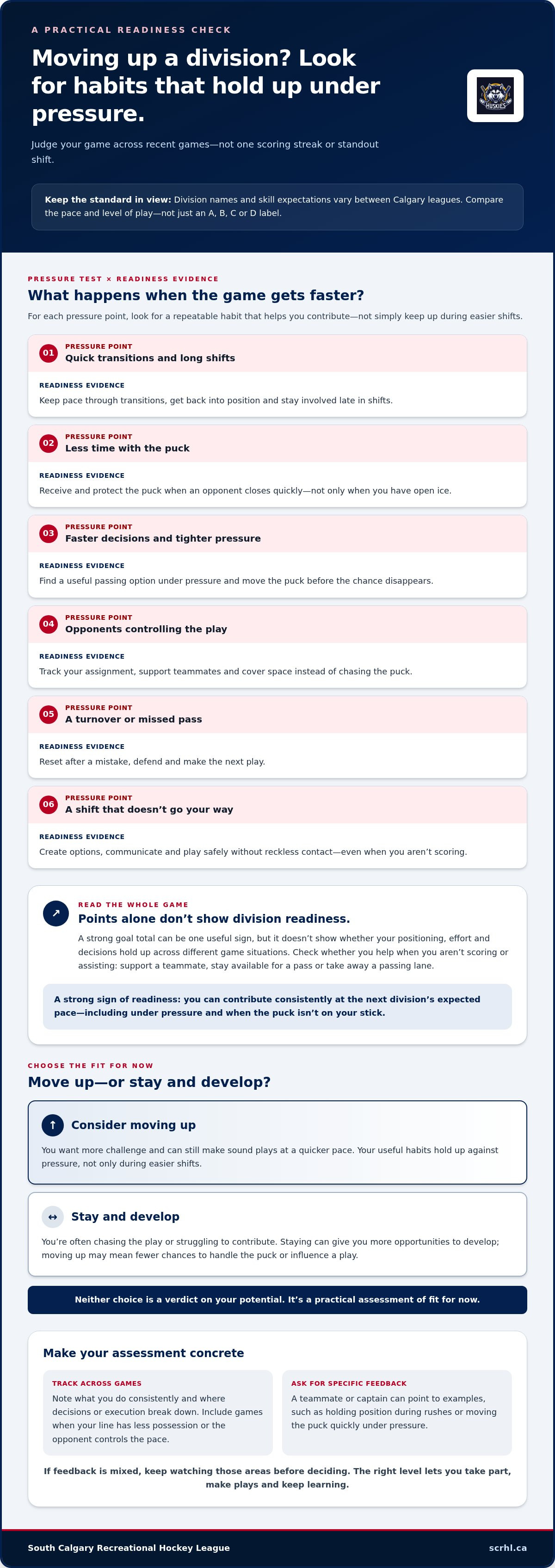
Judge your game across a run of recent games, not one standout shift or a night when you scored. Moving up a division in rec hockey makes sense when your useful habits hold up against faster play and tighter pressure. Look for repeatable evidence, including games where your line has less possession or the opponent controls the pace.
Use this checklist after games. Note what you did consistently and where your decisions or execution broke down:
- Skating: Can you keep pace through transitions, get back into position and stay involved late in shifts?
- Puck control: Can you receive and protect the puck when an opponent closes quickly, rather than relying on open ice?
- Passing decisions: Do you find a useful option under pressure, or hold the puck until the chance disappears?
- Defensive positioning: Do you track your assignment, support teammates and cover space instead of chasing the puck?
- Recovery after mistakes: After a missed pass or lost puck, can you reset, defend and make the next play?
- Team contribution and control: Do you create options, communicate and play safely without reckless contact?
Readiness means contributing consistently at the next division’s expected pace, including when you’re under pressure and the puck isn’t on your stick. A strong goal total can be one useful sign, but it can’t show whether your positioning, effort and decisions are dependable across different game situations.
Look for consistency beyond points and goals
Ask whether you help your team when you aren’t scoring or assisting. Are you available for a pass, supporting a teammate along the boards or taking away a passing lane? Consider whether those choices still work against stronger opponents. Consistent effort matters too: a good shift shouldn’t depend on the game going your way. Look for sound positioning during defensive-zone pressure, neutral-zone transitions and offensive chances.
Check pace, control and team play
A faster pace shouldn’t require you to abandon control. If keeping up means reaching in, making risky plays or using unnecessary contact, that’s a sign to keep developing. Check whether you can move the puck cleanly, make a timely pass and read developing plays as the game speeds up. Recreational hockey is a team game, so assess whether your choices help linemates as well as your own shift.
Ask a teammate or captain for specific examples, not just a confidence boost. “You’re ready” is hard to act on. “You kept your position during their rushes and moved the puck quickly under pressure” points to habits you can evaluate across games. If feedback is mixed, keep tracking those areas before deciding. Players considering a different fit can also explore adult recreational hockey in Calgary as they plan their next season.
Move up now or stay and develop? Compare the two options
There isn’t one right time to move. Compare how you play now with what the next level is likely to demand, then weigh the challenge against the chance to keep building your game. The choice should support competitive balance and enjoyment, not serve as a measure of your value as a player.
| Choice | Readiness signs | Likely benefits | Possible challenges |
|---|---|---|---|
| Move up | You stay effective at a quicker pace, make decisions under pressure and contribute in more than one role. | Stronger competition can test your reads, puck control and ability to support teammates. | You may have less time with the puck, fewer scoring chances or shifts where it’s harder to influence play. |
| Stay and develop | You’re still working on consistent skating, puck control, positioning or decisions when pressured. | More regular involvement can help you practise skills in game situations and build confidence. | You may want a greater challenge, especially if your current games no longer test your habits. |
When moving up may be the better fit
A higher division may suit you if your effectiveness isn’t limited to games where you dominate less experienced opponents. You can handle the pace, make controlled plays under pressure and contribute even when you aren’t carrying the puck. Consider whether you can adjust to different roles, such as supporting a rush, covering defensively or creating space for a teammate. Strong statistics can prompt a closer look, but they don’t prove readiness on their own.
Think about the shifts where the game is difficult. If you can still read developing plays, recover after a mistake and make useful decisions, the added challenge may help you keep progressing. Expect some adjustment. The aim isn’t to control every shift, but to remain involved and contribute to the team.
When staying can help you improve
Another season at your current level can be a sound development choice. It may give you more chances to handle the puck, try a pass or build confidence without feeling rushed on every play. Staying can make sense if basic skills still vary from game to game, or if pressure causes you to lose positioning or rush decisions. That’s information to work with, not a reason to feel behind.
Enjoyment matters. If you’re engaged, contributing and learning, staying can be a better fit than moving into games where you struggle to get involved. A slower decision isn’t a failure. Moving up a division in rec hockey should serve your development and the quality of competition, not a status goal. Reassess as your game becomes more consistent and the next level feels like a challenge you can meet.
How to plan and discuss a division move in Calgary
A division move is easier to discuss when you can point to what happens on the ice. Start with a few recent games, note repeatable examples, then talk about competitive fit. Placement and roster decisions are specific to each league and team, so keep your discussion focused on the level of play you’re seeking and the evidence from your own games.
- Review recent games. Look across different opponents and game situations, not just a win or a strong scoring night.
- Identify evidence. Record examples of how you manage pace, make decisions under pressure and contribute to team play.
- Discuss fit. Share those examples with the appropriate team or league contact, and explain why you think the level may suit you.
- Reassess after playing. If you move, use your next games to judge whether the new pace is challenging but manageable.
Prepare a clear case for a different level
Keep the conversation practical. For example, describe how you supported a rush, made a controlled pass while pressured or maintained defensive position during a difficult shift. Include examples from multiple games. Avoid framing the request around status or personal statistics alone. The useful question is whether the move could support a fair, competitive game for you and the players around you.
For broader local context, the Calgary adult hockey league guide can help you understand the recreational options available in the city. Use it to inform your planning, while keeping your division discussion specific to the league and team involved.
Use the next games as a reality check
After a move, set simple goals before each game. Focus on making a timely pass, holding your defensive position and staying involved even when the puck is elsewhere. Review those goals after playing. Are you still making useful decisions as the pace changes? Can you contribute without forcing plays? Do you feel challenged while remaining engaged in the game?
Give yourself a fair assessment, not a verdict based on one shift. If you’re a captain, consider how a player’s move affects team balance and roles. The Calgary rec hockey roster guide offers team-planning context for that conversation. Keep the focus on fit and a good experience for the group.
Ready to plan your next season around the kind of recreational hockey that suits you? Explore adult recreational hockey in Calgary, including team and individual registration options.
Find a recreational hockey fit with SCRHL in Calgary
Once you’ve assessed your game, choose a recreational hockey setup that fits your playing goals and schedule. The South Calgary Recreational Hockey League (SCRHL) organizes adult recreational hockey in Calgary, with Fall and Winter seasons and morning, evening and weekend sessions. These options give you different ways to plan when you play. Your division fit remains a separate consideration from your preferred season and session time.
Moving up a division in rec hockey is only one way to seek a better fit. The right choice also depends on how you want to participate, whether you already have a team and which session times work with your other commitments. Decide what you’re looking for before comparing registration paths.
Choose a season and registration path
Team registration can suit an established group that wants to play together. Individual registration is an option for a player joining without a full team. The two paths provide different starting points, but choosing one does not determine your division. Keep your readiness assessment separate from the registration choice, and consider how your preferred role and playing level fit your plans.
SCRHL’s Fall and Winter seasons offer a seasonal planning choice. Morning, evening and weekend sessions give you schedule options to weigh alongside your hockey goals. Think about the routine you can maintain through the season. A session that works consistently may be a better fit than one that looks ideal on paper but conflicts with work or other commitments.
If you’re considering individual registration, the individual hockey registration guide can help you understand that starting point. Use it as part of your planning, then consider what you want from your season: a faster challenge, more chances to handle the puck, or a balanced mix of competition and participation.
Keep the focus on fair, enjoyable competition
A suitable level should challenge you while still giving you room to contribute. That balance can look different from player to player. Progress might mean moving into faster games, or it might mean becoming more consistent in your current setting. A higher division isn’t the only marker of improvement. Enjoyment, team contribution and a pace that lets you stay involved matter too.
Before you register, make a short list of what you want from the season: your preferred session times, whether you’re joining with a team or as an individual, and the kind of competition you’re seeking. This gives you a practical basis for comparing options without tying your registration choice to a specific division.
Ready to plan your next season? Explore SCRHL registration options and choose the adult recreational hockey path that fits your goals and schedule.
Make your next season a deliberate step
Choose a season goal that goes beyond changing divisions. You might aim to make quicker decisions, support teammates more consistently or feel comfortable taking on a new role. A clear goal gives you something useful to work towards, whether you move now or give yourself more time to develop.
Moving up a division in rec hockey is one possible next step, not the only sign that your game is progressing. Treat your choice as a practical decision you can review as your experience grows. The best fit should keep you engaged and give you room to contribute.
When you’re ready to plan your next season, choose a registration path that suits your situation. Explore SCRHL registration options and take your next step towards a season that feels right for you.
Frequently Asked Questions
Is there a standard skill level for each rec hockey division?
No. Division names and skill expectations are set by each league, so a label such as “B” doesn’t mean the same thing everywhere. In Calgary, compare the actual level of play rather than assuming divisions align across leagues. If you’re changing leagues, describe your recent experience, position and playing goals to explain the kind of fit you’re looking for. Each league organizes its own divisions.
Can I move up a division in the middle of a season?
That depends on the league’s process, roster considerations and whether a change can be managed fairly during the season. A player may not be able to move simply by request. Mid-season adjustments also affect team balance, so consider those factors when discussing a change. If a move isn’t practical during the season, use the remaining games to gather examples that can inform your next registration decision.
How do I know if I’m ready to move up in rec hockey?
Consider whether you can stay involved when opponents close down space, rather than judging readiness by goals alone. For example, can you receive a pass cleanly, make a useful next play and recover if possession changes? Moving up a division in rec hockey may fit if those habits hold up against stronger competition. If they disappear under pressure, more time developing them could make the next step more rewarding.
Should a whole team move up if only a few players are ready?
Not automatically. A team move affects every player, so consider whether the group as a whole can compete at the faster level. If a few players are ready but others are still developing, a higher division could leave part of the roster struggling to stay involved. Captains can discuss the team’s overall balance and goals before making a decision, keeping fair competition in view for both the roster and its opponents.
Will I get less ice time if I move up a division?
Not necessarily, but a division change doesn’t guarantee the same ice time or role. Your shifts can depend on team size, line rotation, attendance and game situations. Even with similar shift time, you might handle the puck less if opponents apply pressure quickly. Before moving, think about whether you’ll still enjoy contributing through positioning, puck support and defensive work, even if scoring chances are less frequent.
What should I do if the higher division feels too difficult?
Give yourself a clear way to assess the adjustment. After games, note where you’re getting caught out, which plays are difficult to read and what’s improving. Ask a teammate for specific feedback, such as whether you’re arriving in position or moving the puck earlier. If the level continues to limit your involvement, consider whether a different placement would help you stay engaged and contribute.
Can I join a Calgary recreational hockey league as an individual player?
Yes, individual participation is an option in Calgary adult recreational hockey. Before choosing where to play, write down your position, recent playing experience and preferred session times. This gives you a practical way to compare league schedules with your availability and describe the kind of hockey you’re looking for. If you’re new to organized adult play, consider what pace will challenge you while still letting you stay involved.