

A goalie’s value in recreational hockey goes beyond stopping pucks. The perks of being a goalie in a Calgary rec league include an active role in every game, close teamwork and regular chances to connect with other players. Your decisions matter, and you’re part of a team working toward the same goal.
Taking on the position also raises practical questions. You may wonder how teams work with goalies, what the role involves and how playing can help you feel part of a hockey community. These are useful things to consider before choosing a season or joining a team.
This article explains how playing goalie can build team connection, what to expect from recreational hockey and how Calgary league options can help you find a fit. You’ll get a clear picture of the social benefits and responsibilities, so you can decide whether getting between the pipes suits your goals.
Key Takeaways
- See how a goalie’s steady involvement can build trust and stronger connections with teammates.
- Understand why goalie openings depend on team needs and how wait-listed players may be contacted about placement.
- Learn how a substitute shift can offer ice time without guaranteeing a full-season team spot.
- Explore seasonal team and individual registration, including morning hockey sessions, through the South Calgary Recreational Hockey League.
Team community and social connections
One of the perks of being a goalie in a Calgary rec league is having a distinct role in the game’s decisions. A save can keep a close score intact. A clear call can help a defender decide whether to cover the post or challenge a shooter. These moments give teammates practical reasons to communicate and learn each other’s habits through repeated shifts, not just introductions before puck drop.
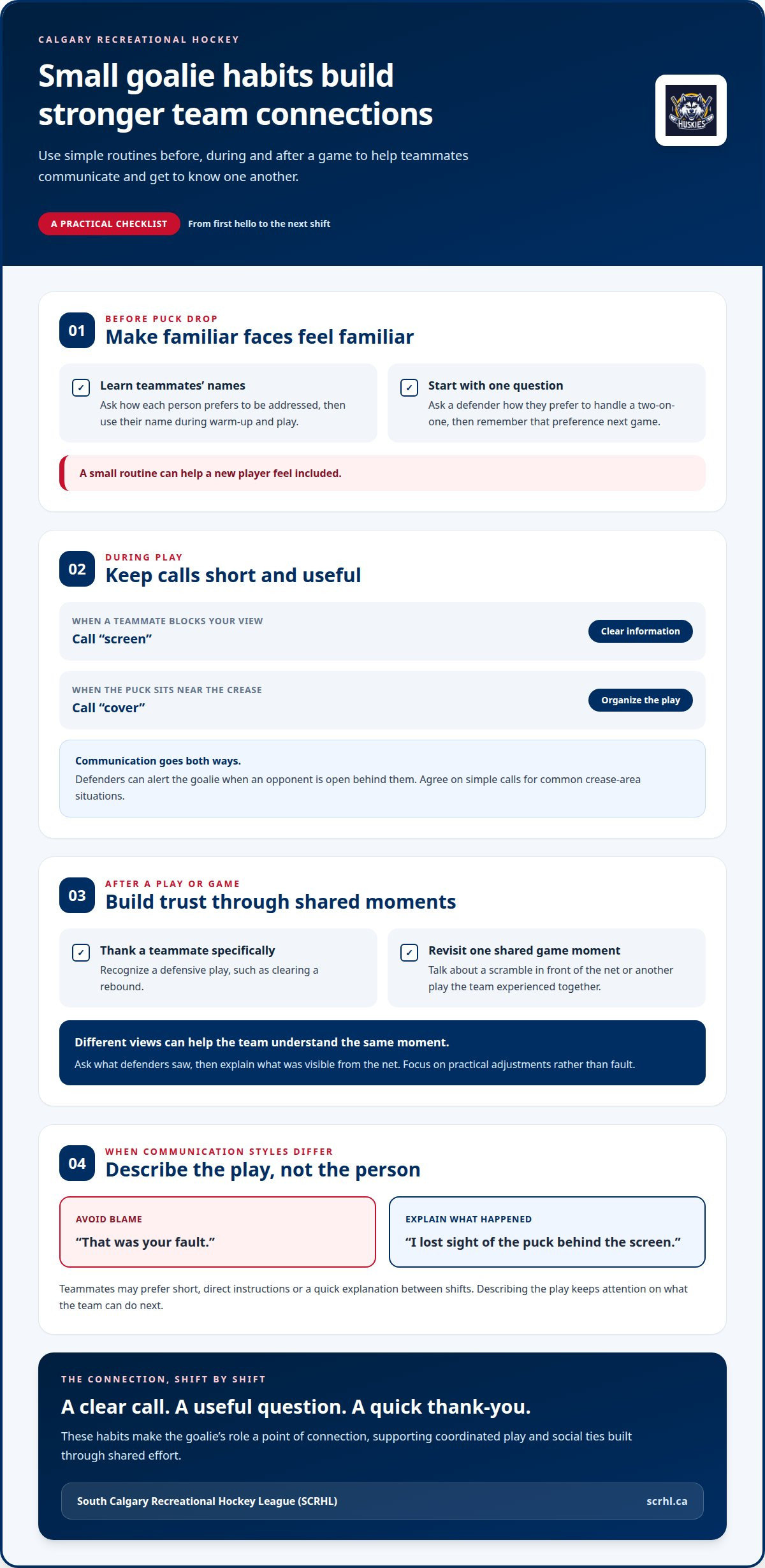
Goalies and defenders share a particularly direct connection. A goalie might call “screen” when a teammate blocks their view, or “cover” when the puck sits near the crease. Those brief instructions help organize the play. Defenders, in turn, can alert the goalie when an opponent is open behind them. Clear, respectful exchanges build trust without requiring long conversations during a fast-moving game.
Team connection also grows beyond a single save. Before a game, a goalie can greet teammates as they tape sticks or organize their gear. During warm-up, using a familiar player’s name can make communication feel easier once play starts. Afterward, a quick conversation about a scramble in front of the net gives teammates a shared moment to revisit. Small routines can help a new player feel included.
For a new goalie, learning teammates’ names is a useful first step. Ask how each person prefers to be addressed, then use their names during warm-up and play. Agree on simple calls for common situations, such as a loose puck near the crease. After a game, thank a defender for clearing a rebound. Specific appreciation makes teammates feel seen and gives them an easy opening to respond.
Rec hockey brings together players with different experience levels and communication styles. One teammate may give short, direct instructions; another may prefer a quick explanation between shifts. A goalie can keep feedback useful by describing the play rather than criticizing a person. For example, “I lost sight of the puck behind the screen” explains the problem more clearly than blaming a defender. This keeps attention on the next play.
Shared challenges can create conversation, too. A team might discuss a rebound that travelled across the crease or a breakaway that shifted the game’s momentum. A goalie can ask what defenders saw, then explain what was visible from the net. Each player has a different view of the same moment. Focusing on practical adjustments rather than fault can build understanding.
Social connection doesn’t depend on being the most outgoing person in the room. A goalie can start with one teammate, one question or one routine. Ask a defender how they prefer to handle a two-on-one, for example. Remembering that preference at the next game shows attention and respect. Over time, these exchanges can help familiar faces become teammates who communicate comfortably on the ice.
- Use teammates’ names during warm-up and play.
- Agree on simple calls for crease-area situations.
- Thank a teammate for a specific defensive play.
- Discuss one shared game moment after the final whistle.
These habits make the goalie’s role a point of connection, not an isolated task. In a Calgary rec game, a clear call, a useful question or a quick thank-you can support the next shift. Consistent communication helps teammates understand what the goalie sees and what support is needed. The result is more coordinated play and social ties built through shared effort.
Are Calgary rec league goalies in high demand, and is it easy to find a team?
Finding a goalie spot in Calgary depends on team needs, open positions and registration timing. A substitute shift can provide ice time, but it doesn’t automatically lead to a full-season place. Treat substitute opportunities and roster placement as separate steps to set realistic expectations when looking to play.
A team may need a goalie for one game, while a season roster needs a committed player. For instance, a substitute might fill in when the regular goalie can’t attend. That shift gives the team coverage and the goalie a chance to play, but it doesn’t establish a permanent roster spot by itself.
So, is it easy to find a team? It can be straightforward when a suitable opening exists, but an opening is essential. Divisions, roster needs and registration timing all affect placement. A goalie looking for a particular schedule or level may have fewer immediate matches than someone open to different options. Flexibility can help, but it can’t create a vacant roster spot.
In Rec Hockey Calgary, wait-listed registrants may be contacted by Division Coordinators if goalie spots become available. The process offers a clear next step: join the wait-list, then coordinators reach out when an opening arises. Being wait-listed means being considered, not receiving an immediate team assignment.
To search practically, set your priorities before looking for a roster. Decide whether a full-season commitment matters most or whether occasional ice time also suits your plans. Then consider which schedules and divisions work for you. Knowing your preferences makes it easier to respond clearly if a team opportunity comes up.
- Set your preferred commitment: substitute shifts, a full season, or either option.
- Identify which schedules and divisions fit your availability.
- Keep your registration details current if you join a wait-list.
- Respond promptly if a Division Coordinator contacts you about an opening.
Availability can change during registration and the season. A spot may open if a team needs goalie coverage or its roster changes. The key factor is still an actual opening in a suitable division. Taking a substitute shift can get you on the ice, while a full-season place depends on team placement.
Goalie demand is best understood as a roster question, not a simple popularity contest. A league may need coverage for a game without having room for another full-season player. Likewise, a wait-listed goalie may be considered when a matching spot opens. Neither situation means every goalie will receive the same opportunity or timeline.
When an opportunity comes up, clarify whether it’s for one game or a season. Confirm the expected commitment, schedule and team placement before accepting. This distinction prevents confusion between helping out as a substitute and joining a roster, and helps the team plan reliable coverage.
For players ready to explore a season-based route, review Calgary recreational hockey options and consider which registration path fits your plans. The perks of being a goalie in a Calgary rec league include opportunities to get involved, but a lasting team spot depends on an available opening and a good schedule fit.
A substitute shift and a season-long place are different outcomes. Taking a substitute goalie shift can provide ice time, but it doesn’t necessarily lead to a full-season spot. It may meet your immediate goal of getting on the ice while leaving roster placement unresolved. Keeping these aims separate makes it easier to assess an opportunity on its own terms, rather than treating a game assignment as a promise of longer-term placement.
If you’re considering a substitute opportunity, decide whether occasional ice time is worthwhile without a guaranteed season spot. If your priority is a full season, assess that separately rather than assuming a substitute shift secures a place. The same distinction applies when weighing how easy it is to find a team: getting a shift and joining a season roster are not interchangeable. Substituting can be a useful way to play, but understand it for what it offers. A full-season spot is a separate outcome, so expectations are clearest when you consider each possibility independently.
South Calgary Recreational Hockey League (SCRHL)
South Calgary Recreational Hockey League (SCRHL) offers adults in Calgary organized ways to join recreational hockey. Fall Season Team Registration and Winter Season Team Registration are seasonal options for teams, while Individual Player Registration suits players joining without a full team. Morning Hockey Sessions can also help you decide whether an earlier ice time fits your routine.
For a goalie, the right fit depends on the available team opportunity, your schedule and whether you want to register individually or with teammates. SCRHL’s registration options offer a practical starting point for taking part and building connections through regular play.
Explore SCRHL’s registration options to find a recreational hockey fit in South Calgary.
Choose your next step on the ice
The perks of being a goalie in a Calgary rec league can take shape over time as you settle into the position and find a rhythm that works for you. Before your next season, consider what you want from the experience: a regular place in your weekly routine, more confidence in net or more time playing with a team. Your priorities give you a useful starting point when weighing your options.
You don’t need to have every detail mapped out before taking action. A conversation can help you understand the available registration paths and decide what fits your plans. Contact South Calgary Recreational Hockey League to discuss getting involved. Whether you’re ready to commit or still weighing your next move, take the step that feels right and make room for more hockey in your season.
Frequently Asked Questions
What perks do Calgary recreational hockey leagues offer goalies?
A practical perk is having a clear personal focus for each game. A goalie can choose one skill to work on, such as setting their stance before a shot or recovering after moving across the crease. Afterward, noting what felt effective gives the next game a specific goal. This can make recreational play personally rewarding without turning it into a professional training program.
What risks or drawbacks come with being a goalie in a rec league?
A substitute shift provides ice time but doesn’t guarantee a full-season roster spot. Placement depends on an opening in a suitable division and schedule, and the role calls for clear, respectful communication with teammates during play.