

Calgary rec hockey players must immediately exit the ice and complete a 6-step protocol followed by written physician clearance before returning to play.
- Each of the 6 recovery stages requires at least 24 hours without symptoms.
- Unless a licensed physician provides a signed medical note, players cannot resume contact.
- Best-for players needing fast, sport-specific evaluations is choosing private clinics over public health.
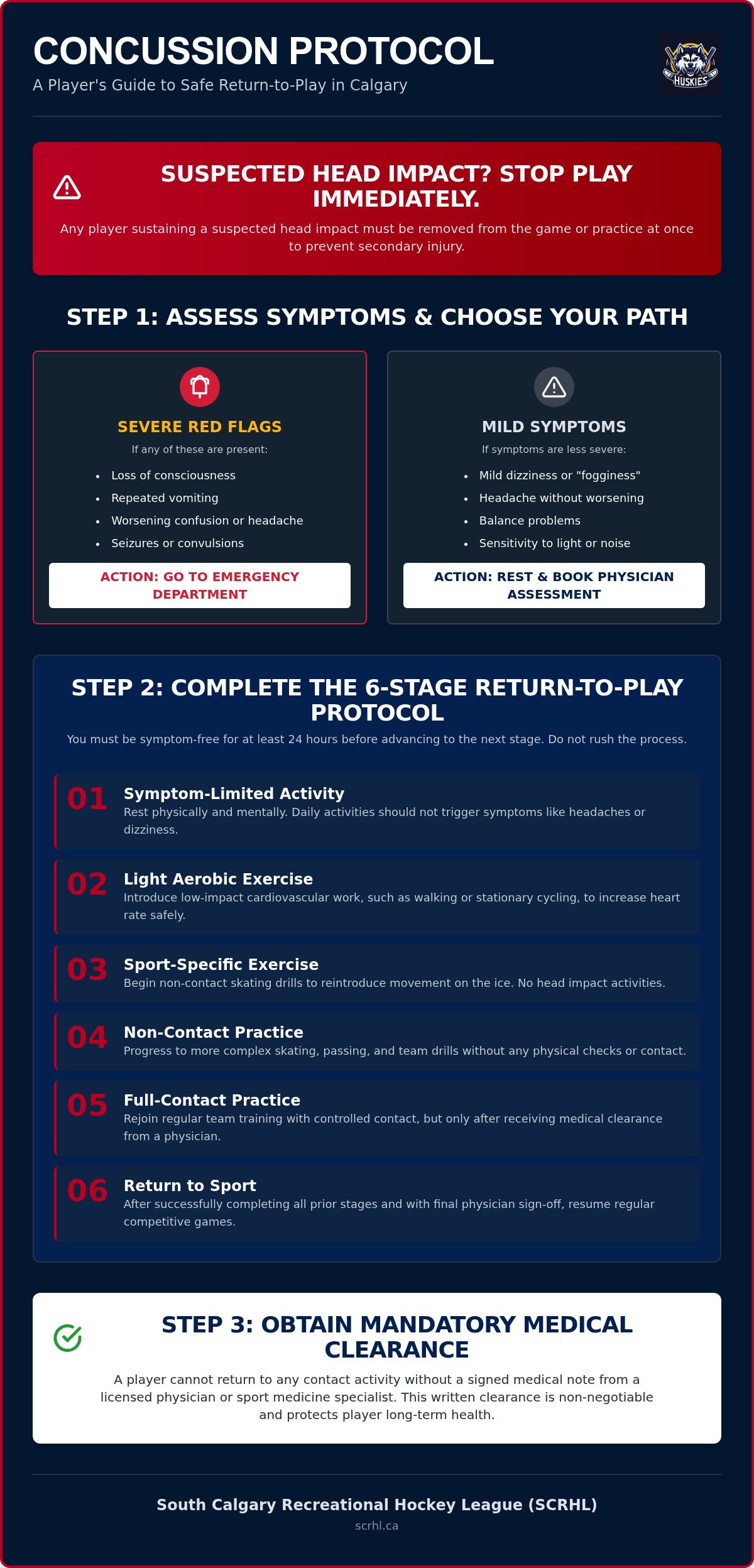
- The SCRHL portal provides mandatory league-specific forms and game preview safety guidelines. In Calgary recreational hockey, any player sustaining a suspected head impact must immediately sit out and complete a mandatory 6-step return-to-play protocol. Full clearance requires written sign-off from a licensed physician or sport medicine specialist before stepping back onto the ice. Your core decisions are simple: sort severe red flags from mild symptoms, pick the right assessment route, and finish each return-to-play stage before you touch the ice again.
Match your recovery path to symptom severity after a hit
Your immediate recovery pathway depends directly on whether you display severe emergency indicators or mild red flags after a hit. Typical situations and the matching move from the facts above:
- Loss of consciousness, repeated vomiting, or worsening confusion: go straight to an emergency department.
- Mild dizziness or headache without emergency markers: rest at once and book a physician concussion assessment.
- Unsure which forms your team needs: check the league player guidelines before the appointment so clearance paperwork is ready.
With clients we see that players who classify their signs and symptoms (concussion recognition) early reduce their overall downtime. Acting immediately prevents further brain trauma during competitive rec games.
If you experience severe red flags like loss of consciousness, repeated vomiting, or worsening confusion, head directly to an emergency department. For mild cases, rest immediately and schedule getting checked out (concussion assessment) with a physician. You can review the official South Calgary Recreational Hockey League player guidelines to confirm specific league safety requirements. Ignoring minor dizziness is like playing on a cracked skate blade, because small issues quickly compound into major structural failures.
Choosing the right medical facility matches your specific health needs. Emergency rooms fit acute trauma, while local clinics handle gradual rehabilitation. Before returning to play, you must complete all steps to get back on ice (return-to-play protocol). A qualified doctor must also sign off on your official doctor's note (medical clearance documentation). Spending time learning about head injuries (concussion education) helps teammates spot hidden issues early. Request a quote for private assessment if you need faster sport-specific timing.
Remove the player at once to stop secondary brain injury
Remove the player from the ice immediately if you notice any signs and symptoms. Pulling someone off the bench right away prevents a minor hit from turning into a severe injury. Continuing to play after a head blow multiplies risk instead of containing it. Following the guidelines from the South Calgary Recreational Hockey League ensures local adult teams follow national safety standards.
Situation: repeated head trauma in high-level play. Solution: immediate removal and medical follow-up rather than same-day return. Numeric result path: according to the Marc Savard Wikipedia entry from 2026, repeated head trauma severely damaged the NHL star's career, showing why immediate removal is critical.
Next, arrange getting checked out by a qualified physician before anyone considers returning to sport. Never rely on informal bench testing. Proper safety protocols require a full doctor's note prior to skating again. Once cleared, follow steps to get back on ice that gradually increase physical exertion. Prioritizing brain health over a single recreational game protects long-term function off the ice as well as on it.
Complete each of the 6 return-to-play stages without shortcuts
Healing takes longer than most adult athletes anticipate, requiring strict adherence to physical recovery milestones before you put your skates back on. While textbook recovery schedules promise a swift recovery, real life involves work stress and late ice times. Attempting to skip recovery stages usually triggers symptom relapses that set your progress back by weeks.
Clearing a single symptom-free day at work does not mean your brain is ready for physical exertion under arena lights. You must progress through each stage without any signs and symptoms returning.
- Symptom-limited activity: Rest physically and mentally until basic daily tasks no longer trigger headaches or dizziness.
- Light aerobic exercise: Start low-impact cardiovascular work like stationary cycling to increase your heart rate safely.
- Sport-specific exercise: Begin non-contact skating drills to reintroduce movement on the ice.
- Non-contact practice: Progress to complex skating patterns and passing drills without physical checks.
- Full-contact practice: Rejoin high-intensity team training only after securing a doctor's note.
- Return to sport: Clear all steps to get back on ice and resume regular competitive games.
Pushing through lingering fatigue during rec games leaves you one unexpected bump away from total failure. When playing in the South Calgary Recreational Hockey League, respecting these strict safety phases favors long-term health over a single win. Listening to local skaters highlights how proper league structure supports safe play.
Among South Calgary Recreational Hockey League (SCRHL)'s Google reviews, Joshua (5★) wrote:
"Absolute highlight of my week. The organization is wonderful. A great environment for a bunch of guys to play hockey and have a good time. Would highly recommend no matter your skill level or experience"
This league review demonstrates how a well-organized recreational environment fosters competitive fun while prioritizing skater safety and health.
Pick the clearance route that fits your timeline and budget
Securing a doctor's note requires completing specific forms and choosing between public health coverage or private clinic services. In our clinical observations, adult players often delay their recovery by showing up to a family physician without the league-mandated paperwork. Having the correct sheet ready during your appointment prevents wasted trips and speeds up your return.
Public health clinics cover standard doctor visits through provincial health plans, but specialized private clinics offer faster access for comprehensive sport-related evaluations. Private out-of-pocket expenses depend on the clinic's standard fee structure and the complexity of your evaluation, so ask for a personalized quote for exact figures. Signing up for initial testing (baseline concussion tests) before your season begins creates a clear reference point, which simplifies the steps to get back on ice after a hit. Choosing a private clinic fits players who need immediate sport-specific evaluations, whereas public health fits those who prefer zero out-of-pocket expenses and can handle longer waiting times.
| Assessment Option | Form Requirements | Financial Structure |
|---|---|---|
| Public Health Physician | Provincial medical clearance sheet | Covered by provincial healthcare plan |
| Private Concussion Clinic | Sport-specific clearance paperwork | Out-of-pocket fee; request personalized quote |
| Baseline Screening | Initial cognitive and physical assessment | Pre-season expense; request personalized quote |
Checking the official game preview guidelines provided by the South Calgary Recreational Hockey League helps you confirm which forms your safety team requires. Treat the paperwork path as mandatory permits before contact resumes: obtain written approval from a medical professional before resuming contact sports. Reach out for a personalized clinic quote if public wait times will block your staged return.
Delayed clearance prevents second-impact and long-term harm
Rushing your return to play after a head trauma can turn a manageable injury into irreversible, life-altering brain damage.
From client work we see skaters routinely fake being symptom-free just to avoid missing a single playoff match. This reckless choice exposes your recovering brain to massive physical risks before it heals.
Situation: pressure to play through unresolved symptoms. Solution: finish the full steps to get back on ice and honest medical review. Result: lower exposure to second-impact syndrome, the severe condition that occurs when a second hit happens before the first brain injury heals, causing rapid and dangerous brain swelling. You might also develop post-concussion syndrome, where headaches, severe brain fog, and intense dizziness persist for months or years.
Lying to your athletic trainer or presenting a fake doctor's note offers a false sense of security. Skaters who bypass proper getting checked out often regret it. Ignoring red flags permanently alters life off the ice, including careers, relationships, and basic daily living. Protecting your brain outweighs any recreational game score.
Frequently asked questions
What steps must be taken if a player is suspected of a concussion?
You must remove the player from the game immediately if you notice signs and symptoms. Do not let them return to the ice on the same day. The player needs to seek getting checked out by a licensed physician before taking any further steps to get back on ice.
When can a player return to play after a concussion?
A player can return to the game only after completing a step-by-step physical progression while remaining completely free of symptoms. Each stage takes at least 24 hours to monitor safety properly. If any symptoms recur, the athlete must rest until they vanish before restarting the progression.
What documentation is required for return to play?
You must submit a written doctor's note signed by a physician prior to resuming full-contact activities. League officials require this physical form to confirm that the athlete has safely completed all recovery steps. South Calgary Recreational Hockey League (SCRHL) administrators track these approvals closely.
Where can I find concussion awareness resources?
Players can access materials for learning about head injuries on the official league portal. These guides provide essential information on early warning indicators and baseline testing protocols. Reviewing these materials helps teams protect players during matches.
What are the signs and symptoms of a concussion?
Common indicators include persistent headaches, dizziness, blurred vision, confusion, nausea, and unusual sensitivity to light or noise. Some individuals experience sudden mood changes or sleep disturbances hours after the initial physical impact. League safety guidelines mandate watching for these physical warnings carefully.
League Safety Next Steps
The same decision thread you started with (symptom sorting, documented assessment, and full 6-step clearance) still governs safe return for the 2026 season. Transparent safety policies across divisions give adult players a clear path from the first hit to written medical sign-off.
Do you need to review specific division rules? Submit your doctor's note directly through the portal or contact your team safety lead. The South Calgary Recreational Hockey League (SCRHL) team remains committed to clear, accessible guidelines for each player.