

Starting a new rec hockey team in Calgary is easier when players agree on the basics before anyone registers. Confirm who wants to play, compare availability, and decide who will coordinate the group. Those steps help you choose a session that more of the team can manage.
It’s common to be unsure who will handle team communication, which session will work, and how to organize registration. Begin with a reliable core group, gather each player’s general availability, and write down questions the team needs answered. That gives the captain a practical starting point without making assumptions about league conditions.
This guide explains how to organize your group, compare schedules, and plan team registration with the South Calgary Recreational Hockey League (SCRHL). It also outlines the difference between team and individual registration so you can consider which route suits your situation.
SCRHL offers morning, evening, and weekend hockey sessions, as well as team and individual registration. Its current combined Fall 2026 & Winter 2027 season runs September 14, 2026 - April 17, 2027. Use the steps below to turn a group chat into a clear plan for Calgary league play.
Key Takeaways
- Starting a new rec hockey team in Calgary works best when players agree on shared commitments before registration.
- Set a simple plan: align the group, assign a coordinator, compare availability, then review registration options.
- Compare morning, evening, and weekend sessions using recurring availability, not one-off exceptions.
- Keep team decisions, such as who will coordinate, separate from SCRHL’s registration conditions.
- SCRHL offers team and individual registration. The current registration deadline is October 31, 2026.
Starting a Rec Hockey Team in Calgary: What the Captain Takes On
A team idea becomes workable when players make shared commitments, not when one person starts filling out forms. Before the captain handles league logistics, the group should agree that it wants scheduled recreational play and is ready to make decisions together. That agreement gives planning a clear starting point.
A recreational hockey team joins scheduled league play. That’s different from arranging an informal skate or picking a date for a casual game. League play means working around a season calendar, sharing decisions with the group, and assessing whether players’ availability is compatible.
What changes when a group becomes a league team?
Informal games can be arranged one at a time. A league team plans for recurring participation, so a change that suits one player may affect the wider group. Decisions about timing, communication, and commitment need to be shared. The main change is not paperwork, but having a reliable way to make and communicate decisions.
Friends may be keen to play but have different work shifts, family plans, or preferred ice times. Before choosing a season, gather a realistic picture of those constraints. You don’t need to resolve every scheduling question immediately. You do need to spot conflicts that could make regular participation difficult.
What should a new captain coordinate first?
Choose one person to keep conversations moving and record decisions. This is a practical coordination role, not a formal SCRHL requirement. The captain can summarize what players agree on, note questions that remain, and keep important information from getting buried in separate messages. Coordination does not mean making every decision alone.
Start with a focused discussion. Ask players which times they can regularly make, how ready they are to commit to a season, and what they need to know before the group proceeds. Record unanswered questions rather than guessing about registration conditions. This gives the team a short, useful list to work through.
For a group starting a new rec hockey team in Calgary, readiness matters more than rushing to register. The captain’s first job is to bring expectations into view and identify where they differ. Before working through roster details, establish whether the group can make the shared commitment that scheduled league play requires.
A brief planning note can capture the team’s preferred season, general availability, the coordinator, and open questions. Keep it short and update it as players respond. A shared reference point helps everyone follow the same plan and makes the next decisions easier.
Build a Team Plan Before You Register for Calgary Rec Hockey
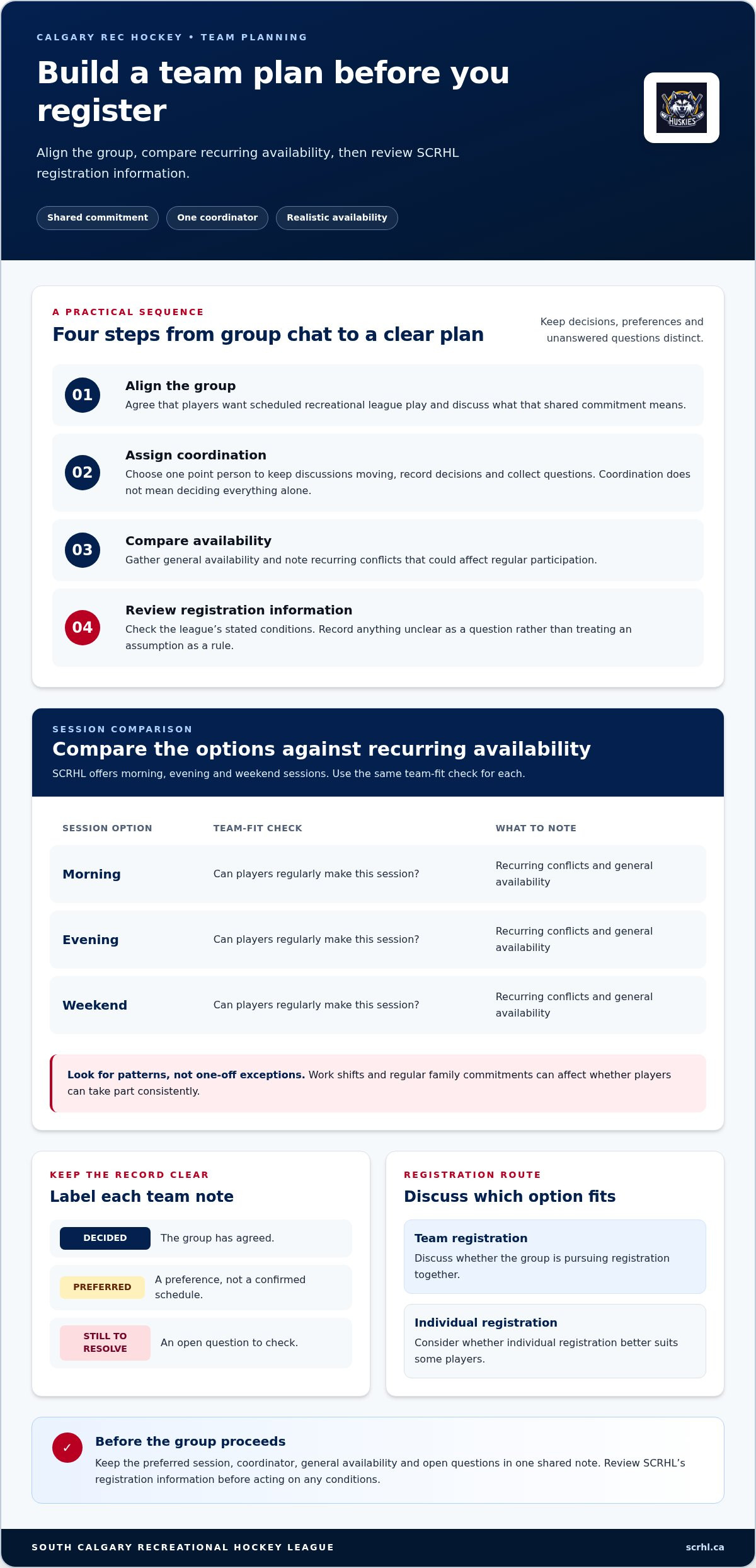
Once the group is interested, turn the idea into a short plan. Align on the goal, assign a coordinator, compare availability, then review league registration information. This sequence helps the captain spot gaps before the team moves into league-specific details.
- Align the group. Agree that players want scheduled recreational league play and discuss what that commitment means.
- Assign coordination. Choose a point person to organize discussions, questions, and decisions.
- Compare availability. Gather general availability and note recurring conflicts that could affect participation.
- Review registration. Once the group has a clearer picture, read the league’s registration information and distinguish stated conditions from assumptions.
How can a captain align the group?
Send a clear message about the goal: joining recreational league play together. Ask players to respond by a date the group agrees on, and explain how you’ll share decisions. One person can track schedule preferences, questions, and team communications. Keep updates in a shared note or message thread so players can refer to the same information.
Use that record to separate firm decisions from preferences. For example, label a preferred session as the group’s preference, not a confirmed schedule. This helps prevent misunderstandings as the plan develops.
Which team decisions should be settled early?
Compare players’ general availability with SCRHL’s morning, evening, and weekend hockey sessions. Ask players to flag recurring conflicts, such as work shifts or regular family commitments. Discuss whether the group is pursuing team registration or whether individual registration better suits some players.
Keep the roster discussion at a high level for now. The immediate goal is to understand the group’s direction and scheduling fit, not to solve every roster detail. A separate team roster guide can help with that next stage.
As you work through the sequence, label information “decided,” “preferred,” or “still to resolve.” Don’t turn a guess about eligibility or registration into a team decision. Record the question and use SCRHL’s registration information to find the applicable condition before acting on it.
That shared plan gives a captain a practical starting point for reviewing SCRHL team registration information. For anyone starting a new rec hockey team in Calgary, the goal is to reach registration with the group’s intent, coordinator, and general availability already discussed.
Choose a Calgary League Season and Ice-Time Fit Your Team Can Manage
A session that suits the captain may not work for the rest of the group. Before settling on a season, compare when players can realistically get to the rink and identify recurring conflicts. This gives the team a stronger basis for choosing than one person’s preferred day or time.
How should captains compare morning, evening, and weekend play?
Ask each player which session types they can regularly attend. Record morning, evening, and weekend availability separately, and note repeating conflicts. Focus on what players can manage throughout the season, rather than what might work on an occasional week.
- Morning: List players who can consistently make morning sessions, and note work or family commitments that could interfere.
- Evening: Record who can attend evening play and flag recurring shifts, caregiving duties, or other regular conflicts.
- Weekend: Note who can make weekend sessions, including predictable commitments that compete for that time.
Then look for overlap. If a player can attend evenings but not weekends, record both facts rather than treating them as equally available for every option. The aim is to identify a session type the group can manage together, not to assume a preferred time will become the team’s schedule.
What does SCRHL’s combined season mean for planning?
SCRHL’s current combined Fall 2026 & Winter 2027 season runs September 14, 2026 - April 17, 2027. Use the season period to compare the team’s work, travel, and other regular commitments against the season calendar.
For a separate ice-cost reference, the City of Calgary’s published 2026-2027 rental rates are C$106.50 per hour for non-prime time before 4 p.m. and C$185.50 per hour for prime time after 4 p.m. These are City of Calgary ice-rental rates, not SCRHL registration prices, so they should not be used to estimate SCRHL fees.
Ask players to identify periods when participation may be difficult, then consider whether the group’s shared availability still supports joining. The season dates give the overall period, not game frequency or particular ice times.
A simple matrix can reveal the difference between individual preference and group fit. For example, if several players mark mornings as workable but others can only attend evenings, the team has a decision to make before choosing a session. Record the mismatch and discuss whether another option has stronger shared availability. Don’t assume one player’s schedule represents the whole roster.
For a clear comparison, list each session type, the players who can attend, and any recurring conflicts. Weigh that against the season period and the group’s priorities. This gives the team a practical basis for choosing among SCRHL’s session options.
A Practical Calgary Rec Hockey Team Readiness Checklist
A checklist helps separate the group’s decisions from the league’s registration conditions. For a captain starting a new rec hockey team in Calgary, the goal is to arrive at registration with the team’s basic direction clear, rather than guessing at requirements.
What should the team have agreed on?
Before moving ahead, make sure the group shares an interest in scheduled recreational hockey and has a point person for team communication. Compare general availability with SCRHL’s morning, evening, and weekend sessions. Keep a shared note of decisions and open questions so players can see what’s settled and what still needs discussion.
- Shared goal: Players understand that the group is planning for recreational league play, not just occasional informal games.
- Team contact: One person is identified to organize team communication and registration questions.
- Schedule fit: The group has compared its availability with the session types and recorded recurring conflicts.
- Registration direction: Players have discussed team or individual registration and which route suits their plans.
- Apparel planning: The team has noted whether custom jerseys or apparel are part of its plans, separately from registration.
These are team-planning decisions. They help the group prepare, but they don’t establish league eligibility or replace SCRHL’s registration conditions. Keep those conditions distinct from the team’s preferences.
What should the captain review before taking the next step?
Once the team’s preferences and availability are documented, review SCRHL’s team and individual registration information. Compare the stated conditions with the questions your group has recorded. A preferred session or apparel choice is a team preference, not a confirmed league requirement or outcome.
Keep the registration process distinct from the readiness check. Use the team-registration guide for process details and SCRHL’s registration information for the conditions that apply. The checklist organizes the group; it is not a substitute for registration details.
Custom-designed jerseys and apparel are available for league participants and teams. Discuss who will coordinate apparel decisions and when to address them, but keep that choice separate from the team’s registration plan.
Once the group has worked through the checklist, review SCRHL team registration information. The captain can then compare the team’s decisions with the registration conditions before proceeding.
Start Your SCRHL Team’s Next Steps in Calgary
With your group’s interest, availability, and coordination plan in place, compare those decisions with SCRHL’s season and registration information. SCRHL offers team and individual registration for recreational hockey. Review the options and choose the route that fits your group.
What should a Calgary captain know about the current registration window?
The current combined Fall 2026 & Winter 2027 season runs September 14, 2026 - April 17, 2027. The firm registration deadline is October 31, 2026. Use these dates to plan with the group and allow time to complete registration by the deadline.
Registration discounts apply within these windows: 10 % off registrations received October 10, 2026 to October 20, 2026, and 5 % off registrations received October 21, 2026 to October 31, 2026. The registration deadline is October 31, 2026, and no discounts apply after that date.
Before proceeding, agree on the team’s preferred registration route and choose a coordinator to manage the next steps. If some players are considering individual registration, keep that as a separate option rather than treating it as the same decision as registering a team.
How can a team take the next step with SCRHL?
Review SCRHL’s registration information for the team and individual options. For guidance focused on the team process, the Calgary team registration guide can help captains follow the registration steps. If you’re still organizing your group, the rec hockey roster-building guide covers the separate task of planning a roster.
Follow the steps in order: settle the group’s direction and scheduling fit, then use the registration guide for the process. Keep the team’s planning notes separate from league conditions. A roster plan supports the decision, but registration information explains the applicable conditions.
Starting a new rec hockey team in Calgary is more manageable when the group agrees on its preferred route and the captain has a clear plan. Review SCRHL’s season and registration information, then decide whether team or individual registration suits your group.
Turn Your Team’s Plan Into a First Step
Starting a new rec hockey team in Calgary is easier when the next action belongs to the whole group, not just the captain. Set a time to review the plan, give players a chance to raise final questions, and agree on who will handle registration. A shared decision helps the team begin with clear expectations.
Use that discussion to confirm that the group is ready to proceed and knows where to find SCRHL’s registration information. SCRHL offers team and individual registration, morning, evening, and weekend sessions, and custom hockey jerseys and apparel for players and teams.
When your group is ready, explore SCRHL team registration and current season information and take the next step together.
Frequently Asked Questions
Can I register for SCRHL as an individual if I do not have a full team?
Yes. SCRHL offers individual player registration as well as team registration. The individual option suits players who want to join league play without organizing a group. If your friends are still deciding whether to form a team, you can consider individual registration separately rather than waiting for the group’s plans to come together.
Does SCRHL offer morning, evening, and weekend hockey sessions?
Yes. SCRHL offers morning, evening, and weekend hockey sessions. If you’re coordinating a group, ask players which session types they can realistically attend and note recurring conflicts, such as work shifts or regular family commitments. Comparing availability helps the captain assess which options suit the group.
Does SCRHL provide custom jerseys for a new rec hockey team?
SCRHL offers custom-designed hockey jerseys and apparel for league participants and teams. Treat apparel as a separate planning decision: first agree whether custom items are part of the team’s plans, then choose someone to coordinate the discussion.
What does a hockey team captain do when starting a rec team?
A captain can keep communication moving, gather players’ availability, record shared decisions, and organize registration. These are useful planning tasks, and the captain can share them with other players. For someone starting a new rec hockey team in Calgary, a shared note of decisions and questions helps the group stay aligned as it considers the next step.
When does SCRHL’s combined Fall 2026 & Winter 2027 season run?
SCRHL’s combined Fall 2026 & Winter 2027 season runs September 14, 2026 - April 17, 2027. Use the date range to discuss whether players’ broader commitments fit the season, including planned travel or regular periods when they may be unavailable.
Can an SCRHL team choose its preferred game time?
SCRHL offers morning, evening, and weekend sessions. Captains can gather each player’s availability and compare the group’s options before deciding which session types to consider. For example, record recurring conflicts separately from occasional ones, then use that comparison to guide the team’s planning.