

What if your team’s best bonding happens in the small moments around each game, not at a big event? Finding team bonding ideas for rec hockey Calgary teams can fit into busy adult schedules can be a challenge. Teammates may share the ice each week and still know little about one another.
That’s normal. A full-roster dinner or elaborate outing won’t suit everyone, and quieter players may prefer a lower-pressure way to join in. Stronger connections grow through welcoming activities and simple habits that give teammates a chance to talk, laugh and communicate beyond the next shift.
This guide offers practical ideas for Calgary teams, from quick post-game check-ins to flexible group outings and inclusive activities for different personalities and schedules. You’ll also find ways to build small shared rituals into a Fall or Winter season, helping create a supportive team culture from the first game to the final buzzer.
Key Takeaways
- Choose team bonding ideas for rec hockey Calgary rosters can fit around different schedules, budgets and comfort levels.
- Use a simple filter: look for activities that are accessible, optional, easy to organize, inclusive and suited to your team.
- Compare low-key conversations, trivia and voluntary skills challenges to find a format that fits your roster.
- Ask teammates about their preferences before choosing an activity or setting a date.
- Build connection gradually across the Fall or Winter season, with captains keeping communication open and welcoming.
Why team bonding ideas matter for Calgary rec hockey teams
Team bonding is the intentional practice of helping teammates build familiarity, trust and clear communication through shared, low-pressure interactions. It can happen before a game, in the room afterward or through a simple team ritual. It doesn’t require a formal event, and it shouldn’t depend on everyone socializing in the same way.
For adult recreational players, connection can make the team environment more welcoming. A teammate who knows people’s names and communication preferences may find it easier to speak up, ask a question or offer support. That can improve the shared experience, but it doesn’t guarantee wins or better results on the scoreboard. Team sports depend on cooperation and coordination, as described in the importance of teamwork in sports, but a recreational roster can value those habits without turning every interaction into a performance goal.
Bonding isn’t mandatory socializing. Players have different energy levels, interests and responsibilities outside hockey. Make invitations clear and participation optional. Someone who skips a group outing can still contribute to a supportive team culture through respectful communication, a friendly greeting or a quick check-in at the rink.
Small actions give teammates repeated chances to learn how the group works. A captain can introduce a new player by name, explain how the team shares updates or make space for questions without putting anyone on the spot. Teammates can share useful details, such as their preferred names or whether they’re comfortable with group messages. These practical exchanges build familiarity while keeping the focus on adult recreational play, not elite development or coaching.
What team bonding can mean beyond winning games
Look for everyday signs of connection: newcomers get a genuine welcome, game information is communicated clearly, and teammates show mutual respect after a mistake or a difference of opinion. No single personality type defines a good team culture. Outgoing players may start conversations; quieter players may contribute by listening, following through and offering thoughtful feedback.
Why Calgary rec teams need flexible plans
In Calgary, work shifts, family commitments and different session times can make it hard to gather the full roster. A short, repeatable moment may be easier to join than one large social commitment. Try a quick introduction before play or a brief team check-in afterward. Keep the format simple, share the invitation early and let players take part when it suits them.
When choosing team bonding ideas for rec hockey Calgary teams can start with the roster’s real routines. Ask what feels comfortable, then choose a small habit the group can repeat without pressure. Consistency helps teammates recognize one another as people, not only as names on a lineup. Over a Fall or Winter season, that familiarity can support clearer communication and a more welcoming recreational experience, even when schedules don’t line up for a full-team outing.
What makes team bonding ideas work for an adult hockey roster?
Choosing team bonding ideas for rec hockey Calgary teams can fit starts with the roster, not the activity. A plan should feel easy to join, simple to coordinate and worthwhile even if not everyone takes part. Captains can make a better choice by asking teammates what they’d enjoy before suggesting a date or committing the group.
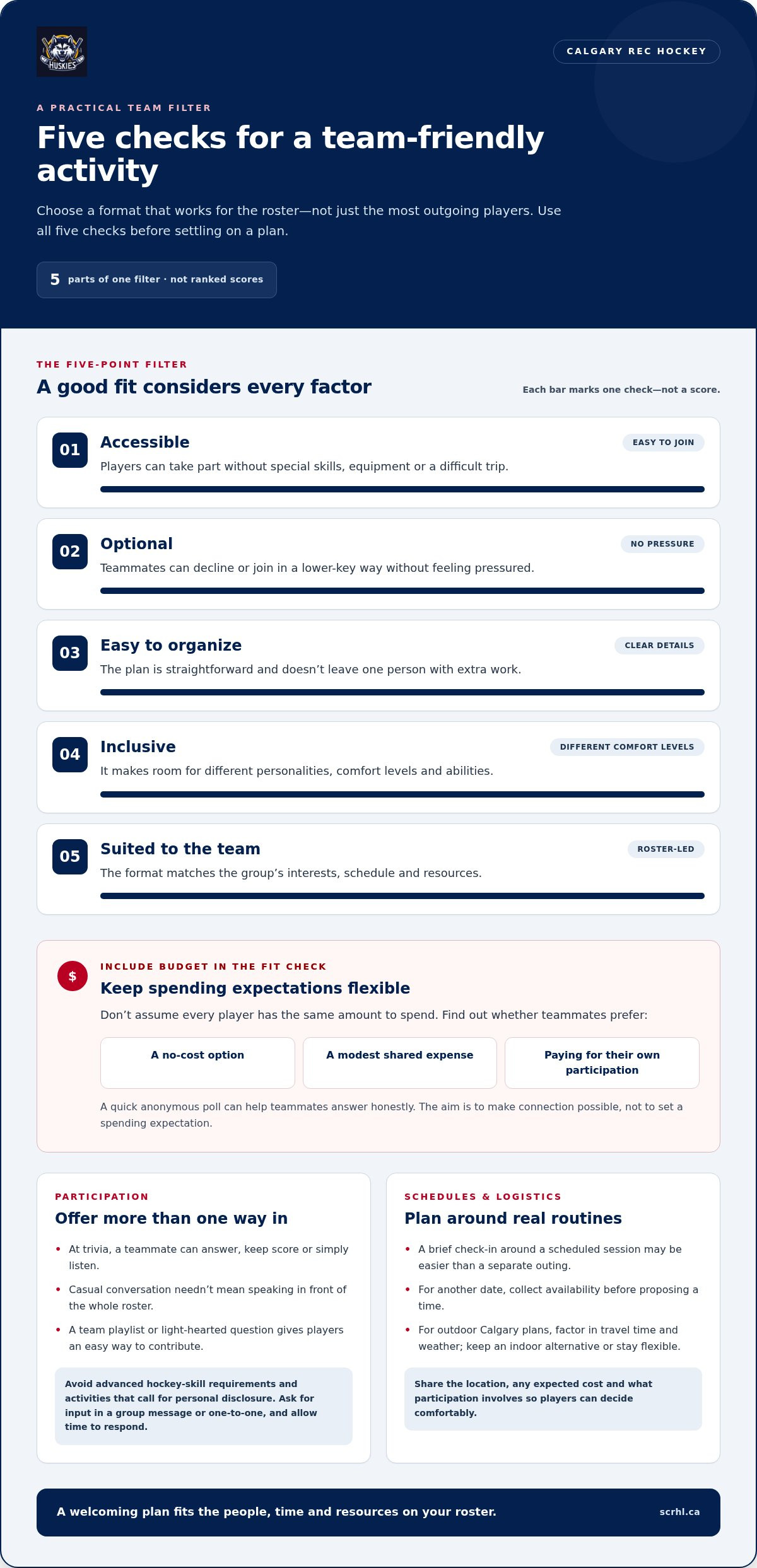
Use this five-point filter to compare options:
- Accessible: Players can take part without special skills, equipment or a difficult trip.
- Optional: Teammates can decline or participate in a lower-key way without pressure.
- Easy to organize: The plan has clear details and doesn’t create extra work for one person.
- Inclusive: It welcomes different personalities, comfort levels and abilities.
- Suited to the team: The format matches the group’s interests, schedule and resources.
Budget is part of that last check. Don’t assume every player has the same amount to spend. Ask whether teammates prefer a no-cost option, a modest shared expense or an activity where people pay for their own participation. The goal is to make connection possible, not to set a spending expectation. A quick anonymous poll can help people answer honestly.
How to make an activity inclusive without making it awkward
Give players more than one way to participate. At a team trivia round, someone can answer, keep score or simply listen. During a casual conversation, nobody needs to speak in front of the whole roster. These small choices make it easier for newer teammates and quieter players to join at their own pace.
Avoid activities that depend on advanced hockey skills or require personal disclosure. Instead of asking everyone to share a personal story, invite players to suggest a team playlist or choose a light-hearted question. Ask for input in a group message or one-to-one, and give people time to respond. That’s more comfortable than calling on someone unexpectedly.
How to fit bonding around Calgary hockey schedules
Start by checking whether a brief activity can fit around a scheduled session. A quick conversation before heading home may be easier than arranging a separate outing. If the plan needs another date, collect availability first, then suggest a time and format that work for as many players as possible. Avoid treating one person’s open evening as the whole team’s availability.
For outdoor options in Calgary, consider travel time and weather as well as the activity itself. Have an indoor alternative or keep the plan flexible if conditions change. Share the location, expected cost if there is one, and what participation involves before players decide. Clear details help each person make a comfortable choice.
Captains can keep the process straightforward: ask, review the responses, choose a practical option and communicate that participation is voluntary. Organized Fall and Winter seasons give teammates regular opportunities to build familiarity, while simple traditions can add a sense of belonging. Explore adult recreational hockey in Calgary and find a season that works for your roster.
On-ice or off-ice? Compare team bonding ideas for Calgary rec hockey
The right choice depends on what your roster has time and energy for. Some ideas fit around a scheduled session; others give teammates a change of pace. Use this comparison to start a team discussion and choose an activity your group can organize.
| Activity | Planning effort | Setting | Best-fit team situation |
|---|---|---|---|
| Low-key post-game conversation | Low | After a scheduled session | Players who want a casual chance to chat without arranging another outing |
| Team trivia round | Low to moderate | Before or after a session, or at a separate gathering | A roster that enjoys light competition and can take turns answering or keeping score |
| Voluntary skills challenge | Moderate | On the ice, only where the team already has an appropriate opportunity | Players who want a hockey-centred activity without ranking skill or ability |
| Casual group meal or coffee | Moderate | Off the ice | Teammates who prefer conversation in a relaxed setting |
| Watch a game together | Low to moderate | At home or another chosen viewing spot | A group looking for a lower-activity option with no need to play |
Hockey-centred ideas that use time the team already shares
A brief pre-game check-in can create an easy opening for conversation. Rotate simple prompts, such as “What’s one song you’d add to a warm-up playlist?” or “What’s your favourite hockey memory?” Keep questions light and let players pass. For an on-ice challenge, focus on taking part, not scoring or ranking. A team might try a shared passing sequence or celebrate everyone who joins in.
A jersey reveal can mark the start of a season or welcome new teammates. SCRHL offers custom-designed jerseys and apparel for its players and teams. Make the reveal optional and treat it as a shared ritual, not a requirement to buy or wear anything beyond the team’s usual gear.
Off-ice ideas for teammates who want a change of pace
Choose a casual meal, coffee or team trivia if players want time to talk in small groups. A watch party is another low-activity option: teammates can drop in, follow the game and chat during breaks. Pick a format that doesn’t force everyone to speak at once. A table with room for side conversations or trivia teams that can change between rounds can help different personalities find a comfortable way to join.
For team bonding ideas for rec hockey Calgary rosters, start with an option that fits the group’s routine. Ask teammates whether they prefer to connect around hockey or away from it, then organize a simple plan that leaves room to opt in at their own comfort level.
How to plan a Calgary rec hockey team activity step by step
A clear plan makes it easier for teammates to decide whether they want to join. Start with a quick preference check, not a fixed date. Ask what kind of gathering people would consider, how much time they have and whether they’d prefer a no-cost option or are comfortable with a shared expense. Keep responses simple, such as a short poll or a few choices in the team’s usual group chat.
Then move through the planning steps in order:
- Ask: Invite preferences before suggesting a specific activity. Include players who are newer or less vocal.
- Choose: Offer a few realistic formats, such as a brief post-session get-together, a casual meal or a low-key team activity.
- Schedule: Check availability before settling on a date. Consider whether the plan can fit around a scheduled session or needs a separate time.
- Communicate: Share the date, general location type, expected time commitment and any cost or other practical details. Make it clear that joining is optional.
- Follow up: Thank players who took part and ask what they’d change next time. Use that feedback to guide future plans.
Choose the activity with the team, not just for the team
Captains don’t need to collect a long list of ideas. Put forward a few options that suit the roster’s schedule and ask players to choose what feels workable. A small set of choices is easier to answer than an open-ended request, and it helps prevent one person’s favourite activity from becoming the automatic team plan.
Set expectations before anything is finalized. Explain whether the activity is attached to a session or separate, what participation involves and whether players should expect an expense. Don’t assume everyone wants a large group event. Some teammates may prefer a short check-in or a smaller gathering. A Calgary roster-building guide can also help captains plan how to bring players together.
Make the plan easy to join
Once the team has chosen a format, send one clear message through its usual communication channel. Include the date, the general location, the plan and a straightforward way to respond, such as replying in the chat. Avoid relying on vague messages like “we should get together soon.” Specific information lets teammates check their schedules and make an informed choice.
Respect players who can’t attend. Don’t ask them to explain why or treat a low turnout as a failure. A brief follow-up can reveal whether the timing, format or communication worked. Keep the feedback practical: Was the plan easy to understand? Would a different kind of gathering suit the roster better?
Regular play gives teammates a natural reason to see one another. Explore adult recreational hockey registration in Calgary for an organized Fall or Winter season.
Build team chemistry through a Calgary rec hockey season
Team chemistry develops through repeated, everyday contact. A single outing can be enjoyable, but a season gives teammates more chances to recognize names, learn communication habits and feel part of the roster. Start with small introductions, then add optional shared activities as people become more comfortable. Keep each step easy to join and repeat.
Use small rituals to keep the team connected
Welcome new players before or after a scheduled game. A captain can introduce them to a few teammates and share useful team communication details. Between sessions, try a simple optional prompt, such as naming a favourite hockey moment, or recognize a teammate who helped make the group feel welcoming. Keep it brief, and let players pass without explanation.
Rituals work best when they belong to the team, not just the captain. Ask what players would like to repeat, change or leave behind. A quick check-in can help the group choose a tradition that feels natural, whether that’s a rotating question, a team playlist or a shared jersey reveal. Keep the focus on participation and connection, not on making every player respond the same way.
Find a league setting for regular adult rec hockey
Scheduled league play gives teammates a recurring reason to see one another. That regular contact can make introductions and short conversations easier over time, even if players can’t attend separate social plans. A Fall or Winter season also gives captains a natural rhythm for welcoming new faces and checking how the team communicates.
For a Calgary roster considering its next season, SCRHL adult recreational hockey information outlines organized league participation. SCRHL offers team and individual registration for Fall and Winter seasons, with morning, evening and weekend hockey sessions. Team bonding ideas for rec hockey Calgary teams can carry into that routine without requiring extra events: greet a new teammate, share a clear update or invite the group to choose a small ritual together.
Keep the next step low-pressure. At the next scheduled game, introduce one teammate to another or ask the roster which simple tradition they’d enjoy. Then let the response guide what comes next. A welcoming team culture isn’t built in one night. It grows through small, consistent actions across the season.
Make your next season a chance to connect
Team culture isn’t measured by how many players attend a social event. It shows in the small choices that make the roster easier to join: sharing information clearly, listening to different viewpoints and treating each teammate with respect. Keep connection practical. One thoughtful habit can give the group a positive starting point without adding pressure to anyone’s schedule.
Choose one team bonding idea for rec hockey Calgary teammates can shape together. Ask what would make participation comfortable, then leave room to adjust if the idea doesn’t suit the group. Shared input can help make bonding part of how the team works, rather than another task on the captain’s list.
If you’re ready to play and build connections over time, explore Fall and Winter team or individual registration with SCRHL. Choose a season and session that suits your Calgary hockey schedule, then start with an open invitation to connect.
Frequently Asked Questions
What are simple team bonding ideas for an adult rec hockey team?
Try a teammate-pair introduction, a shared playlist or a brief appreciation message after a game. These team bonding ideas for rec hockey Calgary rosters can adapt to the group’s mood without requiring a separate event. For example, pair players who haven’t met and invite them to learn each other’s names and preferred positions. Keep the activity short, and let teammates decide whether they want to take part.
How can a hockey team include new players in team bonding?
Give a new player a clear point of contact and a friendly introduction to the roster. A captain can explain common team habits, such as where lineup updates are shared or how players signal a line change. Avoid making the newcomer give a speech or answer personal questions. A quiet, practical welcome helps them learn how the group works and join conversations at their own pace.
Do team bonding activities need to happen off the ice?
No. Teammates can connect through small actions around the hockey they already play, such as learning names or sharing a quick team update. Off-ice gatherings are only one option, and they may not suit everyone’s schedule or comfort level. Keep the activity appropriate to the team’s existing session and avoid adding extra ice arrangements. The aim is familiarity, not another commitment on the calendar.
How often should a rec hockey team plan bonding activities?
There’s no set frequency that works for every roster. Start with occasional, low-pressure gestures and pay attention to whether players respond positively. If an activity feels useful, repeat it; if participation drops or it becomes an obligation, adjust the approach. Captains can also invite feedback privately, so teammates who don’t want to comment in a group chat still have a way to share their preferences.
How can a Calgary hockey team plan an activity around busy schedules?
Look for an overlap in availability before choosing a format. A quick poll can ask whether players prefer a moment connected to a game or a separate gathering, without asking everyone to explain personal commitments. If schedules differ, choose a simple option that can happen more than once or be joined by whoever is available. Share practical details early so teammates can make plans around work and family responsibilities.
What should a team captain do if players do not want to attend social events?
Respect their choice and don’t treat attendance as a measure of commitment to the team. Some players may prefer to build rapport through clear, respectful communication during hockey rather than socializing outside it. Keep team updates useful and welcoming, and make sure recognition or introductions don’t depend on attending an outing. If interest changes later, players can opt in without pressure or needing to explain why they previously declined.