

A mid-season move isn’t automatically permanent. Transferring to a new team mid-season may be temporary or permanent, depending on the league’s rules and the teams’ agreement.
Before changing lineups, schedules or team commitments, get clear answers about the process. Transfer charges and payment for remaining games can also raise questions, and recreational leagues do not all handle them the same way.
This guide explains why players move during a hockey season, what can determine whether they return to their original team, and how transfer charges and remaining game payments may be handled. It also covers practical factors for a transfer request in Calgary, so players and team organizers can understand the considerations before a roster change.
Key Takeaways
- Roster changes can address team needs, including replacing a player who can no longer play.
- A mid-season move may be temporary or permanent, depending on the league’s rules and the arrangement between teams.
- Transfer costs and payment for remaining games depend on the terms agreed for the move.
- Explore individual or team registration and hockey sessions through South Calgary Recreational Hockey League when planning your next season.
Reasons teams may transfer players mid-season
Teams may seek a player when an injury, availability change or roster gap affects their lineup. In the IPL, mid-season loans could involve Indian or overseas players, capped or uncapped, during IPL 2020. The receiving team’s need and the available player’s fit can shape a move; this professional cricket example does not establish Calgary hockey rules.
Overseas-player limits are a specific IPL consideration: an IPL mid-season transfer does not change a team’s overseas player allocation. For injured players, IPL squads had until their twelfth match to find substitutes in IPL 2026. In IPL 2020, replacing an injured player through the transfer window required IPL Governing Council permission.
Compare teams by schedule, location, playing role and expected commitment. For a Calgary hockey transfer, the required documents and approvals depend on the league’s process. A written request and updated roster record can help clarify the change.
There is no single deadline or waiting period for Canadian recreational hockey. The league’s roster rules and the timing of upcoming games affect when a change can take effect. A team may delay or decline a request under its transfer rules, so follow the process that applies to that league.
After a transfer, eligibility depends on the league’s registration record and rules; insurance coverage depends on the applicable policy and registration status. Before playing for a new team, make sure the roster change is recorded. Potential issues include missed games, a gap in eligibility or coverage, and a mismatch in schedules or team expectations.
Transfer fees and remaining match fees
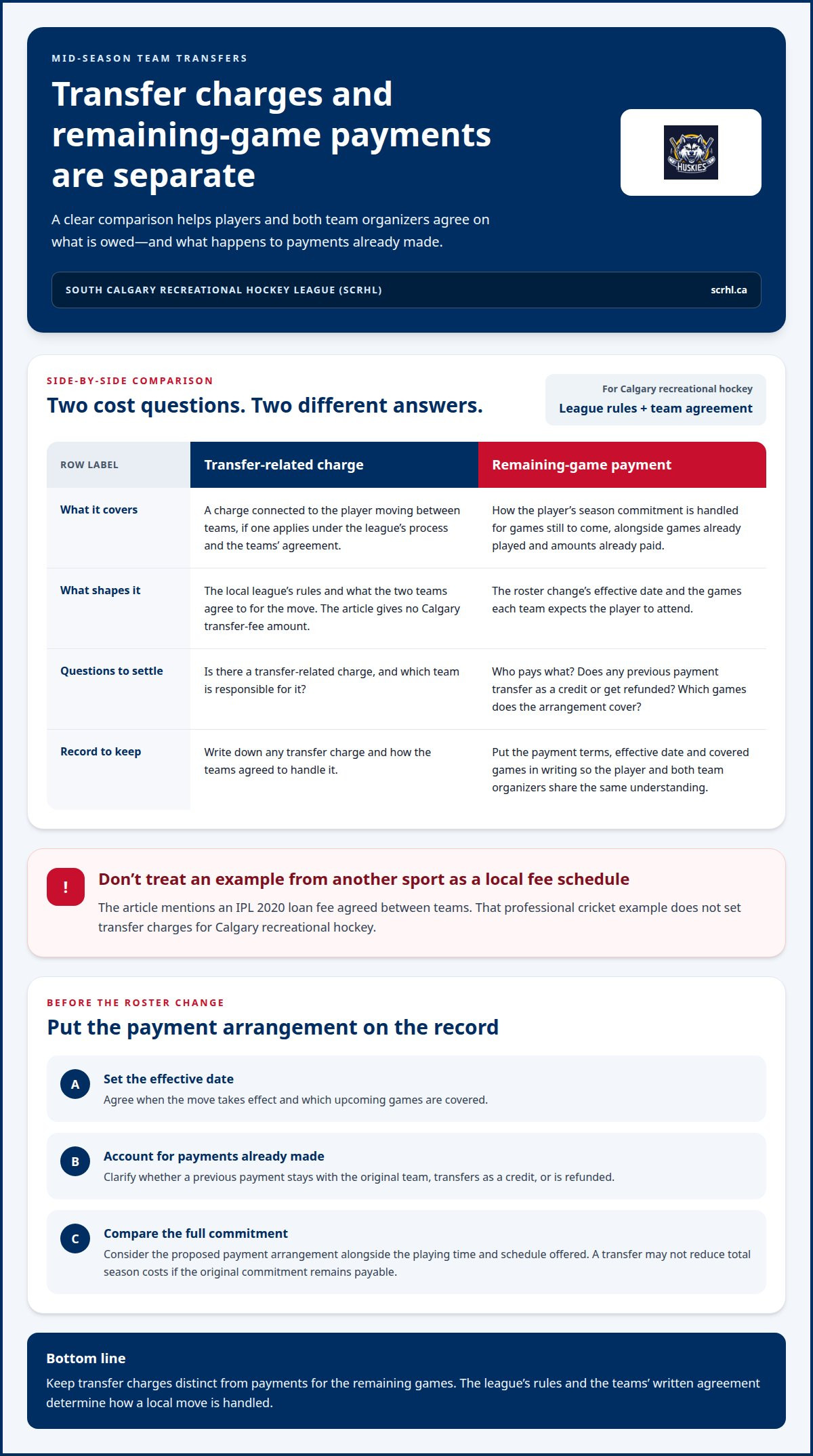
A transfer fee and payment for games left in a season are separate questions. In IPL 2020, mid-season loans could include a fee mutually agreed between the two teams. That professional cricket arrangement is not a fee schedule for Calgary recreational hockey. For a local move, the league’s rules and the teams’ agreement shape how costs are handled.
Separate any transfer-related charge from the player’s existing season commitment. The teams may need to account for games already played, upcoming games and amounts already paid. For example, if a player leaves after several scheduled games, the teams can clarify whether the departing team keeps the payment or whether some portion transfers with the player. Follow the league’s process.
Discuss remaining game payments based on the roster change’s effective date and the games each team expects the player to attend. Put the arrangement in writing, including who pays what, when the change takes effect, and whether any previous payment is credited or refunded. This helps the player and both team organizers avoid relying on different assumptions.
Before accepting a move, compare the proposed payment arrangement with the playing time and schedule offered. A transfer may not reduce a player’s total season costs if the original commitment remains payable. For future seasons, adult recreational hockey registration can provide a clear starting point for joining a team or registering individually.
The IPL mid-season transfer window opens after match 30, while the example return-leg match between Chennai Super Kings and Kings XI Punjab was scheduled for November 1.
Ajinkya Rahane had played 1 match for Delhi Capitals out of seven in IPL 2020, another case where participation and transfer terms are distinct.
What are the rules for transferring to a new team mid-season in Canada?
Canadian recreational hockey transfers follow the rules of the league running the competition. A player moving between Calgary teams should distinguish a team agreement from an approved roster change. The teams can discuss the move, but league procedures determine how registration and eligibility are recorded. Rules differ between recreational leagues, so a process used elsewhere in Canada may not apply locally.
Key details include whether the player is currently registered, when the move takes effect, and whether the receiving team has an open roster position. The league’s rules may also cover approval, deadlines, outstanding team commitments and eligibility to play. These details determine whether a player can join the new lineup immediately or must wait for the roster record to change.
A clear transfer record should identify:
- The player’s current team and intended new team.
- The agreed effective date and games covered by the change.
- Any required league approval and roster updates.
- How both teams will handle payments already made.
Pay attention to registration and insurance status before the player takes the ice. A team change alone does not document a league roster update. Eligibility and applicable coverage depend on the league’s registration process and governing terms. For example, if the outgoing team still lists the player, the receiving team’s lineup record may not reflect the transfer yet.
Use the local league’s written transfer procedure rather than assuming every Canadian hockey organization uses the same form or deadline. Keep the decision, effective date and roster status aligned. A shared record helps the player and both team organizers confirm the change before the next game.
It depends on the league’s rules and roster procedures. A player’s eligibility for another team must be confirmed through the league’s registration and transfer process.
How do I request a mid-season team transfer?
Start with the league’s transfer procedure, since approval and roster rules depend on the competition. A clear request identifies your current team, proposed team, preferred effective date and reason for the change. Keep it focused on the roster move and the games affected.
- Review the applicable rules. Find the league’s process for transfers, eligibility, roster updates and deadlines. Note any required form or approval.
- Discuss the move with both teams. Confirm that your current team and the proposed team understand the timing, expected commitment and any payment arrangement.
- Submit the request through the league’s stated channel. Include the player’s identifying and registration details, the teams involved and the requested effective date.
- Wait for the roster record to be updated. Confirm the transfer’s status before joining the new lineup, so eligibility is not assumed from a verbal agreement.
Keep a written record of the decision, effective date and any agreed handling of remaining game payments. For example, an email confirming which team records the player for the next game can prevent conflicting lineup information. If the request is declined or delayed, ask which rule or step applies, then follow the league’s review process.
Professional cricket offers a separate example, not a Canadian hockey rule: IPL 2020 mid-season transfers required mutual agreement between franchises, and any loan fee had to be reported to the IPL Governing Council. For a Calgary hockey move, use the governing league’s own procedure instead.
If you’re planning your next season rather than changing teams now, review team registration options and choose the season that fits your schedule.
South Calgary Recreational Hockey League (SCRHL)
South Calgary Recreational Hockey League (SCRHL) offers adult recreational hockey registration in South Calgary. If a mid-season move raises questions about finding a team or choosing a future season, its team and individual registration options are a practical next step. SCRHL registration is separate from another league’s transfer approval process.
Fall Season Team Registration and Winter Season Team Registration are options for groups organizing for those seasons. Individual Player Registration is available to players registering without a team. These options help players plan how to participate without assuming a new registration changes an existing team roster.
Ice-time preferences can also guide planning. SCRHL offers Morning Hockey Sessions, as well as Evening and Weekend Hockey Sessions. If you’re weighing a move, consider which session fits your schedule, while keeping that choice separate from the transfer’s effective date and any roster requirements set by your current league.
For example, someone leaving a team during its season may need to resolve the roster change through the league currently managing the team. Someone planning for a later season can consider team or individual registration with SCRHL. Keeping those situations separate helps avoid treating seasonal registration as an automatic mid-season transfer.
SCRHL is a practical next step for adults considering recreational hockey participation in Calgary, whether they’re planning as a team or as an individual. Contact South Calgary Recreational Hockey League (SCRHL) to discuss your next step.
Plan your next move with confidence
A roster change can affect more than where you play. It can shape your routine, team relationships and plans for the season ahead. Treat transferring to a new team mid-season as a decision about fit as well as timing. Consider the role you want, the schedule you can maintain and the team environment in which you enjoy playing. A thoughtful choice can help clarify what you want from hockey.
If a move is still in progress, focus on the next step and the people responsible for the roster record. If you’re planning ahead, use that time to consider which hockey option suits your availability and preferred way to play. You don’t need to map out every season today. Start with the choice that fits your current priorities.
For help planning your next recreational hockey step in Calgary, contact South Calgary Recreational Hockey League (SCRHL). A clear plan can make your next shift feel like a fresh start.
Frequently Asked Questions
Is this going to be a permanent transfer?
Not necessarily. The move’s duration depends on the arrangement and the league’s rules. A loan or temporary move can have an agreed return point, while a permanent roster change removes the player from the former team’s roster. For example, the teams may agree that a player joins only for the rest of the current season. The written decision should make the intended duration clear.
Do transfer rules differ by sport, age group, province, or league?
Yes. Rules can vary by sport and by the organization running a competition. A recreational adult hockey league in South Calgary may have its own roster process, while another league can set different approval steps, eligibility conditions or deadlines. Age divisions may also have separate policies. Identify which league controls the team and competition, then follow its rules rather than applying another organization’s process.
Are there transfer fees or refunds when changing teams mid-season?
They may be handled differently, and a refund isn’t automatic. The relevant league rules and any agreement between the teams can affect whether a transfer charge applies and how already-paid season costs are treated. For example, the teams might record which games the original payment covers and whether the new team collects payment separately. Put the arrangement and effective date in writing before the player changes rosters.