

Adult recreational hockey in South Calgary isn't just minor hockey for older skaters; it operates under a distinct system designed to protect working adults and keep games moving. Whether you lace up at Cardel Rec South or the Trico Centre, understanding hockey league rules Calgary officials enforce is the quickest way to avoid costly penalties and stay in the lineup.
Every player knows the frustration of inconsistent calls on incidental contact versus illegal body checks, or the shock of hitting a sudden three-penalty game ejection threshold. You step onto the ice for structured competition, fitness, and camaraderie, not bench arguments or injuries that jeopardize your regular workday.
Mastering these adult rec modifications lets you play safely, avoid discipline reviews, and maximize your community ice time. Here is your practical guide to navigating Calgary rec play, covering key differences like blue-line icing, tag-up offside rules, suspension limits, and South Calgary facility roster requirements.
Key Takeaways
- Adult recreational rules modify traditional timing protocols and red-line calls to maximize continuous action within standard arena bookings.
- A clear framework for understanding hockey league rules Calgary refs enforce helps skaters master non-contact body positioning, blue-line icing, and tag-up offside play.
- Strict penalty accumulation limits, including individual three-penalty game ejection thresholds, keep game play safe and prevent workplace injuries.
- Postseason eligibility requires completing official roster check-ins and meeting regular-season appearance minimums to eliminate unregistered ringers.
- Early-season division re-tiering maintains balanced competition across South Calgary circuits, preventing one-sided blowouts and protecting fair play.
Adult Rec Hockey vs. Minor Hockey: How Calgary Rules Differ
Competitive junior hockey prioritizes physical scouting, collision, and full twenty-minute stop-time periods. In contrast, adult recreational play adapts the traditional Hockey Canada framework into a practical system centered on player safety and scheduling efficiency. A thorough understanding of hockey league rules Calgary leagues apply helps skaters transition smoothly from minor or junior programs into organized adult divisions without collecting avoidable penalties.
The Purpose of Recreational Rule Adaptations
Adult recreational hockey exists to promote physical fitness and competitive fun without putting players' livelihoods at risk. Participants must return to work on Monday morning, which is why local circuits enforce strict zero-tolerance policies against dangerous stick work, boarding, and reckless checks.
Calgary leagues clearly distinguish incidental contact from intentional body checking. Battling for positioning in front of the net or angling a puck carrier toward the boards is standard hockey, but dropping a shoulder or delivering an intentional hit triggers an immediate minor penalty or game ejection. For an in-depth breakdown of how local leagues structure their divisions to protect players, explore the ultimate guide to choosing a non-contact hockey league in Calgary for 2026.
Game Clock Management and Period Formats
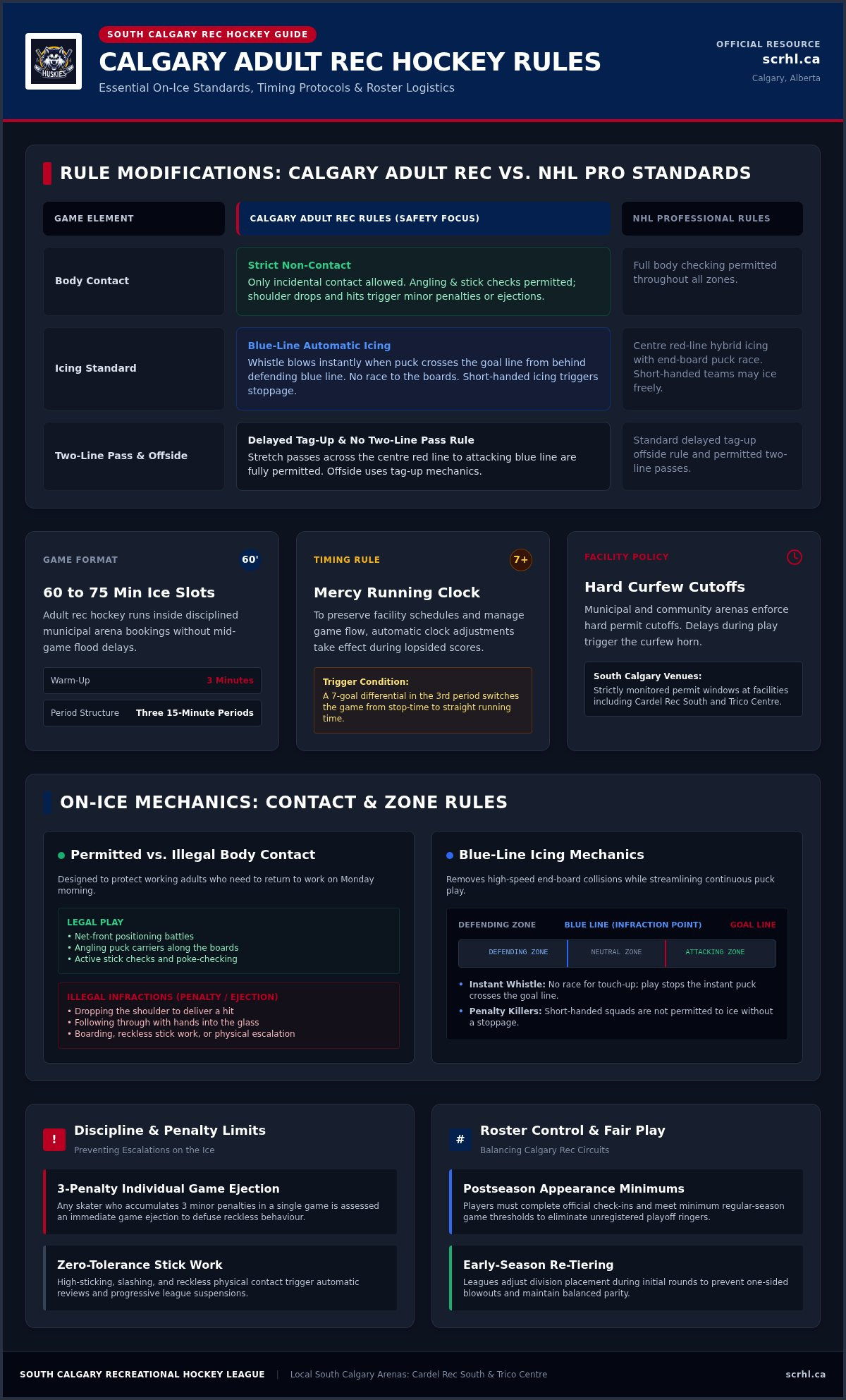
Ice availability across Calgary recreation centres requires strict scheduling discipline. While elite minor hockey often books 90-minute blocks with flood breaks between frames, adult games operate inside standard 60- to 75-minute facility slots. Leagues format games around a 3-minute warm-up followed by three 15-minute periods.
To ensure games finish on time, leagues use modified timing rules:
- Running-time mercy triggers: If a team takes a commanding lead of seven or more goals in the third period, the clock switches from stop-time to straight running time to preserve the schedule.
- Arena curfews: Municipal and community arenas enforce hard curfew cutoffs. If multiple stoppages delay play, the ice monitor sounds the curfew horn, terminating the game at the scheduled permit end time.
Developing an accurate understanding of hockey league rules Calgary facilities require ensures your squad manages the game clock efficiently without forfeiting ice time to the facility curfew.
Core On-Ice Rules: Contact, Icing, and Offside Variations
Television broadcasts showcase professional standards, but adult recreational play follows distinct parameters. Developing a clear framework for understanding hockey league rules Calgary refs enforce helps players adjust their habits, maintain possession, and avoid unnecessary stoppages.
| Game Element | Calgary Adult Rec Rules | NHL Professional Rules |
|---|---|---|
| Body Contact | Non-contact; incidental collisions only | Full body checking permitted |
| Icing Standard | Blue-line icing; automatic whistle | Centre red-line; hybrid icing race |
| Two-Line Pass | Permitted across centre red line | Permitted across centre red line |
| Offsides | Delayed tag-up rule | Delayed tag-up rule |
Understanding Strict Non-Contact Enforcement
Angling a puck carrier toward the boards or stick-checking to strip possession is legal rec play. Lowering a shoulder, following through with hands, or steering a skater into the glass is not. Referees assess immediate minor penalties for illegal body contact or roughing. Officials actively blow plays dead along the boards if players become tangled, shutting down unnecessary physical escalations before injuries occur.
Icing Rules Built for Player Safety
Most Calgary adult circuits use blue-line icing. A team only commits an infraction if they shoot the puck from behind their own defending blue line across the opposing goal line. The linesperson blows the whistle the instant the puck crosses the line. There is no footrace to the end boards, which removes the risk of dangerous high-speed collisions. Additionally, short-handed teams in rec circuits are generally not permitted to ice the puck without triggering a stoppage.
Offside Mechanics and Centre Red Line Usage
The centre red line does not restrict playmaking. Skaters can complete long stretch passes from their defensive zone directly to the attacking blue line without an infraction. When offside plays occur, leagues operate on delayed tag-up rules. Attacking players who cross the line ahead of the puck must clear back to touch the blue line to nullify the whistle. Errant offside plays or intentional offsides result in face-offs moved outside the zone or back to the offending team's defensive end.
If you are looking for clean, organized ice time built around balanced competition, check out registration options with the South Calgary Recreational Hockey League.
Penalties, Infractions, and League Discipline in Calgary
Maintaining safety across recreational rinks requires swift, predictable enforcement. Adult circuits cannot rely on extended penalty box discussions while the arena clock ticks away. A complete framework for understanding hockey league rules Calgary administrators apply ensures players keep their composure, protect their teammates, and avoid costly disciplinary suspensions.
Minor Penalties and Three-Penalty Ejection Thresholds
Standard minor penalties run for two minutes during stop-time play. If a game transitions to a running-time clock due to third-period mercy conditions, minor infractions adjust to three continuous minutes. Common stick calls include tripping, hooking, and slashing, alongside unsportsmanlike conduct for arguing with game officials.
Calgary leagues enforce a strict individual penalty cap. Any skater who collects three minor penalties in a single game receives an automatic game ejection. Goaltenders assessed three minors can finish the match to prevent an immediate default, but they serve an automatic one-game suspension during the team's next scheduled matchup.
Major Infractions and Suspensions
Reckless actions draw severe penalties. Major infractions such as fighting, intent to injure, and deliberate head contact carry automatic game misconducts, match penalties, and formal committee reviews.
Disciplinary outcomes for dangerous play follow clear standards:
- Fighting expulsions: Calgary adult circuits carry zero tolerance for bare-knuckle alterations. A single fight can trigger a one-year ban or permanent league expulsion.
- Verbal maltreatment: Abusing referees, linespersons, or arena staff carries immediate multi-game suspensions under Section 11 abuse policies.
- Cross-league transparency: Disciplinary directors communicate across local circuits. Severe bans for violent conduct often transfer between Calgary rec organizations.
Arena Facility Rules and Dressing Room Policies
League discipline extends past the ice surface into arena facilities. The City of Calgary recreation department and private community venues like Cardel Rec South or the Trico Centre enforce strict property regulations.
City bylaws prohibit open alcohol consumption in municipal dressing rooms without designated facility permits. Leagues face strict penalties from venue operators for non-compliance. Teams caught bringing unauthorized beer into change rooms risk fines up to $200, points deductions in league standings, or facility bans. Dressing rooms must be left clean and undamaged, or the offending team assumes full financial responsibility for custodial repairs.
Mastering this side of understanding hockey league rules Calgary officials enforce keeps your roster eligible and your squad welcome at every community ice sheet.
Roster Rules, Player Eligibility, and Game Day Logistics
Clean officiating on the ice depends heavily on administrative order off the ice. Adult recreation circuits operate strict registration systems to keep games balanced, prevent unregistered substitutes from tipping outcomes, and ensure facility insurance requirements remain valid. A practical understanding of hockey league rules Calgary teams navigate starts in the dressing room long before the opening puck drop.
Game Sheet Protocol and Roster Verification
Team managers submit verified rosters before hitting the ice. Most local circuits have replaced traditional paper clipboards with digital check-ins via tablet systems at the scorekeeper bench. Captains review active skaters, confirm jersey numbers, and sign off prior to warm-ups.
Officials and league staff conduct spot photo ID checks to verify participant identities and eliminate ringers. To avoid a default loss, teams must dress a baseline squad. Standard requirements stipulate a minimum of six dressed skaters and one goaltender ready at game time. If the goalie is delayed, teams typically receive a brief grace period before forfeiting the fixture.
Playoff Eligibility and Spare Player Rules
Postseason competition brings tighter roster scrutiny. Unregistered spares cannot simply join a playoff push. Calgary leagues require skaters to appear in a set minimum of regular-season games, typically 5 to 8 appearances, to earn elimination round eligibility.
Spare player guidelines maintain division parity:
- Tier boundaries: Skaters registered in top divisions cannot sub down into lower recreational flights, protecting skill parity.
- Emergency goaltender exceptions: Because netminders are scarce, leagues allow approved substitute goalies from equal or lower tiers to fill in during regular season games without penalty.
- Roster caps: Teams maintain an active limit, generally between 15 and 20 registered participants, preventing squads from rotating an endless pool of spare skaters.
For a detailed walkthrough on assembling an eligible squad, read our guide on how to build a rec hockey team roster in Calgary.
Uniform and Equipment Compliance
Safety equipment is mandatory. Calgary adult players must wear a CSA-certified helmet with a securely fastened chin strap. While full cages are voluntary for adults, most leagues require at least a half-visor. Shin guards, elbow pads, hockey gloves, and pants are required for facility insurance validity.
Teams must wear matching uniforms with distinct, permanent back numbers. Taped numbers or mismatched sweaters complicate scorekeeping and stat tracking. If two teams share similar colours, the designated home team must switch to an alternative set.
Deepening your team's understanding of hockey league rules Calgary coordinators run helps your roster stay compliant from opening night through the championship final. Secure your squad's place for the upcoming season by submitting your Winter Season Team Registration today.
Finding Fair Play and Division Parity in South Calgary
Lopsided games ruin the recreational hockey experience for everyone involved. Blowouts frustrate trailing teams and leave winning rosters uninspired. True sportsmanship thrives on close, competitive games decided in the final minutes. A solid foundation for understanding hockey league rules Calgary circuits follow includes recognizing how leagues actively manage division parity to keep games fair.
How Parity Systems Protect Competitive Balance
Structured leagues prevent tier stagnation by using rolling re-seeding schedules. Rather than locking teams into fixed divisions based on preseason paperwork, administrators evaluate scores and goal differentials over the first five matchups. Dominant squads move up to higher flights, while struggling teams shift down to more suitable brackets.
This dynamic adjustment prevents persistent blowouts and keeps games safe. When rosters match each other in skating ability and defensive awareness, aggressive overcompensation disappears. To explore division breakdowns and discover where your squad fits best, review our adult hockey league Calgary guide.
Flexible Ice Times for Busy Calgary Schedules
Balancing ice times around careers and family obligations is a top priority for adult players across South Calgary. SCRHL addresses these demands with varied programming across premier south-end facilities like Cardel Rec South and the Trico Centre.
Players can select ice times that fit their routine:
- Morning hockey sessions: Early-bird ice times scheduled before the workday begins, keeping your evenings completely free.
- Evening and weekend hockey sessions: Prime-time slots designed for traditional post-work leagues and weekend play without midnight starts.
Consistent, predictable scheduling allows working adults to enjoy competitive community hockey without sacrificing their weekday productivity.
Get on the Ice for the Upcoming Season
Getting involved is straightforward whether you have a complete roster or are joining solo. Team captains can secure a spot through Fall Season Team Registration or Winter Season Team Registration. If you are an unattached skater or goaltender looking for a team, Individual Player Registration places you with a squad matched directly to your skill level.
Captains can also coordinate custom jersey apparel early to guarantee their squad meets league uniform guidelines before opening night. Gaining a complete understanding of hockey league rules Calgary refs enforce sets your team up for a safe, competitive season on South Calgary ice.
Step Onto South Calgary Ice with Total Confidence
Recreational hockey should deliver intense competition, fitness, and community camaraderie without putting your workday in jeopardy. Developing a clear foundation for understanding hockey league rules Calgary leagues apply ensures your squad avoids sudden game ejections, executes blue-line icing cleanly, and respects arena facility guidelines.
Organized adult hockey succeeds when players trust the process. Strict non-contact enforcement keeps working adults safe, while rolling division re-tiering guarantees close, competitive contests every week. With convenient morning, evening, and weekend ice sessions hosted across premier South Calgary facilities, you get quality ice time that easily fits your weekly schedule.
Ready to play safe, competitive hockey with balanced division parity? Register your team or join as an individual with SCRHL today, pull on your sweater, and make this upcoming season your best yet.
Frequently Asked Questions
Are adult recreational hockey leagues in Calgary non-contact?
Yes, Calgary adult recreational leagues operate under strict non-contact rules. Body checking is completely prohibited to ensure working adults remain safe from workplace-disrupting injuries. While referees allow incidental contact during puck battles along the boards, lowering a shoulder or delivering an intentional hit results in an immediate penalty or game misconduct. Developing a solid framework for understanding hockey league rules Calgary officials enforce helps skaters balance physical competitiveness with disciplined positioning.
What happens if a player receives three penalties in one game?
Any skater assessed three penalties in a single game receives an automatic game ejection. The player must leave the ice surface immediately and proceed directly to their dressing room for the remainder of the evening. Another rostered teammate serves the final penalty in the box. Goaltenders who receive three minor penalties can stay on the ice to avoid defaulting the contest, but they serve an automatic one-game suspension during their team's next scheduled fixture.
Do Calgary adult rec leagues require full facial protection?
No, full cages or full plastic face shields are voluntary for adult players in Calgary. Adult recreational circuits mandate a minimum of a CSA-certified helmet with a securely fastened chin strap and at least a half-visor. Full cages and BNQ-certified neck guards remain strictly mandated in minor hockey, but adult leagues leave full facial protection up to personal preference. League organizers still strongly encourage full shields to protect against high sticks and deflected pucks.
Can our team borrow a substitute goaltender for a game?
Yes, most Calgary rec circuits permit teams to source approved emergency substitute netminders. Goaltenders face unique scheduling challenges, so league bylaws allow teams to borrow active goalies from equal or lower competitive divisions without forfeiting the contest. Skaters cannot substitute this way; only netminders qualify for this exemption. Captains must notify the league coordinator or game officials before the opening face-off to verify that the substitute meets division eligibility standards.
How do running time and stop time work in Calgary rec hockey?
Games run on standard stop-time clocks unless a lopsided score triggers running time. Adult games typically feature three 15-minute stop-time periods within a 60-minute arena slot. If the goal differential hits seven goals in the third period, the clock switches immediately to continuous running time. Minor penalties adjust from two minutes to three minutes during running time. The clock returns to standard stop-time only if the trailing squad cuts the lead back under the threshold.
How many games must a player skate to be eligible for playoffs?
Players generally must skate in 5 to 8 regular-season games to qualify for postseason play. Local Calgary leagues enforce this minimum threshold to eliminate unregistered substitute ringers who join specifically for championship brackets. Capable league administrators track digital game sheets throughout the winter and fall sessions. Roster verification officials conduct photo ID checks before playoff elimination matches. Skaters who fail to meet the attendance cutoff cannot dress, keeping postseason competition fair across all tiers.
What should a team do if both squads have the same jersey colour?
The designated home team must change jerseys if both teams arrive in identical colours. Team captains should always carry a backup set of contrasting pinnies or an alternate jersey colour to resolve game-day sweater clashes. Having an accurate grasp of understanding hockey league rules Calgary venues enforce ensures quick fixes that keep games running on schedule. Teams can also invest in custom jersey apparel packages with home and away colourways before opening night to prevent uniform confusion.