

An 11:30 PM puck drop on a Tuesday night isn't just a late game; it's a productivity killer for any working professional in Calgary. You shouldn't have to choose between your passion for the sport and your ability to function at the office the next morning. Knowing exactly what to look for in a rec hockey league is the difference between a season of frustration and a rewarding experience on the ice.
Most players agree that an organized schedule and balanced competition are the foundations of a successful season. You want to play against teams that match your skill level without worrying about reckless play. This 2026 guide will show you how to evaluate skill levels, ice times, and safety standards to find the perfect adult hockey league in Calgary. We examine division parity, arena locations, and officiating standards. You will also see how a strict non-contact philosophy keeps players safe for their morning commitments.
Key Takeaways
- Evaluate division parity to ensure your team competes against similar skill levels and avoids lopsided results.
- Prioritize leagues that offer consistent schedules and reasonable start times to protect your work-life balance.
- Identify safety standards, including certified officiating and non-contact rules, that minimize the risk of injury.
- Learn exactly what to look for in a rec hockey league regarding administrative transparency, registration costs, and team apparel options.
- Discover how localized arena hubs in South Calgary can significantly reduce your commute time during the winter months.
Skill Level Parity and Division Structure
Finding the right balance is the most critical factor when deciding what to look for in a rec hockey league. Parity refers to the competitive balance within a division. It ensures that every team has a reasonable chance of winning on any given night. Unlike some loosely managed amateur beer leagues, an organized circuit prioritizes even matchups. Without this balance, games become one-sided blowouts. These lopsided scores frustrate players and lead to poor player retention. Significant skill gaps also create safety risks. High-level players may move too fast for beginners, increasing the likelihood of collisions or accidental injuries.
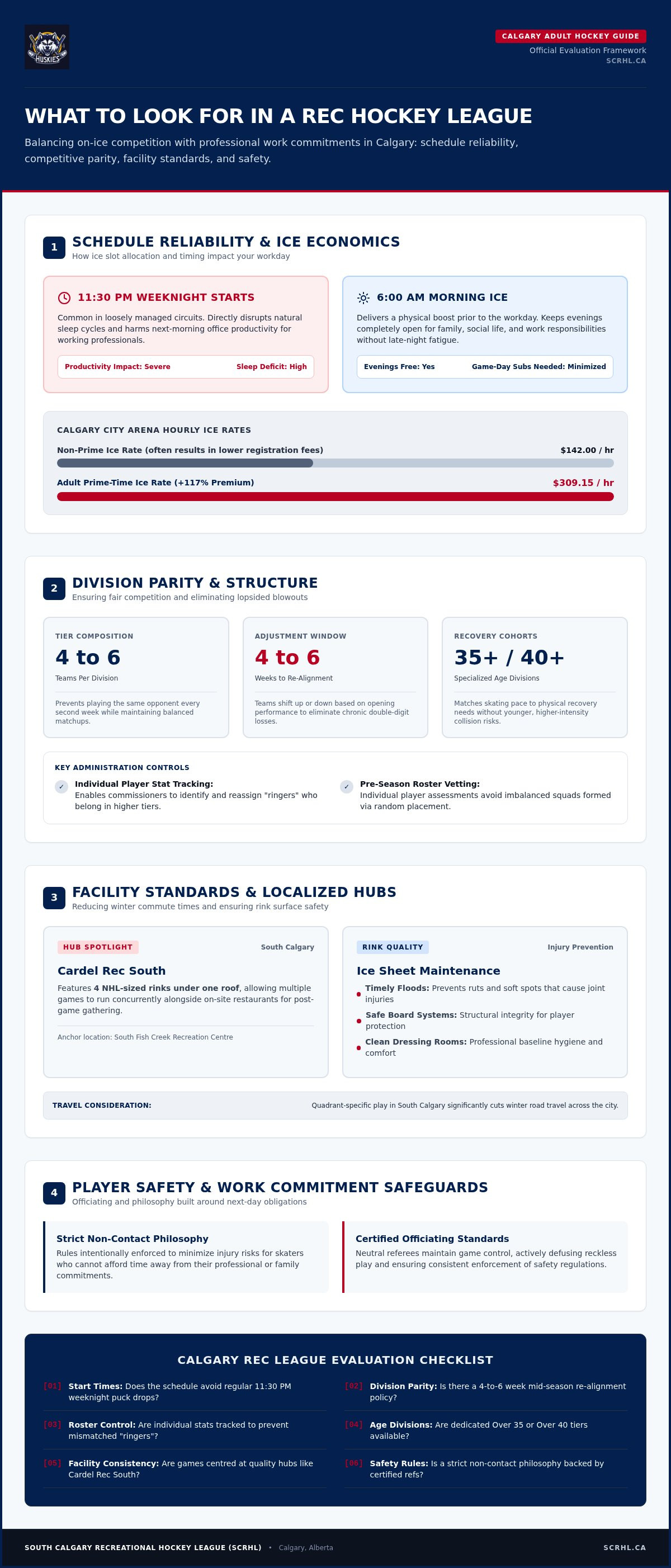
Top-tier leagues implement mid-season re-alignment to fix lopsided divisions. This process involves moving teams up or down based on their performance during the first 4 to 6 weeks. It prevents a team from spending an entire season losing by double digits. When researching options, ask organizers about their specific ranking system for new teams. They should have a clear method for assessing skill levels before the first puck drop.
Evaluating Division Depth
A well-structured league should maintain 4 to 6 teams per tier. This variety prevents you from playing the same opponent every second week. You should also check if the organizer tracks individual player stats. Detailed stats allow commissioners to identify "ringers" who belong in a higher division. For older skaters, specialized "Over 35" or "Over 40" divisions provide a pace that matches their physical recovery needs. These cohorts allow for competitive play without the intensity of younger, faster divisions.
The Role of the League Commissioner
The commissioner acts as the final authority on fairness. You need to know who manages player eligibility disputes and how they handle team movement. Effective leagues use a vetting process for individual player registrations before placing them on a roster. This prevents unbalanced teams from forming through random assignments. Ask about the specific timeline for mid-season adjustments. In Calgary, professional organizers evaluate standings early to ensure every team is in the right spot. This proactive management builds a sense of community and trust between the players and the league office.
Ice Times and Schedule Reliability
Ice time is the most valuable commodity in Calgary. When researching what to look for in a rec hockey league, schedule reliability should be at the top of your list. Many city-wide leagues struggle with unpredictable ice slots. This often results in 11:30 PM starts on weeknights. These late games disrupt sleep cycles and impact work performance the following day. A well-managed league prioritizes reasonable puck drops. It understands the needs of professionals with family obligations. In Calgary, city arena rental pricing reflects a 117% premium for adult prime-time ice, costing $309.15 per hour. Knowing what to look for in a rec hockey league requires focusing on the clock as much as the competition.
Consistent rink locations improve team attendance. Travelling across Calgary in winter is difficult and time-consuming. Quadrant-specific play reduces travel time and keeps your team together. Fixed schedules allow captains to plan rosters weeks in advance. You won't be searching for sub players at 5:00 PM on a game day. Stability builds team identity. It ensures a better social experience for everyone involved. Reliable scheduling is the foundation of a successful season.
Morning vs. Evening Hockey Sessions
Morning sessions fit the schedules of many Calgary professionals. A 6:00 AM puck drop provides a physical boost before the workday starts. It leaves your evening free for family and other commitments. These slots avoid the late-night fatigue associated with traditional late-night "beer league" games. Evening sessions offer a traditional social atmosphere but can suffer from delays. Weekend options provide flexibility for those with rigid weekday work schedules. City arena non-prime ice costs $142.00 per hour, which often results in lower registration fees. Learning about morning hockey helps you find the right fit for your lifestyle.
Facility Quality in South Calgary
Arena quality directly impacts your playing experience. Look for well-maintained ice and clean dressing rooms. Playing at a consistent home rink like the South Fish Creek Recreation Centre provides a professional environment. Centralized hubs reduce travel and offer better amenities. Cardel Rec South features four NHL-sized rinks under one roof. This allows for multiple games to run simultaneously and provides on-site restaurants for post-game socializing. Facility managers must ensure timely floods and safe boards. Consistent maintenance prevents ruts and soft spots that lead to injuries. A well-kept rink reflects a well-managed league.
Safety Protocols and Officiating Standards
Safety is the most important factor for players who have professional and family commitments the next morning. High-quality officiating serves as the primary deterrent for aggressive play and ensures games remain under control. When evaluating what to look for in a rec hockey league, you should prioritize organizations that enforce a "Work Tomorrow" philosophy. This mindset places player safety above competitive intensity. Certified officials manage the game flow and identify potential flashpoints before they escalate into dangerous situations. Leagues that track penalty minutes and suspensions effectively remove repeat offenders who threaten the community atmosphere.
Insurance coverage is a standard requirement for organized play in Calgary. Most reputable circuits provide liability insurance through CARHA Hockey or Zen Insurance. It's vital to understand that this typically covers league-wide liability rather than individual medical or dental costs. Players should maintain their own supplemental health benefits for personal injuries. Reliable leagues provide clear documentation on what their insurance permit covers during the registration process. This transparency is a hallmark of a well-run organization that values its participants.
Non-Contact League Rules
There is a significant difference between "non-contact" and "no-check" hockey. In a non-contact hockey league Calgary players expect a game where intentional body checking is strictly prohibited. Referees must distinguish between incidental contact occurring during puck battles and deliberate hits. Clear rulebooks should be distributed to every team captain before the season begins. These documents outline specific consequences for reckless aggression and fighting. A zero-tolerance policy for violence is essential for maintaining a safe environment for all participants.
Referee Consistency and Training
Consistency in officiating is another key indicator of what to look for in a rec hockey league. Ask if the league employs carded officials with up-to-date certifications. A two-referee and one-timekeeper system is the standard for ensuring all areas of the ice are monitored. Single-referee games often lead to missed calls and increased frustration among players. Effective leagues also maintain a feedback loop. This allows team captains to report concerns regarding officiating quality or specific incidents. This accountability ensures that referees remain professional and aligned with the league's safety standards throughout the season.
League Administration and Team Identity
Professional administration is a major part of what to look for in a rec hockey league. You need efficient off-ice management to ensure a smooth season. Fee transparency is essential. A well-run league outlines all costs upfront. This includes insurance, officiating, and ice time. It prevents surprise bills later in the year. Organized management makes the season better for everyone. It ensures that your registration dollars are used effectively to support a high-quality playing environment.
Modern leagues provide online portals for real-time tracking. You should be able to access schedules, standings, and player stats from your phone. This professional structure reduces the administrative burden on team captains. Automated systems handle payment tracking and roster management. It allows you to focus on the game. You won't have to spend your time chasing teammates for money or verifying player eligibility. Reliable administration builds trust between the players and the league office.
Custom Jerseys and Apparel
Professional uniforms improve the player experience. Consistent colours aren't just for team pride. They help referees make better calls during fast-paced play. Mismatched jerseys make it difficult for officials to identify players quickly. Many organized circuits offer options for ordering custom team hockey jerseys directly through the league. This ensures high-quality apparel that meets league standards. Wearing a unified kit builds a sense of identity. It separates organized play from casual drop-in sessions. High-quality jerseys make your team look and feel like a professional unit.
Registration Flexibility
Flexibility is another key factor when deciding what to look for in a rec hockey league. Some leagues only accept full teams. Others welcome individual free agents. Organizations that offer an individual draft process help place skaters on balanced rosters. This is a great way to meet new players and find a permanent team home. If you are leading a group, you can learn how to build a rec hockey team roster Calgary captains trust. Access to a league-wide sub goalie network is also a major benefit. It prevents game cancellations when your regular netminder is unavailable.
Simplify your team management by choosing an organized partner. View our Fall Season Team Registration packages to secure your spot for the upcoming season.
Joining the South Calgary Recreational Hockey League (SCRHL)
The South Calgary Recreational Hockey League provides a structured environment that addresses the common frustrations of adult players. When considering what to look for in a rec hockey league, you should prioritize organizations with a proven track record. SCRHL marks its 20th year of continuous operations in September 2026. This longevity reflects a commitment to fair play and organized schedules. The 2026 Fall and Winter seasons offer divisions for various skill levels. This ensures that every game remains competitive and safe. By focusing on parity, the league eliminates the lopsided scores often found in less managed circuits.
Ice availability includes morning, evening, and weekend sessions to accommodate diverse work schedules. Morning hockey allows you to finish your game and get to the office without missing evening family time. Games are primarily hosted at Cardel Rec South. This four-sheet facility prevents cross-city travel and provides a consistent home for your team. The "Work Tomorrow" philosophy remains the core of the league culture. It protects participants through strict non-contact rules and certified officiating. These features represent exactly what to look for in a rec hockey league if you value your health and your career.
Registering for the 2026 Season
Securing a spot requires prompt action as divisions fill quickly. Captains should visit the Calgary hockey team registration page to view available tiers. You can choose between full team registration or individual player entries. The individual draft process places free agents on balanced rosters based on their evaluated skill level. Ensure all payments and roster submissions are completed before the seasonal deadline to confirm your place in the schedule. This organized approach ensures the league can finalize divisions and ice times well before opening night.
Preparing Your Team for Success
Success on the ice starts with proper preparation off the ice. Consult the captain's guide for a checklist of equipment and jersey requirements. Attendance at the pre-season meeting is mandatory for reviewing updated league rules and schedules. This is also the time to organize your team's custom apparel. Ordering custom jersey apparel through the league ensures your squad looks professional and meets colour standards. High-quality uniforms build team pride and help officials manage the game effectively. Proper preparation guarantees your team is ready for the first puck drop of the 2026 season.
Prepare for the 2026 Calgary Hockey Season
Choosing the right environment for your team requires balancing schedule reliability with competitive fairness. You've learned that division parity prevents frustrating blowouts while consistent ice times protect your work-life balance. Safety stays at the centre of a well-run organization through certified officiating and strict non-contact rules. Understanding what to look for in a rec hockey league ensures your squad has a productive and injury-free year on the ice.
The South Calgary Recreational Hockey League delivers a professional experience for local players. We provide organized parity for all skill levels and offer flexible morning or weekend ice times. You can also build your team's identity with custom team jerseys designed in Calgary. Our "Work Tomorrow" philosophy ensures that every participant remains safe for their morning commitments. Don't wait for the seasonal deadline to pass.
Register your team for the 2026 SCRHL Fall Season. We look forward to seeing you at the rink for another competitive season of Calgary hockey.
Frequently Asked Questions
How much does a rec hockey league cost in Calgary for the 2026 season?
Market rates for full-team winter registration in Calgary typically range from $9,500 to over $14,000 plus GST. Individual player fees generally fall between $600 and $850 for a full winter season. Shorter formats or morning sessions often cost between $300 and $500 per skater. These figures cover ice rental, insurance, and officiating costs. Prices vary based on the number of games and the specific arena facilities used.
What is the difference between individual and team registration?
Team registration is designed for pre-formed groups who have a full roster and a designated captain. Individual registration allows single players to join the league as free agents. These individuals are evaluated and drafted onto balanced rosters to ensure fair play. This is a key factor in what to look for in a rec hockey league if you don't have a full squad. Both options provide access to the same facilities and officiating standards.
Can I join a league if I haven't played hockey in several years?
Yes, players of all skill levels are welcome to register for the Fall and Winter seasons. Most leagues use a tiering system to place teams and individuals in divisions that match their current abilities. If you are returning to the sport, look for a league that prioritizes parity and active commissioner balancing. This ensures you aren't placed in a division that is too fast or overly competitive for your current fitness level.
What happens if our team is in a division that is too difficult?
Professional leagues use mid-season re-alignment to address lopsided divisions. If a team is struggling significantly, the commissioner typically moves them to a lower tier after the first 4 to 6 weeks of play. This process maintains competitive balance and prevents player frustration. It's an essential administrative feature to check for when researching league options. Active tiering ensures every team has a fair chance to compete throughout the entire season.
Are there non-contact hockey options for adults in South Calgary?
Most adult recreational circuits in Calgary operate under strict non-contact rules. These leagues employ a zero-tolerance policy for body checking and reckless aggression to protect players who have work commitments. Certified officials are trained to distinguish between incidental contact and intentional hits. This "Work Tomorrow" philosophy is a standard feature in South Calgary hubs like Cardel Rec South. It ensures a safe environment for hobbyists and professionals alike.
How do morning hockey sessions compare to evening games?
Morning sessions typically start at 6:00 AM and allow players to finish their games before the workday begins. These slots often have lower registration fees because non-prime ice rentals cost approximately $142 per hour compared to $309 for prime evening time. Evening games usually start between 9:00 PM and 10:30 PM. While evenings offer a traditional social atmosphere, morning sessions are increasingly popular for those who want to avoid late-night fatigue and protect evening family time.
What equipment is mandatory for adult recreational hockey in Alberta?
Players must wear full hockey equipment that meets CSA safety standards. Mandatory gear includes a CSA-approved helmet, skates, gloves, shin pads, elbow pads, and hockey pants. While neck guards and full face shields aren't always required for adults, they are highly recommended for added protection. Most leagues also require teams to wear matching jerseys with unique numbers. This helps officials identify players and ensures a professional appearance during scheduled league play.
How does the league handle player discipline and safety?
Discipline is managed through a combination of certified officiating and administrative oversight. Leagues track penalty minutes and game misconducts to identify repeat offenders. Players who display reckless behaviour or excessive aggression face mandatory suspensions or permanent removal from the league. This proactive approach is exactly what to look for in a rec hockey league to ensure a safe environment. Certified two-referee systems help officials monitor the entire ice surface and maintain game control.