

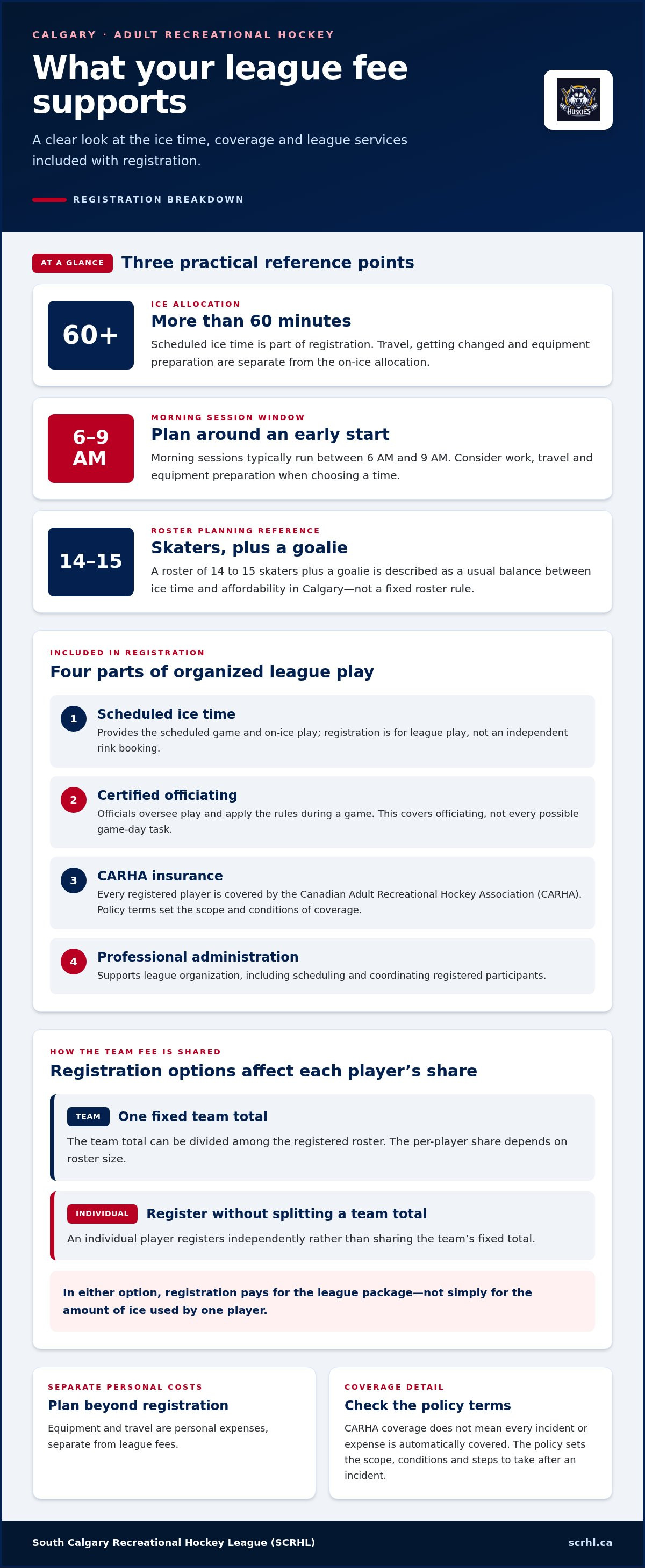
A league fee pays for more than time on the ice. What’s included in SCRHL league fees is more than 60 minutes of ice time, certified officiating, CARHA insurance and professional administration. Every registered player is covered by the Canadian Adult Recreational Hockey Association (CARHA).
It’s reasonable to want a clear breakdown before committing to a season. Knowing what registration covers also helps you plan for personal costs, such as equipment or travel, that are separate from league fees.
This article explains how ice time, insurance and league administration fit into registration, and what can affect extra costs. You’ll get a practical overview of the fee structure for adult recreational hockey in Calgary, so you can understand what you’re paying for before choosing a season or registration option.
Key Takeaways
- See how registration fees account for ice time, certified officiating and league administration.
- Understand how CARHA insurance fits into player coverage and the overall registration fee.
- Learn why team roster size affects the per-player share of a fixed team fee.
- Find out which factors can affect additional costs, and how early-bird discounts may change the amount due.
- Compare team and individual registration options, and see how season and session choices shape the fit.
What registration fees cover
A registration payment supports several parts of organized adult hockey. The listed package includes more than 60 minutes of ice time, certified officiating, CARHA insurance, and professional administration. Each component has a distinct role during a season. Ice time provides the scheduled play, officials oversee the game, insurance covers registered players under its terms, and administration organizes league activity.
A clear way to understand what’s included in SCRHL league fees is to look beyond the rink time. For example, a player joining a scheduled game relies on both the ice allocation and the officials overseeing play. Administration supports the organization behind that session. These components are connected, but they aren’t interchangeable: ice access alone doesn’t provide the structure of an organized league game.
Certified officiating is part of the registration package. Officials oversee play and apply the rules during a game. That gives players a defined on-ice role and keeps rule enforcement separate from team duties. For instance, teammates can focus on their shifts rather than assigning one player to manage officiating. The inclusion applies to officiating, not every possible game-day task.
Professional administration supports the organization of league play. Scheduling and coordinating registered participants are practical examples of the work involved. Players benefit from having those logistics handled as part of the league structure. A team organizer can then focus on communicating with teammates, rather than building an independent schedule for every game.
CARHA insurance is included, and every registered player is covered by the Canadian Adult Recreational Hockey Association (CARHA). This identifies the coverage provider and who is covered, but doesn’t mean every incident or expense is automatically covered. Policy terms set the scope and conditions, so review the applicable coverage information to understand what it addresses and what steps to take after an incident.
Team registration has a fixed total, while each player’s share depends on roster size. Teammates can divide the team total among the registered roster. With individual registration, a player registers without splitting a team total. In both cases, the payment is for registration, not simply the amount of ice used by one player.
When comparing options, ask what’s included in SCRHL league fees and identify each component separately. Check the ice allocation, officiating, CARHA coverage, and league administration. This makes it easier to compare team registration with individual registration and to distinguish organized league participation from separate personal expenses. The package is best understood as a set of connected services supporting scheduled adult recreational hockey.
Ice time and rink facilities
The ice allocation is a central part of a hockey registration. SCRHL registration includes more than 60 minutes of ice time, so the listed time covers the scheduled game and its on-ice play. Players should distinguish that playing allocation from time spent travelling, preparing equipment, or getting changed. Those activities are part of a player’s schedule, not additional game time.
Ice slots also shape a season’s routine. A morning session typically runs between 6 AM and 9 AM, a useful window for players who prefer to skate before work. Choosing a morning time means planning around an early start, commute, and equipment preparation. For example, a player with a fixed morning commitment may find an evening slot easier to fit into a weekly routine.
Roster size affects how a team shares its time and cost. A roster of 14 to 15 skaters plus a goalie is described as a usual balance between ice time and affordability in Calgary. With a larger roster, more players share the team cost, but each player may have fewer shifts. A smaller roster changes that balance: each player’s share can rise, while more shifts may be available.
Scheduled ice time is for organized hockey, not a general facility rental. Players register for league play rather than booking a rink independently. When comparing options, consider the season and session timing, not just the rink location. Don’t assume registration includes separate practice time or facility access beyond scheduled play.
Before selecting a slot, map the ice time against your normal week. A morning start between 6 AM and 9 AM may suit a player with open mornings, while another player may need an evening or weekend routine. Consider travel time, work commitments, and how consistently you can attend. These practical factors help you choose a schedule you can maintain through the season.
Team organizers can use the 14 to 15 skater guideline as a planning reference, not a fixed roster rule. Compare the number of available players with the team’s budget and expected attendance. For example, a roster that often misses games may need enough available players to keep play organized. The best balance depends on the group’s participation and how it shares the team cost.
For players comparing session times, morning hockey session details can help frame the choice around an early start and weekly routine. Match the scheduled ice to your availability, then consider roster size if registering as a team. Those two decisions clarify how the ice allocation fits your schedule and how the team shares its costs.
Insurance and liability costs
CARHA insurance is part of the registration arrangement for adult recreational hockey. Every registered player is covered by the Canadian Adult Recreational Hockey Association (CARHA). That makes insurance one component of the overall league cost, alongside the scheduled play and league operations. Players can treat it as part of the registration package, rather than assuming insurance is unrelated to participation.
Insurance and liability are related but distinct. Insurance refers to coverage under a policy, while liability concerns responsibility for an incident or loss. A collision during a game, for example, may raise questions about both. Policy terms explain how coverage applies; the circumstances determine the facts relevant to responsibility.
CARHA coverage doesn’t mean every possible cost or incident is automatically covered. Policy language sets the scope, conditions, and limits of protection. Players should read the coverage information that applies to their registration. Pay attention to what events the policy addresses, who qualifies as a covered participant, and any steps required after an incident. Those details explain the practical value of the insurance component.
Insurance is included in the registration arrangement, but it isn’t listed as a separate dollar amount. The registration total covers multiple league components, so don’t mistake the insurance component for the full payment. Team organizers can explain how the team total is shared; individual players should refer to their individual registration amount.
Consider a player deciding between team registration and individual registration. In either case, the key question is whether the registered player receives CARHA coverage. The answer is yes for every registered player. That gives participants a clear baseline, while policy wording answers more specific questions about covered events and conditions. Insurance doesn’t replace safe play, equipment checks, or attention to rink rules.
Liability questions can also arise outside the moment of play. A player may need to understand what information to record after an incident, which policy terms apply, and how the league’s procedures relate to the insurance process. Keep incident details accurate and follow the applicable reporting instructions. Clear records help distinguish what happened from assumptions about responsibility or coverage.
For a practical comparison, separate three ideas: registration, CARHA insurance, and personal liability. Registration places a player in organized league play. CARHA insurance provides coverage for registered players under its policy terms. Liability depends on the circumstances and applicable responsibilities. Reading those parts separately helps players understand what the insurance component contributes, without treating it as unlimited protection or assuming every claim has the same outcome.
Predictable pricing and additional fees
A fixed team registration total makes budgeting easier. Each player’s contribution depends on how many teammates share the cost: a larger roster spreads the total across more players, while a smaller roster means a larger share per player. Agree on the split before collecting payments, and make any changes clear if the roster shifts.
Individual registration works differently. A player registers without dividing a team total among teammates. The registration option and applicable season shape the amount. The exact figure is provided after a quote request, with the registration arrangement and roster size among the factors to consider. Keep the team total separate from personal expenses when setting a season budget.
Early-bird discounts can reduce registration costs. Registration discounts range from 5% to 20%. For Winter 2027, a 5% promotion is available with code GST2 until October 31, 2026. Apply the code before that deadline to use the stated promotion. A discount changes the registration amount, not the team’s roster-sharing arrangement.
Plan for possible expenses beyond registration without treating them as league charges. Personal equipment or travel costs, for example, depend on each player’s circumstances and are separate from league registration. List team registration contributions separately from individual spending to keep track of what is owed to the league.
Additional league charges, if applicable, should be distinguished from optional personal purchases. Don’t treat an equipment replacement or a trip to the rink as a registration fee. For a team, record the agreed registration contribution and any separate team expenses in different categories. For an individual, keep the registration amount apart from personal costs. This simple separation helps prevent the season budget from mixing league charges with individual choices.
Before registering, a team organizer can set out the fixed team total, how players will divide it and whether an applicable discount is available. The team can agree on an equal share, then adjust contributions if the roster changes. The per-player amount depends on roster size, even when the team total stays the same. Record any adjustment clearly.
Individual players can compare their registration amount with their season budget and account for personal expenses separately. Teams can confirm the roster and contribution plan before collecting payments. The distinction is simple: registration covers league participation, while roster size determines how a team shares its fixed cost.
Do SCRHL fees vary by division, season, or age group?
Compare registration by season and format first. Fall and Winter are separate registration periods, and each has its own registration choice. A team’s total is a fixed cost, while its per-player share depends on roster size. That means two players may contribute different amounts if their teams divide costs across different roster numbers.
Division labels describe evening play groupings, not a player’s age. The evening divisions run from 1E through 3E. A division number helps identify the group a player is considering, but the fee comparison should also account for team or individual registration. For example, two players in different evening divisions may have different per-player shares because their team rosters differ.
Age-group pricing is not the main distinction for this adult recreational league. Participants must be at least 18 years old. That age requirement sets who can register, while the team roster and registration format shape how costs are shared. A player comparing options should separate eligibility from price: meeting the age requirement does not tell them how a team divides its total.
Season timing can affect the amount payable through an early-bird offer. Registration discounts range from 5% to 20%. For Winter 2027, a 5% discount with code GST2 runs until October 31, 2026. A player considering Fall and Winter should compare the relevant registration period and any applicable discount before budgeting. The promotion applies to the stated Winter 2027 registration period.
Use a consistent comparison when reviewing options:
- Season: identify whether the registration is for Fall or Winter.
- Format: distinguish a team registration from individual registration.
- Roster: calculate how the fixed team total is shared among its players.
- Division: note the evening grouping, such as 1E, 2E, or 3E.
- Timing: account for any early-bird discount that applies to the season.
This comparison avoids treating division, age, and roster size as interchangeable. A player aged 18 or older may be eligible, but the cost-sharing method still depends on registration format. A team’s per-player share can shift when its roster changes, even if its season and division remain the same. For individual registration, compare the registration option and season directly.
Choose the season and registration format that fit your plans, then review the relevant team or individual option. Compare Fall and Winter registration options to identify the route that matches your team or individual plans.
South Calgary Recreational Hockey League (SCRHL): Fall Season Team Registration
South Calgary Recreational Hockey League (SCRHL) offers Fall Season Team Registration for Calgary adults planning organized team play. Choose team registration if your group is ready to sign up together. Individual Player Registration is available for players joining on their own, and Winter Season Team Registration is a separate seasonal option.
Choose the format that fits: team registration for an organized group or individual registration if you’re signing up on your own. Morning Hockey Sessions provide another schedule option. Reviewing the available choices helps you match the registration format and season to your plans.
For registration details or help choosing an option, contact SCRHL or visit scrhl.ca.
Choose the registration path that fits your season
Knowing what’s included in SCRHL league fees can help you choose the right registration option. Decide whether you’re organizing a team or joining individually, then select the season that fits your plans. South Calgary Recreational Hockey League (SCRHL) offers Fall Season Team Registration, Winter Season Team Registration and Individual Player Registration.
Before registering, consider who will coordinate the team and how players will share the cost. Individual players can focus on their own registration choice. Team organizers can discuss the preferred season and registration arrangement with teammates so everyone understands the plan.
For help with the next step, contact South Calgary Recreational Hockey League (SCRHL). A clear registration plan makes it easier to get organized and look ahead to your season on the ice.
Frequently Asked Questions
What is included in the SCRHL registration fee?
Registration includes organized ice time, certified officiating, CARHA insurance and professional administration. For Calgary players, these components support scheduled league participation, rather than a standalone rink booking. Team organizers can use this breakdown to explain the team contribution, while individual players can see which league services are part of their registration.
Are SCRHL ice time and facility costs included in league fees?
Yes. Registration includes more than 60 minutes of ice time for scheduled play. That covers league ice time, not a general rink rental or separate practice booking. For example, a player planning a week around a scheduled game should distinguish the game allocation from personal travel and preparation time. The fee’s ice component is tied to organized league play in Calgary.
Do SCRHL fees include referees, scorekeepers, or league administration?
Fees include certified officiating and professional administration. Officials oversee play, while administration supports league operations. Those roles don’t automatically mean a separate scorekeeper is supplied. A team can plan game-day responsibilities with that distinction in mind, rather than assuming registration assigns every task. The stated fee components cover officiating and administration; they don’t establish a separate scorekeeping service.
Are jerseys, equipment, or team uniforms included in SCRHL fees?
Custom jersey apparel is available, while hockey equipment sales aren’t an SCRHL offering. Keep gear planning separate from league registration: a player can choose a registration format and handle equipment needs independently. Teams considering jerseys can treat apparel as a separate team decision. Registration’s stated components cover organized play and league operations, so don’t assume equipment is part of those components.
Are there additional SCRHL costs for insurance, playoffs, or tournaments?
CARHA insurance is included with registration, so it’s part of the league package rather than a separate insurance purchase for each registered player. For team budgeting, keep any playoff or tournament participation in a separate line from regular registration. That makes it easier to distinguish the cost of joining scheduled league play from any additional event plans the team may consider.